

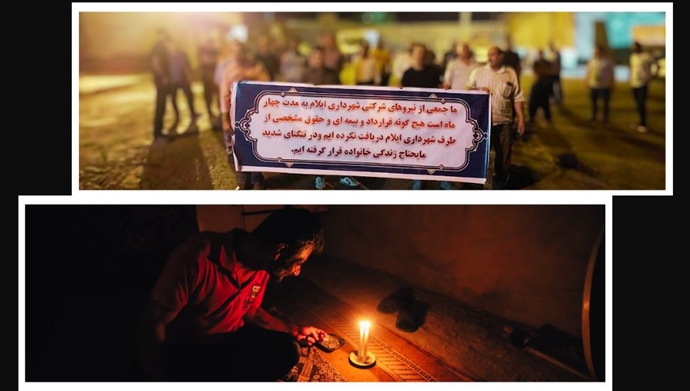

The beginning of the tenure of Massoud Pezeshkian, the new president of Iran’s regime, clearly reveals the quagmire that has engulfed the regime. The implementation of the hollow Seventh Development Plan hasn’t even started yet, but to compensate for the losses suffered by nurses, wheat farmers, and government employees, the regime has emptied the last reserves of the National Development Fund. Regime Supreme Leader Ali Khamenei, ever generous when it comes to building bombs, missiles, and supporting proxy terrorist groups in the region, gave his approval. However, the crisis runs deeper. Public schools, still closed due to disrepair, have had their water cut off because they can’t pay their 6 trillion rial debt.
Water cutoffs at 40 schools
Following the water cutoff at several schools in District 18 of Tehran, around 40 public schools in District 8 have now faced the same issue “due to sewage debt.”
On September 3, the state-run Khabar Online news website wrote, “The strangest part of this situation is that both the Ministry of Education and the Water and Sewage Organization are government institutions funded by the state, but it is the students and ordinary citizens who are paying the price for the debt between these two entities with school water outages.”
News continues to break about the exploitation of nurses and workers, the dire situation of retirees, and the severe recession affecting production enterprises due to power and gas shortages and lack of capital to even cover depreciation. On the other hand, there’s rampant theft, corruption, and looting of resources by the regime’s officials of all factions. One example is the “special privileges for banks”.
On September 7, the state-run Setareh Sobh newspaper wrote, “Since 2021, banks have given 1.46 quadrillion rials in low-interest loans with extended repayment periods to their employees. Shockingly, this amount is twice the budget allocated to the National Housing Movement Project.”
A fresh scandal involves the stock exchange chief granting himself and his associates billions in loans before handing over the keys to the stock market’s vault. On September 6, Tehran stock market information and analysis website Bourse24 reported, “With the approval of the Supreme Council of the Stock Exchange, Majid Eshqi, as the chairman, along with four members of the council, received 1.05 trillion rials in loans at a 4% interest rate with a ten-year repayment period.”
With such activities by the regime’s officials, there is no time or resources left for the proper production and distribution of water, electricity, gas, and gasoline.
Power outages in industrial towns
On September 7, Rouydad 24 news website reported, “Power outages in cities now last two hours per area and in industries, the outages are for three days a week. Due to aging infrastructure, power plant efficiency is low, and transmission losses are high. Around 17% of the country’s generated electricity is lost during transmission.”
Inflation on essential goods remains over 50%
The plight of the suffering people of Iran, amid all this corruption, theft, and backwardness in the economy and production sectors, continues to worsen with the inflation of essential goods and the lack of a minimum standard of living.
On September 7, Eco Iran news website wrote, “According to data from the Statistical Center of Iran, the highest food inflation in August was in red meat and poultry (58.3%), followed by fish (52.7%). The highest non-food inflation was in public transportation services (55.9%).”
On September 7, Arman-e Emrooz news website reported, “In recent days, we have witnessed several statements by the president focusing on the need for surgery in Iran’s economy… but when the term ‘economic surgery’ comes up, everyone recalls the unsuccessful experience of the previous government, which led to record-breaking increases in food prices in Iran, with inflation rates exceeding even seventy percent in some cases… Economic surgery is typically accompanied by short-term costs such as temporary unemployment or a reduction in income for some groups. Therefore, society must be prepared to bear these costs.”
The preparation of a crisis-ridden society, of course, is accompanied by fear and concern for the entire regime. One reason for this is the people’s focus on regime’s foreign policies, with all their resulting damages and disasters for the oppressed Iranian nation.
On September 7, the state-run Donya-ye Eghtesad newspaper wrote, “In recent years, foreign policy has become very prominent in the minds of the Iranian people. This foreign policy has been extremely costly and has not provided the stability needed to improve their lives, resulting in their impoverishment.”
The ineffectiveness of Khamenei’s new government
Now, looking at Masoud Pezeshkian’s situation, even from the perspective of his own allies, one can see the “depth of disgrace” in Khamenei’s rhetoric.
On September 7, the state-run Ham-Mihan newspaper wrote, “What will become of an unprofessional, non-partisan politician like Masoud Pezeshkian, who has suddenly and unpredictably taken the seat of the presidency? Pezeshkian is not only not a party figure, but his personality, speech, and behavior are also far removed from the usual principles of attractive diplomats and politicians. Pezeshkian himself admits this. The public, especially Pezeshkian’s supporters and allies, have no choice but to see the ‘existing Pezeshkian’ as a real phenomenon and abandon scenarios based on constructing the ‘ideal Pezeshkian.’ Today, Pezeshkian inherits a crisis-ridden country, a society filled with imbalances. A society with reverse and backward development. For such a society, perhaps Pezeshkian, with his calm tone, lack of promises, and tired, low-energy appearance, is more suitable.”