

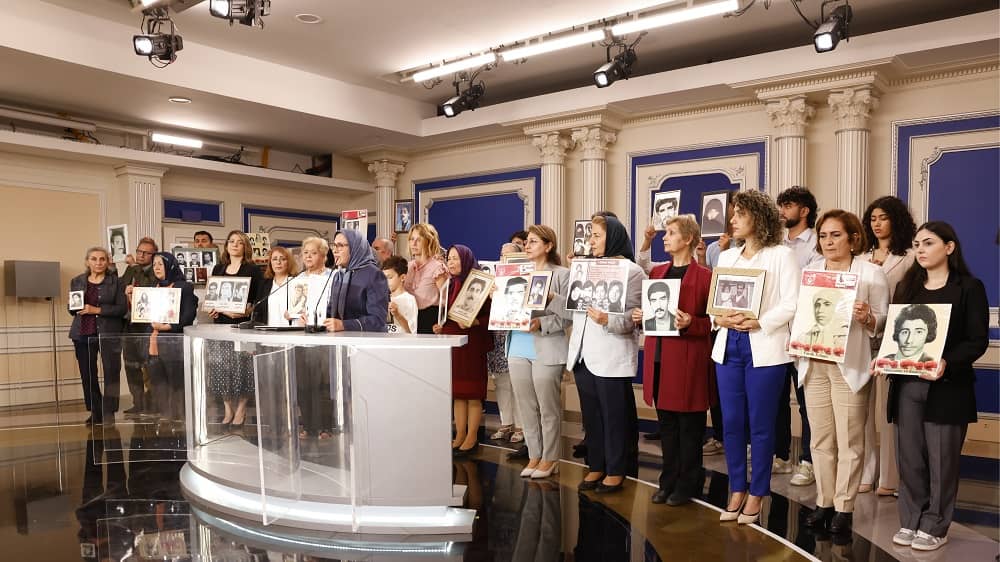

On August 24, an international conference titled “Crimes Against Humanity: Time for Accountability and an End to Impunity” convened former UN officials, prominent legal experts, and human rights advocates to discuss the urgent need for justice for the victims of the 1988 massacre in Iran.
The event featured a speech from Maryam Rajavi, the President-elect of the National Council of Resistance of Iran (NCRI), and focused on the Iranian regime’s atrocities, particularly the systematic execution of political prisoners. Participants underscored the importance of international accountability mechanisms and the role of universal jurisdiction in prosecuting crimes against humanity. The conference also aimed to shed light on the ongoing human rights abuses in Iran, emphasizing the need for global action to end impunity and bring justice to the victims.
Today, in our country, a regime rules, whose governance is predicated upon the suppression of #HumanRights, and whose survival is secured and guaranteed by the killing of people. pic.twitter.com/GfTK1YdNYR
— Maryam Rajavi (@Maryam_Rajavi) August 24, 2024
Recognition of the 1988 Massacre as a Genocide
The 1988 massacre in Iran, where more than 30,000 political prisoners were executed, predominantly members of the People’s Mojahedin Organization of Iran (PMOI/MEK), was discussed at length as potentially meeting the legal definition of genocide.
Dr. Chile Eboe-Osuji, former President of the International Criminal Court (ICC), pointed out that the targeted killings could be seen as genocide under international law. He noted that the nature of the mass executions and targeted killings of political prisoners, primarily members of the PMOI in 1988, could be seen as fitting the legal definition of genocide, further underscoring the necessity for international action to hold perpetrators accountable.
Professor Javaid Rehman, the UN Special Rapporteur on the situation of human rights in Iran from 2018 to 2024, supported this viewpoint, emphasizing the genocidal intent behind the Iranian regime’s actions. He stated, “There is considerable evidence that mass killings, torture, and other inhumane acts against members of the PMOI were conducted with genocidal intent.”
Rehman highlighted that the regime viewed the PMOI as a deviant religious group, which justified the mass executions and torture under a religious decree, further supporting the classification of these acts as genocide.
Professor Leila Nadya Sadat, former Special Adviser on Crimes Against Humanity to the ICC Prosecutor, emphasized the importance of pursuing this classification to garner international support and pressure the international community to act.
Call for Justice and Accountability for the 1988 Massacre
The conference emphasized the urgent need for justice and accountability for the 1988 massacre, with speakers highlighting the importance of international efforts to hold the Iranian regime accountable for its actions. Mrs. Rajavi called for international action, stating, “Today, in our country, a regime rules, whose governance is predicated upon the suppression of human rights, and whose survival is secured and guaranteed by the killing of people.”
Dr. Eboe-Osuji underscored the necessity of holding perpetrators accountable, stating that international law no longer grants immunity to government officials for committing atrocity crimes.
Professor Sadat stressed the need for immediate international intervention, arguing that “the impunity for and denial of justice for the crimes of 1988 has led the regime to continue oppressing Iranians at home and abroad.”
She advocated for the establishment of an international investigative mechanism to collect evidence and facilitate prosecutions.
The calls for justice were echoed by Professor William A. Schabas, a leading expert in international law, who emphasized the importance of establishing a UN Commission of Inquiry into the 1988 massacre to ensure thorough investigations and accountability.
International Legal Mechanisms and Universal Jurisdiction
The conference highlighted the importance of international legal mechanisms and universal jurisdiction in prosecuting Iranian officials for crimes against humanity and potential genocide. Dr. Mark Ellis, Executive Director of the International Bar Association, emphasized the critical role of universal jurisdiction, which allows national courts to prosecute individuals for grave international crimes regardless of where they were committed. He stated, “The principle allows courts in national courts to prosecute individuals for grave international crimes, such as war crimes, genocide, crimes against humanity.”
Dr. Eboe-Osuji explained the role of the Rome Statute, which gives the ICC jurisdiction over crimes committed on the territory of its member states if those states do not take action themselves. He pointed out, “If crimes against humanity are committed in countries like Albania or France, which are member states of the ICC, and those countries do not prosecute or investigate, the ICC has the authority to step in.”
Professor Sadat further advocated for using universal jurisdiction, noting that there are ample opportunities for investigation and mechanisms for accountability, urging countries to use their legal systems to prosecute perpetrators found within their borders. Professor Schabas also highlighted universal jurisdiction and commissions of inquiry as vital tools in addressing impunity for the 1988 massacre, criticizing the lack of action by some countries and advocating for stronger international responses.
Ongoing Human Rights Abuses by the Iranian Regime
The conference also brought attention to the ongoing human rights abuses by the Iranian regime, linking these violations to the lack of accountability for past crimes, particularly the 1988 massacre. Maryam Rajavi highlighted the stark contrast between the ideals outlined in the Universal Declaration of Human Rights and the actions of the Iranian regime, stating, “The massacre of 30,000 political prisoners in 1988 remains one of the most egregious violations of human rights in Iran’s history.” She underscored the regime’s continued use of violence and repression to maintain power, pointing out that these abuses are a direct result of the impunity granted for past atrocities.
Professor Javaid Rehman provided a detailed report on the Iranian regime’s continued human rights violations, including mass executions and enforced disappearances of political prisoners. He emphasized that “the crime of enforced disappearance remains a continuing crime in international law as long as the perpetrators continue to conceal the fate of the disappeared persons.”
Clément Nyaletsossi Voule, UN Special Rapporteur on the Rights to Freedom of Peaceful Assembly and of Association, stressed the importance of international action in addressing these violations, warning against sacrificing human rights on the altar of geopolitical interests. He called for the international community to take responsibility for addressing the crimes committed in Iran, emphasizing that justice for the victims is essential for genuine peace and stability.