

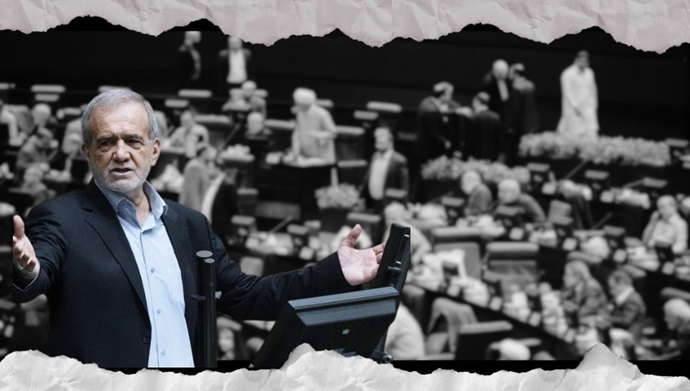

On August 17, the Iranian regime’s new President, Massoud Pezeshkian, along with the cabinet members he had introduced to the Majlis (Parliament), attended the session to defend them. This cabinet is described by Pezeshkian’s disillusioned allies as the second administration of former president Ebrahim Raisi, and they sarcastically remark that if Saeed Jalili had known the cabinet composition, he would have stepped aside in Pezeshkian’s favor. However, despite this, the Parliament became a battleground, even though Pezeshkian spared no effort in showing deference and alignment with the so-called purified Parliament.
Pezeshkian began his speech by invoking Iranian regime founder Ruhollah Khomeini and praising former IRGC Quds Force commander Qasem Soleimani and Raisi, using words that reflected his deep fear and terror of the fires of division, conflict, and the threats engulfing the regime’s factions. He shouted: “Lack of unity and cohesion means the brink of fire. Lack of commitment, lack of unity, and lack of adherence means the edge of fire.” He added: “If we continue in this way, thinking that we will reach a destination is madness.”
Pezeshkian, who had previously stated that the reason for his participation in the electoral show was that “I entered because I saw the regime in danger…,” this time invoked regime supreme leader Ali Khamenei, saying: “The Supreme Leader explicitly stated that the success of the government is the success of the state, and what success is greater than reducing the dangers and threats?”
He also expressed concern about the explosive situation and said: “If the voice of the people is not heard in time, increasing disillusionment and despair will take shape… the country will find itself in a critical situation.”
Pezeshkian also referred to the widespread corruption and the existential crises surrounding the regime from all sides, saying: “Corruption, rent-seeking relationships, and defective structures are rampant. Major imbalances in the budget, enormous threats related to water, the environment, and pension funds are endangering the country.” However, instead of presenting a plan to address these crises and fight corruption, he absurdly promoted his patchwork cabinet, assembled using figures from previous administrations, and said: “The files of over 10,000 people were reviewed, and these are the dear ones now sitting before you. Believe me, the team we introduced to the Parliament is the best we could do. It symbolizes unity, a symbol of solidarity from the Raisi, [Hassan] Rouhani, and [Mahmoud] Ahmadinejad governments.”
However, the factional infighting intensified with a sharp tone of mockery. MP Hamid Rasaee wrote on his X (formerly Twitter) account about Pezeshkian’s speech: “It’s as if you rewound a tape! We are once again hearing the same words we heard in the endorsement and inauguration ceremonies, along with repeated slips of the tongue, which ultimately were blamed on the representatives! Pezeshkian himself didn’t have the patience to read the text, so he said the representatives didn’t have the patience.”
MP Mehdi Kouchakzadeh said: “Pezeshkian always says that my program is the Seventh Development Plan, the general policies, and the vision document. Now that Haji Deligani has declared his opposition, did he oppose Nahj al-balāgha (The collection of sermons, letters, and sayings attributed to the first Shia imam), or the Seventh Development Plan?” He added: “In a situation where the president has not submitted his program to the Parliament, supporters and opponents genuinely do not know what they should be opposing or supporting.”
Also, MP Mohammad Qasim Osmani said: “Our people today say that you deceived us in the election. Among the Sunni community, you did not trust any Sunni, and no one has caused as much disappointment and despair for this important part of the Sunni community and the Iranian nation as your cabinet composition. ”
On the first day of the Parliament ‘s interaction with Pezeshkian’s so-called unity cabinet, despite his efforts to navigate this challenge with a blend of previous governments, the flames of factional conflict and the dangers threatening the regime flared up intensely.