

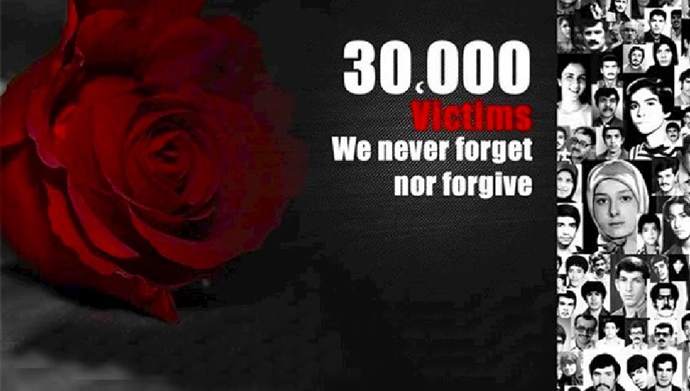

In 1988, when Iranian regime supreme leader Ruhollah Khomeini issued a handwritten decree for the massacre of political prisoners, he believed that by physically eliminating the PMOI, he could also destroy their ideals. If we examine history from this perspective, we will find that this is a mistake often made by dictators. In response to the executioners who had doubts after receiving his handwritten decree, he wrote:
“Anyone who remains loyal to the cause of hypocrisy [PMOI] at any stage should be executed. Destroy the enemies of Islam swiftly. Regarding the handling of the case files, whichever way the verdict can be carried out faster is preferred.”
With this emphasis, there is no doubt that Khomeini harbored the intention of committing genocide against the Mojahedin and took action on it in the last years of his disgraceful life. His successor Ali Khamenei continued this policy towards the PMOI. The secret and silent burial of the massacred bodies in mass graves, paving and constructing over those sites, and not revealing the burial locations to the grieving families were all intended to ensure that no trace of the “steadfast Mojahedin” remained, as if they had never existed in this period of Iranian history.
A step forward in the justice-seeking movement
Since crimes against humanity cannot be hidden anywhere in the world, the unjustly shed blood of PMOI martyrs resurfaced and the veil of crime was lifted. After 45 years of the disgraceful rule of the religious dictatorship and dozens of condemnations by the UN General Assembly and other UN bodies, we have entered a new phase of the justice-seeking movement.
Thirty-six years after the massacre of Mojahedin and political prisoners in the summer of 1988, all previous efforts culminated in a new milestone: the report of UN Special Rapporteur on Human Rights in Iran Javaid Rehman.
The report was in no small amount made possible by the persistence of the Iranian Resistance and the tireless efforts of the justice-seeking families. It represents a brilliant victory for the justice-seeking movement—a movement that has consistently stood against the policy of covering up and denying the massacre of 30,000 political prisoners, never backing down. The regime sought to erase the identity of the justice-seeking movement by exploiting the names and reputations of these proud martyrs but failed to achieve its goal.
Iran’s regime reacts
With the release of the news and then the text of the UN Special Rapporteur’s report, the regime and the perpetrators of the massacre showed hysterical reactions. The so-called “human rights secretary” of the regime called the UN Special Rapporteur a “paid mercenary of the [PMOI]!” This report, an irrefutable document of crimes against humanity and genocide, hit the mark. The notorious secretary of torture and execution has no choice but to desperately claim:
“Mr. Rehman can tell us how much he has received from this group for holding several meetings with them, giving speeches in their favor, and preparing an arbitrary written report in the last days of his mission in support of this group?!”
“Atrocity crimes”
Rehman’s report mentions “atrocity crimes” for the first time. The rapporteur has taken the view that “the ‘atrocity crimes’ of the crimes against humanity in particular murder through arbitrary, summary and extrajudicial executions of thousands of political prisoners, torture, persecution and enforced disappearances and other inhumane acts against political prisoner as well as genocide took place in the Islamic Republic of Iran between the end of July until end of September 1988.”
The report adds: “Between June 1981 to March 1982, thousands of dissidents, including hundreds of children, were arbitrarily detained and subjected to systematic patterns of enforced disappearance, torture and summary, arbitrary and extrajudicial executions on religiously motivated and vaguely defined charges of moharebeh (‘waging war against God’), efsad-e fel-arz (‘spreading corruption on Earth’) and irtidad (apostacy). Most of the victims were members or sympathizers of PMOI.”
Among the executed were hundreds of children, one of whom was Fatemeh Mesbah, a 13-year-old supporter of the PMOI. Between June 1981 and March 1982, thousands of dissidents, including hundreds of children, were arbitrarily arrested and subjected to enforced disappearances, torture, and rushed, extrajudicial executions. Most of the victims were members or supporters of the Mojahedin.
Khomeini’s Fatwa, an Undeniable Document of Genocide
One of the notable aspects of this report is the examination of Khomeini’s criminal fatwa as an undeniable document of genocide. The report states that Khomeini’s 1988 fatwa clearly shows that he deliberately and intentionally ordered the mass execution of all Mojahedin.
The report states:
“The specific requirements of the Genocide Convention and the challenges related to establishing genocide have already been considered. Khomeini’s fatwa, a key document of the 1988 massacre, lays bare the genocidal intent in physically destroying the PMOI, which was treated as a religious group by the perpetrators. The fatwa explicitly characterizes the PMOI’s alleged religious transgressions as ‘waging war against God’ that must be punished by execution.”
Establishing an international mechanism for investigation and accountability
In his recommendations, the Special Rapporteur calls on all UN member states to use universal jurisdiction to conduct immediate, impartial, complete, and transparent investigations into crimes under international law and to collect, integrate, and preserve evidence for future criminal prosecution of all perpetrators.
Javaid Rehman calls for an end to the impunity of those responsible for savage crimes by establishing an international mechanism to ensure swift, impartial, complete, and transparent criminal investigations into the following:
(a) the “atrocity crime” of crimes against humanity, committed against thousands of political opponents of the authorities, in particular their mass murder through summary, arbitrary and extra-judicial executions, and imprisonment, torture, rape and other sexual offences, other inhumane acts, as well as the enforced disappearances.
(b) the “atrocity crime” of genocide during the 1980s including in 1981–1982 and 1988 committed with perpetrator’s specific intent of killing, or physically or mentally harming members of groups perceived as apostates, non-believers, believing in deviant religions or beliefs or members of religious minorities.
The global recognition of the mass killings committed by this regime as “atrocity crimes” (crimes against humanity and genocide) is a qualitative step in the justice-seeking movement of the Iranian people. This movement, directly linked with the movement for regime change, can and must bring the perpetrators of these crimes and genocides to justice.