

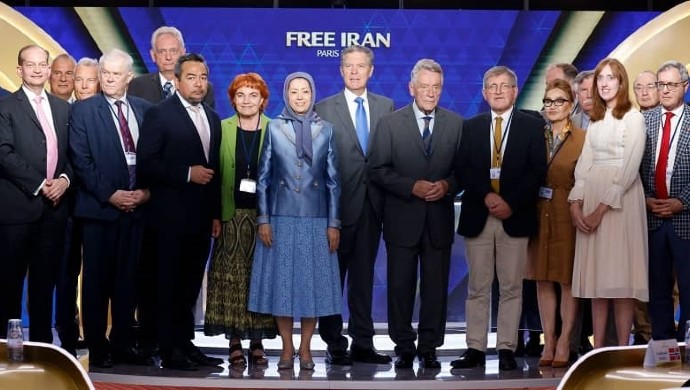

The third day of the Free Iran 2024 World Summit, titled “Crimes Against Humanity and Accountability for Perpetrators,” held featured a series of speeches by prominent international figures with a focus on the Iranian regime’s human rights abuses, especially against dissidents and political opponents.
They expressed strong support for the Iranian resistance movement, highlighting the regime’s human rights abuses and advocating for global recognition and backing of the National Council of Resistance of Iran (NCRI) led by Mrs. Maryam Rajavi. Speakers emphasized the necessity of justice, accountability, and international pressure to end the regime’s oppressive practices and pave the way for a free, democratic, and non-nuclear Iran.
In her keynote speech, Mrs. Rajavi commemorated the martyrs of the struggle for freedom and those who continue to fight.
On this third day of the #FreeIran2024 World Summit, we extend our warmest greetings to those who have fought and sacrificed their lives to uphold human rights in Iran, those who fight and sacrifice their lives, forsaking their own rights to help the people of #Iran win theirs. pic.twitter.com/XbajYIELWw
— Maryam Rajavi (@Maryam_Rajavi) July 2, 2024
“Iran holds a contemporary world record in many forms of repression, including the imprisonment and torture of at least 500,000 people for political reasons and the execution of more than 100,000 political prisoners,” Mrs. Rajavi said. “Iran also has one of the highest numbers of executions each year. Last year, three-quarters of the executions recorded globally took place in Iran.”
Mrs. Rajavi warned that the absence of any international accountability for these crimes has emboldened the mullahs to shed blood without hesitation throughout the past four decades.
“Suppression and control are pervasive processes deeply entrenched in every facet of society—from schools, universities, and workplaces to administrative units, the Internet, and both urban and rural environments,” she said.
Mrs. Rajavi said that oppressed ethnic groups, particularly Baluch, Kurdish, and Arab communities, face even more severe oppression. She also underlined the institutionalized suppression and brutal assault on women, along with the imposition of religious tyranny, epitomize the history and the real image of this regime.
“They aim to instill fear and deepen repression, countering the protests and resistance of Iranian women. But the mullahs have failed. Ultimately, the pioneering role of the PMOI and other courageous women fighters will bring down the Velayat-e Faqih regime,” she said.
The 1988 massacre of political prisoners
The speakers highlighted the grave human rights violations committed by the Iranian regime during the 1988 massacre and underscored the need for international accountability. The massacre, which resulted in the execution of thousands of political prisoners, remains a pivotal issue in the quest for justice and regime change in Iran. The speakers collectively called for the international community to intensify efforts to hold the Iranian regime accountable for the 1988 massacre and ongoing human rights abuses.
Dr. Mark Ellis, International Criminal Law Expert, Executive Director of the International Bar Association, emphasized the gravity of the massacre, stating, “These acts have reached the level of crimes against humanity and genocide. These are the most egregious of all atrocity crimes, and they reflect much of what’s happening in Iran.”
Lars Rise, Former Norwegian MP, highlighted the importance of international legal mechanisms, noting, “The Special Rapporteur…concluded that the 1988 massacre of thousands of political prisoners in Iran amounted to crimes against humanity and genocide.”
Gilles Paruelle, French Jurist, called for stronger international actions, asserting, “We need to go after the people who plotted these actions. We know who they are, but they have not been met with proper legal proceedings.”
Continued crimes
Speakers at the conference stressed the continued crimes of the Iranian regime, particularly against women. These speakers illustrated the persistent and systemic nature of the regime’s crimes and underscored the severe repression and human rights abuses perpetuated by the regime, calling for global accountability and support for the Iranian resistance.
Marit Nybakk, Former Deputy Speaker of the Norwegian Parliament, emphasized the regime’s ongoing suppression, especially targeting women: “Over the last year, we have witnessed manifestations involving thousands of women demonstrating against the compulsory use of the hijab.”
Dainius Puras, Former UN Special Rapporteur on the right of attainable physical and mental health, highlighted the regime’s misuse of psychiatry for political repression: “The regime in Iran also abuses psychiatry, using diagnoses like ‘antisocial personality disorder’ to stigmatize civil disobedience.”
Mariana Stilman, Former Argentinian MP, spoke about the systematic oppression of women and said, “Women cannot have leadership roles in Iran. Their human rights are being violated. We have to eradicate the application of the death penalty.”
Poor international response
During the conference, several speakers criticized the international community’s inadequate response to the Iranian regime’s human rights abuses. Their discussions highlighted the need for stronger global actions and accountability measures.
During the third day of the Free Iran 2024 World Summit, several speakers criticized the international community’s inadequate response to the Iranian regime’s human rights abuses. They highlighted the necessity for stronger global action and accountability measures.
Marit Nybakk, Former Deputy Speaker of the Norwegian Parliament, condemned the regime’s record on executions and gender apartheid, emphasizing the failure of the international community to take decisive action and saying, “Iran holds the world record for public executions and death penalties. Despite this, the international community’s response remains insufficient.”
Alan Dershowitz, Human Rights Lawyer, criticized the appeasement policies of Western governments and said, “Our government, the United States, is appeasing Iran. It is not implementing sanctions or putting pressure on the regime. This must change to prevent further atrocities.”
Prof. Wolfgang Schomburg, Former Judge at the International Tribunal for the Former Yugoslavia, advocated for the establishment of an international tribunal, “The crimes committed in Iran must meet justice through an international tribunal. The global community must fight for this to bring peace and justice to the region.”
Holding the regime to account
The speakers also discussed the crucial role of the international community in holding the Iranian regime accountable for its crimes. They outlined actionable steps and emphasized the need for justice, international pressure, and support for the Iranian resistance.
Dr. Ellis highlighted the significance of universal jurisdiction, stating, “Under the concept of universal jurisdiction, every state has a duty and responsibility to ensure those who have perpetrated these crimes are brought to justice.”
Sen. Sam Brownback, Former US Senator and Ambassador-at-Large for International Religious Freedom, called for increased pressure on the regime, stating, “We must put maximum economic pressure on the Iranian regime. We need to put maximum political pressure on the ruling mullahs.”
Alan Dershowitz advocated for legal action, asserting, “I really do think that a case should be opened by the International Criminal Court against the mullahs of Iran, naming specifically people who were involved in decisions to commit genocide, to commit war crimes, to commit acts of aggression against other countries.”
Dr. Valeriu M. Ciucă, Former Judge at the Court of Justice of the European Union, called for international justice, saying, “I believe the best way for justice is to create an ad-hoc international court for the regime’s crimes against the opposition and protesters.”
Support for the Iranian Resistance
The participants underscored the crucial role of supporting the Iranian Resistance to end human rights abuses in Iran. The speakers expressed hope for the potential for transformative change through the efforts of the National Council of Resistance of Iran (NCRI) led by Mrs. Maryam Rajavi.
Former French Minister Alain Vivien condemned the regime’s use of hostages as bargaining tools and called for global recognition of the resistance: “The resistance should be recognized just as Britain recognized the French Resistance in the 1940s.”
Marit Nybakk, Former Deputy Speaker of the Norwegian Parliament, highlighted the regime’s gender apartheid and the international community’s role in supporting the resistance: “The protests against capital punishment and the death penalty are increasing. The NCRI has consistently demonstrated its organizational capability, leadership, and commitment to democratic values.”