

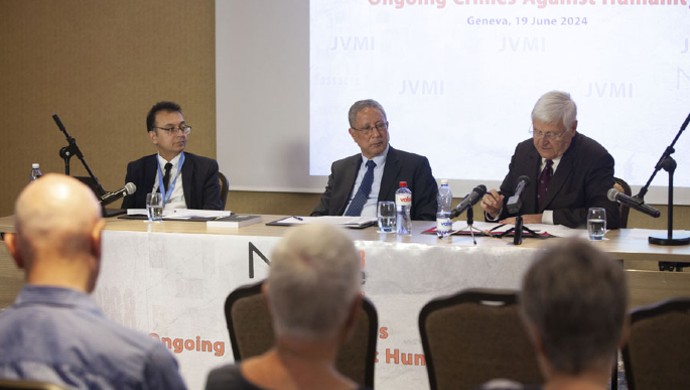

On Wednesday, June 19, 2024, at a conference in Geneva titled “Justice for Iran’s Ongoing Crimes Against Humanity,” Javaid Rehman, the United Nations Special Rapporteur on the human rights conditions in Iran, presented his latest report on the 1988 massacre and the executions of 1981 and 1982 by the clerical regime. He stated, “I take a sense of pride and achievement, because I have now completed my report on what I call ‘atrocity crimes and grave violations of human rights’ committed in the Islamic Republic of Iran from 1981, and they go on to the 1988 massacre… this is such an important issue in the lives of thousands of people. It is not a historical issue, as many people think. It is a live issue. There are serious concerns about gross violations of human rights.”
He added, “The death of Ebrahim Raisi on 19 May 2024 must not result in denial of the right to truth, justice and reparations for the Iranian people. Raisi was a member of the ‘Death Commission’ that committed crimes against humanity including mass murder, the arbitrary, summary and extra-judicial executions of several thousand political prisoners in 1988. Those who committed crimes against humanity during the 1980s and subsequently must be held accountable and impunity must end in the Islamic Republic of Iran.”
The UN Special Rapporteur emphasized that accountability for crimes against humanity is not subject to a statute of limitations. Regarding his report, he clarified: “This report is relevant because it is affecting people today. It’s affecting their lives.”
Rehman stressed that “there are other interrelated and important contemporary issues which we must bear in mind as to why the 1980s and 1988 are relevant today.”
For example, he referred to the 2022 nationwide uprising and said, “That wasn’t the start of women’s struggle for equality and rule of law and women’s rights. It goes back to the time when Khomeini came into power in 1979, and then he started placing restrictions, ultimately to the point of enforced hijab. So, you have to look back at what happened in the 1980s.”
The UN Special Rapporteur, referring to Ruhollah Khomeini’s criminal fatwa for the massacre of the People’s Mojahedin Organization of Iran (PMOI/MEK), noted, “All of these crimes I have analysed in great depth when I’m looking at the 1988 massacre. And just to give you a brief summary of my analysis, the key elements of what happened in 1988 was that thousands of political prisoners were targeted and murdered. There was no fair trial for them. There was this fatwa. Imam Khomeini issued that fatwa, in which he said that all of those monafiqeen (Mojahedin), as he termed it, all of those monafiqeen who remain steadfast must be executed. And he used this terminology through a religious prism, but he also urged the commissioners that he mentioned to show their revolutionary zeal, or religious zeal, to show no kind of consideration to principles of rule of law and human rights. So that was the basic agenda on which he ordered the executions.”
Rehman added, “these prisoners were punished for their ideological position. They had a political position. They were tortured because of that. So, torture was exercised… And then what happened was that, obviously it was not a court of law, so they did not have any rights. They could not question the judgments of these commissions. They were executed at a very short notice. Many of them could not defend their case. They were asked questions that were not legal.
“They were asked, for example, would you betray the PMOI, or would you help support the execution of your prison mates? I mean, these were not legal questions.”
After the conference, the UN Special Rapporteur said in an interview with Simay-e Azadi television,
“The international community and UN member states, as well as civil society and other stakeholders, take notice. We need to work towards accountability and ensure that those who committed these serious crimes, which I have classified as crimes against humanity and genocide, are punished in courts of law.”