


These days, Iranian regime officials and media are fast busy writing essays about the benefits of Ebrahim Raisi, the former regime president who died in a helicopter crash on May 19. These statements are often nonsense; however, in this context, Mojtaba Zonnour, the Deputy Speaker of the reactionary parliament, has said things that are worth hearing.
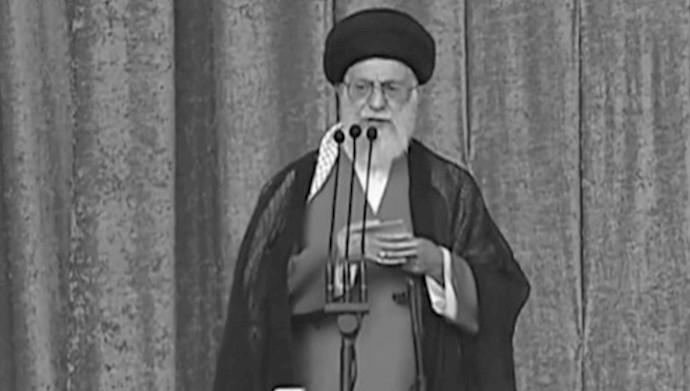
Zonnur said, “During the three years that Raisi was president, [Iranian regime supreme leader Ali] Khamenei could breathe easily; because the previous concerns, the lack of coordination among the branches, the conflicts, disputes, circumventions, and deviations did not occur, and the leader’s concerns were reduced; because Raisi was committed to adhering to the views and orders of the leader, which is the right thing to do.”
Zonnour complements his statement with an analogy: “The leader is like the pilot of an airplane, and the president, as the highest executive official of the country, is the co-pilot.” Comparing the medieval clerical regime to an airplane is an irrelevant comparison, but if we slightly downgrade it to the “car of the mullahs’ regime,” the Supreme Leader is like the driver and the president is the driver’s assistant and the one who collects fares. Former president Mohammad Khatami had also said that the president in this regime is merely a logistics coordinator.
Amid the chaos and crackdowns enforcing mandatory hijab, Ahmad-Reza Radan, the head of the State Security Forces, while complaining that no one was helping or supporting him, exempted a few people, the first being Raisi. He said, “The president, in conditions where presidents usually do not enter these fields due to the need to gain votes in elections, is present in the field… Usually, no president does such things.” In other words, Raisi had no concern for his reputation or social disfavor in executing Khamenei’s orders. Just as in the 1980s and the summer of 1988, he had nothing in mind but the complete execution of the order of regime founder Ruhollah Khomeini for the massacre of political prisoners.
The fundamental contradiction between the medieval regime and the institution of the presidency has plagued the regime since Khomeini’s time, and even Khamenei, as president, had conflicts with Khomeini. This same contradiction emerged when between Khamenei and regime’s presidents after he became the supreme leader. Consequently, Khamenei considered changing the system from presidential to parliamentary to rid himself of the “president,” but he couldn’t. By sidelining Rafsanjani, he resorted to the “logistics coordinator” and “absolute obedient” solution. This solution was also not free of trouble for the beleaguered supreme leader, and he had many clashes with former presidents Khatami, Mahmoud Ahmadinejad, and Hassan Rouhani. Ultimately, he was forced to use the Guardian Council and appoint the notorious executioner Raisi as the president.
And now Khamenei is left with unresolved contradictions and, as Zonnour puts it, another endless cycle of “previous concerns, lack of coordination among branches, conflicts, disputes, circumventions, and deviations.” The upcoming sham elections have already intensified the regime’s internal crisis, which will peak more and more in the coming weeks, and after that, it will only be the beginning of this calamity.
In the helicopter incident, it wasn’t just Raisi whose death took away the comfort of the Khamenei; along with him, the regime’s Foreign Minister Hossein Amir-Abdollahian.
Regarding this, Esmaeil Kowsari, a member of the Majlis (parliament), after mentioning the mutual affection between former IRGC Quds Force commander Qasem Soleimani and Amir-Abdollahian, told state-run television on May 23, “When (Amir-Abdollahian) went for negotiations… the Quds Force was assured that he was aligned… He followed the work with the Quds Force very comfortably.”
Thus, with the elimination of Raisi and Abdollahian, two sources of comfort for the supreme leader, have vanished. No matter how much he tries to pretend and show himself as carefree and relaxed, the walls and surroundings bear witness to the turmoil of the crisis-ridden regime, faced with the anger and hatred of an explosive society.