


A new case of government-linked embezzlement case has been making the rounds across Iran.
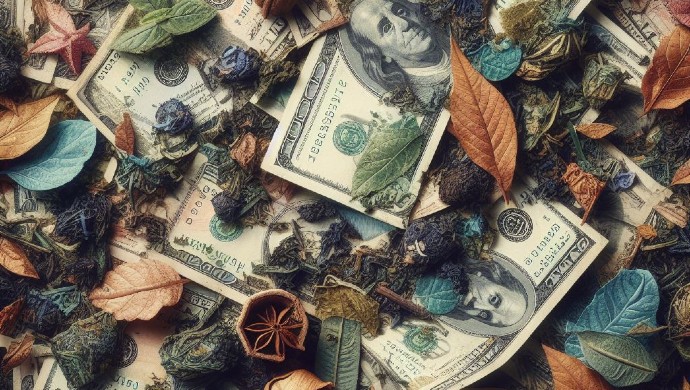
This latest case of economic corruption has taken place in the “tea” market. According to a statement by the head of the regime’s inspectorate, a “commercial group from 2019 to mid-2022 has received approximately $3.37 billion for the import of tea and advanced printing and packaging machinery. However, so far, for $1.4 billion of the received currency, it has not fulfilled its commitment and has not imported any goods into the country. Moreover, this company has sold the received government currencies at a higher rate in the open market, and this figure is expected to increase to nearly $2 billion.”
The revelation of this $3.7 billion corruption scandal in the current circumstances quickly pointed fingers at the Ebrahim Raisi government.
On December 5, in an article titled “Pointing the Finger at the Claimants of Fighting Corruption,” the state-run Ham-Mihan newspaper wrote, “The disclosure of the $3.7 billion corruption scandal in the thirteenth government seems to be a way to conveniently sweep the expectations for the realization of this slogan into oblivion forever.”
On same day, in an article titled, “The Seven-Headed Dragon of Corruption on the People’s Table,” the state-run newspaper Setareh Sobh, wrote, “When Raisi came to power with the slogan of economic surgery and removing essential goods from government currency, it accelerated inflation and inflicted harm on the government with disastrous consequences.”
As a result, Raisi, who rose to presidency with promises of economic reforms. But in effect, he was brought to power with one goal: protect the regime against the uprising of the people and the organized resistance. He neither can nor wants to stop corruption. And this entire regime benefits and lives on embezzlement and corruption.
On March 29, the state-run Eghtesad News website quoted Hossein Marashi, a regime expert, as saying, “This state has been defeated and will inevitably have to accept this defeat, and we must change course.”
On December 5, the state-run Ebtakar newspaper, in a reference to the $6 billion that were released as a result of appeasement policies, wrote: “To understand the figure of $3.37 billion, it may be necessary to refer to Iran’s debt to South Korea. This country owed Iran $7 billion, and this debt has been settled and paid in recent years. In this atmosphere and in the midst of a currency crisis, the volume of corruption has reached a staggering $3.37 billion.”
The disgrace and scandal of the “Tea corruption,” which is referred to as the largest “economic corruption in the history of Iran” by the regime, has put regime supreme leader Ali Khamenei on the defensive. Keyhan newspaper, which is known as the mouthpiece of Khamenei, tried to defend Raisi in vain. These efforts only exacerbated the infighting among the regime’s factions.
On December 5, Ham-Mihan wrote, “Some are trying to divert public opinion so that no one realizes what a horrific incident has occurred in the tea corruption case, and what is their responsibility in this matter? Instead of providing useful information and leaving the judgment to the court and public opinion, they have rushed to make judgments and pass verdicts, seeking to exonerate themselves. The recent corruption is intolerable.”
On December 3, the state-run Jamaran news website quoted a former member of the Chamber of Commerce, who is informed about government corruption cases, as saying, “Allocating such a huge amount without extensive collaboration and coordination, special permits, and the approval of high-level officials is impossible, and selling this amount of currency in the free market is not possible without an extensive network. Not only the boundaries of corruption have been crossed, but also the boundaries of smuggling have been shifted.”
After the 2017 nationwide uprising, which was triggered by economic grievances, Khamenei acknowledged the existence of a seven-headed corruption mafia within the regime and said, “We must fight against corruption and injustice, although it is very difficult. Corruption is like the seven-headed dragon of legends. When you strike one head, the other six move. Eliminating it is not easy. Dealing with those who benefit from corruption is a very difficult task.”
Corruption, crime, and warmongering are inextricable aspects of the mullahs’ rule in Iran. The only way to end the corruption of this regime is through an uprising by the people of Iran and their organized resistance.