


October 10 marks the World Day Against the Death Penalty.
According to the annual report by Amnesty International, over 50% of global executions (excluding China) take place in Iran. Officially reported statistics from the Iranian regime indicate that at least 660 individuals were hanged in Iran between October 10, 2022, and October 10, 2023. This is in addition to hundreds of street killings, torture of young people, and suppressions during this period.
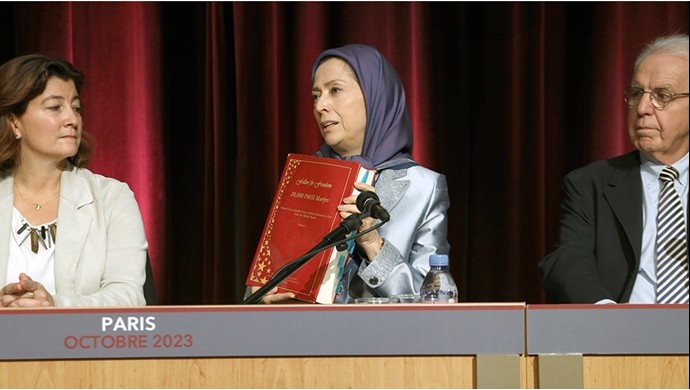
On Thursday, October 11, concurrent with the anniversary of the World Day Against the Death Penalty, a conference was held at the French National Assembly. In this conference, Ms. Maryam Rajavi, the president-elect of the National Council of Resistance of Iran (NCRI), and several representatives of the French National Assembly delivered speeches, calling for the prosecution of Iranian regime officials who have been involved in crimes and the suppression of the Iranian people.
In her speech, Mrs. Rajavi said, “The world must stand against the mullahs’ warmongering. Instrumentalizing the Palestinian issue is a well-known tactic of this deceitful regime. Today, Khamenei and Raisi want to transform the Iranian people‘s uprising and struggle against religious fascism in Iran into a Muslim-Jewish war.”
Mrs. Rajavi stressed that the right policy is “to stand against the clerical regime, the foremost state sponsor of terrorism and warmongering.”
Mrs. Rajavi also warned that the massacre of innocent civilians fuels religious fascism in Iran and serves as a shield and cover to suppress the uprising in Iran and avoid the regime’s downfall. “To achieve peace and freedom, one should target the head of the snake (leadership) in Tehran,” she said.
André Chassaigne, the head of the Communist bloc in the French Parliament and deputy of the parliamentary Committee for Democratic Iran, underscored that in Iran, the death penalty is not just a judicial tool or a cruel and inhumane punishment, but rather a political instrument used to suppress the people extensively. Mr. Chassaigne also highlighted that despite the regime’s repressive measures, PMOI Resistance Units continued their activities.
Mr. Émile Blessig, a former senior MP and co-founder of the parliamentary Committee for Democratic Iran, emphasized that the international community will not passively watch the escalating number of executions in Iran. Those responsible for executions, torture, and human rights violations, particularly the Revolutionary Guards, will face prosecution, Mr. Blessing said.
MP Cécile Rilhac, head of the Parliamentary Committee for Democratic Iran representing the majority fraction (Renaissance), expressed pride in the committee’s initiative to support the Iranian people’s struggle for a democratic republic with a clear separation of religion and state. She mentioned that the initiative received significant support from representatives of various political movements. “Our progress has faced opposition from proponents of appeasement with the mullahs and those desiring a return to the previous dictatorship,” she stated. However, she affirmed their determination to stand with the Iranian people in their fight for democracy.
Professor Aude de Thuin, former president of the Supreme Education Union, emphasized that the struggle in Iran encompasses not only the issue of hijab but the fundamental rights of all individuals. Furthermore, she urged the United Nations to investigate the 30,000 arrests and 3,000 disappearances, calling for France’s support of the UN’s investigative mission.
Mrs. Dominique Attias, head of the Administrative Council of the European Lawyers’ Foundation and former head of the Paris Bar Association and the European Lawyers’ Federation, highlighted that Ebrahim Raisi, the Iranian regime’s current president, was implicated with his accomplices in the massacre of 30,000 prisoners in 1988. She emphasized the direct connection between the call for the abolition of executions and the advancement of modern democracy. Mrs. Attias noted that Mrs. Rajavi has been tirelessly advocating for the abolition of executions since 2006 as part of her Ten-Point Plan.
Tahar Boumedra, the director of the Committee for Justice for the victims of the 1988 massacre (JVMI) and former representative of the United Nations Secretary-General in Iraq for Ashraf, highlighted the need for the Iranian regime’s president Ebrahim Raisi to be prosecuted and tried for his direct involvement in the extrajudicial executions of thousands of political prisoners. He also mentioned the rise in executions in Iran despite global progress in abolishing the death penalty.