


Analysis by PMOI/MEK
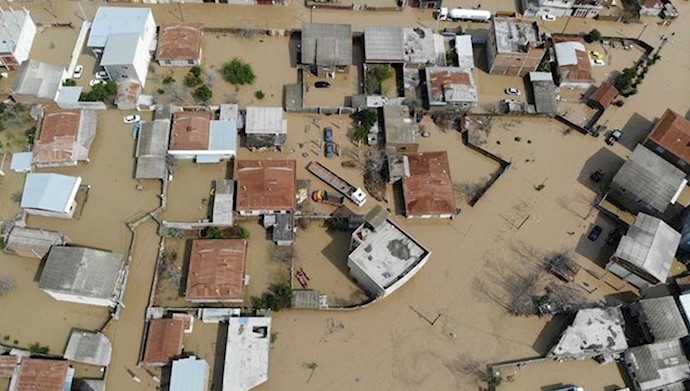
March 27, 2019 – Floods are threatening various provinces across all of Iran and the Greater Tehran area is facing a major risk. Reports of rising water has been incoming from a variety of districts throughout the country’s capital that is home to around 9 million people.
In Shiraz, south-central Iran, after floods entered the city for the second day on Tuesday, people’s homes suffered enormous damages, especially in the Sa’diyeh neighborhood. Videos posted on social media platforms showed people seeking refuge on their rooftops. The number of people killed in these floods of Shiraz alone, being the result of 40 years of destructive policies imposed by the mullahs’ regime, has now risen over 150, according to local reports and eyewitnesses. Further reports from this devastated city indicate authorities are blocking people and reporters from entering hospitals to prevent any leakage of the true number of people killed by these floods.
Reports also show landslides blocking many roads across the country.
Expressing her condolences, Iranian opposition President Maryam Rajavi, head of the National Council of Resistance of Iran (NCRI), is calling on all Iranians, especially the youth, to provide help to those in need.
I call on the people of Iran and especially the youth to form popular councils in every city, neighborhood and village to confront the flash floods and their disastrous consequences, and to help the people who have suffered in the floods. #Iran#IranFlood pic.twitter.com/xIPBeoT291
— Maryam Rajavi (@Maryam_Rajavi) March 26, 2019
NCRI President Maryam Rajavi also shed light on how the mullahs’ regime of Iran has been destroying the country for 40 years and counting.
By destruction of the environment, and irregular construction of roads and buildings, the regime’s leaders and the IRGC have ruined the traditional barriers to flash floods, causing devastating flooding of cities and villages. #Iran#IranFlood
— Maryam Rajavi (@Maryam_Rajavi) March 25, 2019
A day after Monday’s devastating floods, the mullahs’ Supreme Leader Ali Khamenei issued a message to his representative in Shiraz and claimed the flood has brought him great grief! While it has become common knowledge that the regime’s policies have led to these recent floods across the country, Khamenei called for measures that are actually meant to control any possible popular protests.
It is crystal clear that service and maintenance of waterways was the least the mullahs’ regime could have done to prevent such floods. However, embezzlement and corruption has reached such a high among regime authorities that they have literally left no funds to provide for the people’s needs. The regime's own experts have acknowledged time and again that government mismanagement and lack of funding for the public sector have led to natural disasters spinning out of control
People in Shiraz are fully aware that roads built alongside the city’s famous Quran Gate have blocked water paths, resulting in massive floods.
Deforestation and selling Iran’s soil to foreign countries, alongside a variety of construction regulation violations, are further reasons behind the recent floods.
After Khamenei, with much delay, called on the Revolutionary Guards (IRGC) and the army to provide help to flood-hit areas, reports from Golestan Province in northeast Iran indicate people are expressing their anger at the IRGC and authorities.
Reports also show authorities preventing a team of specialist physicians from entering a village in Golestan Province. Eyewitnesses say the locals are in desperate need of aid.
In Khuzestan Province, southwest Iran, rains are reportedly increasing and amount of water entering Karkhe Dam has quadrupled. “Concerns remain over the Karkhe River overflowing and leading to floods. Water levels are rising above normal conditions,” one regime official said.
In Dezful, southwest Iran, floodwaters have reached the city center.
A flooding river in Dorud, western Iran, is placing a local cement factory in grave danger.
In Izeh, southwest Iran, at least two neighborhoods are in grave danger of full flooding and locals have been ordered to evacuate their homes. Residents of these areas are saying they have nowhere to go.
The road linking the two cities of Behbahan and Ramhormoz in southwest Iran is now blocked due to massive floods.
In Kohgiluyeh & Boyer-Ahmed Province, southwest Iran, flood took the life of a 15-year-old. Three villages in this province have been evacuated and one village was literally destroyed. Roads to more than 60 villages and paths used by 80 percent of local tribes have been blocked. A landslide in this province has reportedly engulfed an entire village.
Water level in the river of Yasuj, southern Iran, continues to rise. The regime’s provincial governor said, “This village has completely disappeared and there is no trace of it.” He did not indicate the number of casualties.
Floodwaters have also reached the city of Borujen in Chaharmahal & Bakhtiari Province, southern Iran; the village of Tarzjan in Yazd, central Iran; areas near Mashhad, northeast Iran; the town of Afshar in Zanjan Province, northwest Iran; the town of Qaen in South Khorasan Province, eastern Iran.