

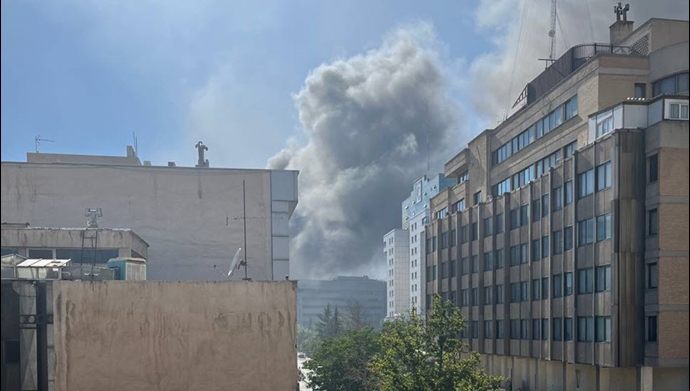

On Tuesday, June 24, the twelfth day of the conflict between Iran and Israel that began over Tehran’s nuclear program, a ceasefire brokered by the United States was thrown into disarray almost immediately after it was announced. The day was marked by conflicting statements from Tehran, accusations of truce violations from both sides, and reports of significant casualties among the Iranian regime’s security forces.
The ceasefire announcement
U.S. President Donald Trump announced the ceasefire late Monday night, claiming that both nations had sought peace. “Israel & Iran came to me, almost simultaneously, and said, ‘PEACE!’” Trump wrote on his Truth Social platform. “The World, and the Middle East, are the real WINNERS! Both Nations will see tremendous LOVE, PEACE, AND PROSPERITY in their futures.” He later posted, “THE CEASEFIRE IS NOW IN EFFECT. PLEASE DO NOT VIOLATE IT!” (CNN).
The announcement followed what CNN reported as furious behind-the-scenes work by Trump and his top officials to broker a deal. In Israel, Prime Minister Benjamin Netanyahu confirmed that his government had agreed to the bilateral ceasefire, telling his security cabinet that Israel had achieved all of its war goals, including removing the threat of Iran’s nuclear and ballistic missile programs (Associated Press).
Conflicting messages and conditions from Tehran
The regime in Tehran sent mixed signals regarding the truce. While Iranian state television reported on Tuesday that a ceasefire had begun, the regime’s foreign minister, Abbas Araghchi, contradicted the idea of a formal deal (Associated Press).
On the social media platform X, Araghchi wrote, “As of now, there is NO ‘agreement’ on any ceasefire… However, provided that the Israeli regime stops its illegal aggression against the Iranian people no later than 4 am Tehran time, we have no intention to continue our response afterwards.”
As Iran has repeatedly made clear: Israel launched war on Iran, not the other way around.
As of now, there is NO "agreement" on any ceasefire or cessation of military operations. However, provided that the Israeli regime stops its illegal aggression against the Iranian people no…
— Seyed Abbas Araghchi (@araghchi) June 24, 2025
This ambiguity was echoed by hardliners within the regime. Hamid Rasai, a member of the regime’s parliament, stated that declaring war or peace is the exclusive authority of Supreme Leader Ali Khamenei, calling any other claims a “suspicious project.” The state-run Kayhan newspaper, which reflects Khamenei’s views, warned that the ceasefire could be a tactic by the “enemy” to create “internal division.”
Ceasefire immediately tested by violations and retaliation
The ceasefire was almost immediately put to the test. The Israeli military said it had identified missile launches from Iran just moments before Trump’s peace announcement (CNN). Hours after the truce was due to begin, Israeli Defense Minister Israel Katz accused Iran of a “complete violation” for launching missiles and instructed the military to resume targeting sites in Tehran (Associated Press).
President Trump expressed frustration with both sides but directed his sharpest words at Israel. “Israel, as soon as we made the deal, they came out and they dropped a load of bombs, the likes of which I’ve never seen before,” Trump told reporters, adding, “I’ve got to get Israel to calm down now” (Reuters).
Following the alleged Iranian missile launch, Israel struck a radar site north of Tehran. The state-affiliated Fars News Agency reported that an explosion was heard in the coastal city of Babolsar, north of Tehran (CNN, Fars News Agency).
However, according to the Israeli Prime Minister’s Office, Prime Minister Netanyahu committed to refraining from additional strikes after an “exceptionally firm and direct” phone call with President Trump (CNN).
The Iranian regime’s military later issued a formal denial that it had fired any missiles after the ceasefire began (Associated Press).
The regime’s reported losses and defiance
Meanwhile, reports detailed significant casualties among the regime’s military and security leadership. An Israeli strike on Monday in Karaj, near Tehran, killed seven members of the Islamic Revolutionary Guard Corps (IRGC), including two generals (Associated Press).
Tasnim News Agency, which is affiliated with the IRGC’s Quds Force, reported that an Israeli attack in Gilan province killed 13 people and wounded 41. The IRGC in Alborz province also released a list of its commanders killed in a strike, including Brigadier General Mojtaba Karami, the deputy commander of the province. Additionally, reports confirmed the assassination of Mohammadreza Sedighi Saber, a scientist sanctioned by the U.S. for his work on nuclear weapons proliferation, and the death of Alireza Lotfi, the deputy head of intelligence for Iran’s State Security Forces (FARAJA) (Sabereen News, State-run Media).
Despite these losses and claims by U.S. Vice President JD Vance that Iran is now “incapable of building a nuclear weapon” (Reuters), the head of the Iranian regime’s Atomic Energy Organization, Mohammad Eslami, struck a defiant tone. He stated that contingency plans for the “revival” of the program were already in place and that there would be “no interruption in the production process and services.”
The opposition’s response and continued domestic repression
The Iranian opposition welcomed the halt in fighting. Maryam Rajavi, the President-elect of the National Council of Resistance of Iran, issued a statement “welcoming the ceasefire and end of the foreign war.” She framed the development as “a step forward for the third option: neither war nor appeasement,” and called for the focus to return to the Iranian people’s struggle for freedom. “Let the people of Iran themselves, in the battle of destiny, bring down Khamenei and the dictatorship of velayat-e faqih,” she wrote, reiterating the goal of a “democratic, non-nuclear republic.”
Welcoming the ceasefire and end of the foreign war
Reaffirming the will of the Iranian people:
freedom and victory in the battle of destiny against religious fascism
The proposal for a ceasefire and ending the war is a step forward for the third option: neither war nor… pic.twitter.com/HDu9TYKWC9— Maryam Rajavi (@Maryam_Rajavi) June 24, 2025
Amid the external conflict, reports emerged of the regime intensifying its domestic crackdown. Following an airstrike on Tehran’s Evin Prison, prisoners from several wards, including the women’s ward, were forcibly transferred to other facilities. Male prisoners were sent to the Tehran Greater Prison and female prisoners to Qarchak Prison. According to reports, the prisoners were bound together with handcuffs and legcuffs during the transfer and were not allowed to take their essential personal belongings. The fate of prisoners held in the Ministry of Intelligence’s Ward 209 at Evin remains unknown.