

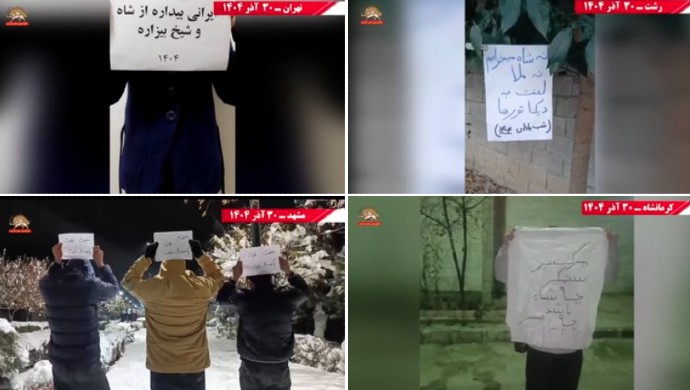

On December 21, as Iranians observed Yalda—the ancient festival of the Winter Solstice—members of the PMOI Resistance Units organized anti-regime activities across the country. Using the longest night of the year as a metaphor for the dark era of the clerical dictatorship, the Resistance Units spread a message of hope and defiance, emphasizing that the “dawn of freedom” is inevitable.
In cities ranging from the capital, Tehran, to Mashhad in the northeast and Shiraz in the south, placards and banners appeared on streets and public places rejecting all forms of dictatorship. The central theme of these activities was a firm refusal to return to the monarchical past or tolerate the current theocracy. A slogan widely displayed in Karaj, Isfahan, Kermanshah, and Qazvin read, “Down with the oppressor, be it the shah or the supreme leader.”
December 21—Iran
PMOI Resistance Units across Iran mark Yalda festivities (Winter Solstice) with anti-regime activities and rejection of all forms of dictatorship. pic.twitter.com/yM6x36y9F7— People's Mojahedin Organization of Iran (PMOI/MEK) (@Mojahedineng) December 22, 2025
The political symbolism of Yalda
For the Iranian people, Yalda is not merely a cultural tradition; it is a symbol of the victory of light over darkness. While the clerical regime has attempted to erase Yalda from the social calendar to suppress its message of fighting darkness, the people have turned the celebration into an act of resistance.
In Mashhad, Resistance Units put up posters declaring, “Monarchy and mullahs, one hundred years of crime,” while in Borazjan, the message was explicit: “The solution is the overthrow of the mullahs’ regime by the people and organized Resistance movement of Iran.”
This defiance comes amidst a crushing economic crisis caused by regime corruption. With the minimum monthly wage for a worker standing at 10.4 million tomans, the cost of a modest Yalda celebration—including simple items like nuts and pomegranates—now ranges between 2.1 and 2.8 million tomans. This means a single night’s traditional observance costs nearly 30% of a worker’s monthly income. Despite this poverty, Iranians continue to celebrate to honor their national identity and defy a regime that has tried to destroy their heritage.
Karaj
"Down with the oppressor, be it the shah or the supreme leader" pic.twitter.com/F4NFaQVUpz— People's Mojahedin Organization of Iran (PMOI/MEK) (@Mojahedineng) December 22, 2025
Resistance amidst a wave of executions
The activities of the Resistance Units are particularly significant given the regime’s unprecedented crackdown. In 2025, the regime executed over 2,000 people, a figure the UN High Commissioner for Human Rights describes as unseen since the 1988 massacre. In November 2025 alone, 335 people were hanged.
The regime has specifically targeted supporters of the People’s Mojahedin Organization of Iran (PMOI/MEK) to prevent youth from joining the Resistance Units. Currently, 18 political prisoners are on death row. However, as the banners in Kerman proclaimed, “The greatest darkness will be overcome by our struggle.”
Baneh
"The people and history [of Iran] curse the bloodthirsty shah and mullahs" pic.twitter.com/aNvnhYZL3V— People's Mojahedin Organization of Iran (PMOI/MEK) (@Mojahedineng) December 22, 2025
The third solution
The consistency of the slogans across Iran highlights the people’s demand for a “Third Solution”—neither a foreign war nor appeasement, but regime change by the Iranian people and their organized Resistance. The Iranian Resistance asserts that the international community must abandon appeasement.
The banners in Bushehr summarized the national sentiment: “No to monarchy, no to mullahs’ rule, yes to freedom and equality.” The Resistance Units continue to prove they are the vanguard of this struggle, ensuring that the “night of the nation”—as described in their slogans—will indeed eventually end.