

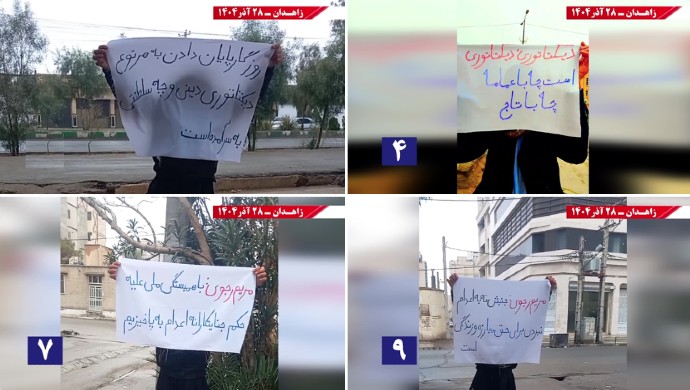

On December 19, PMOI Resistance Units in Zahedan, southeast Iran, launched a new wave of political activities and street protests, turning the city into a scene of confrontation against all forms of dictatorship. In a bold display of defiance, these activists reiterated their commitment to establishing a free and democratic republic, explicitly rejecting both the current clerical regime and the remnants of the past monarchical dictatorship.
These actions occur as the regime intensifies psychological warfare and executions to suppress public anger. The Resistance Units emphasized that the only path forward is an organized uprising to overthrow the regime. Their placards carried a clear message to political opportunists: “Anyone who thinks they can hijack the new democratic revolution of Iran like the constitutional and anti-monarchic revolution is badly mistaken.”
December 19—Zahedan, southeast Iran
PMOI Resistance Units resume activities, condemning the regime's corruption and repression and reiterating their commitment to the establishment of a free and democratic republic that rejects all forms of dictatorship. pic.twitter.com/f2a2Kyrg9p— People's Mojahedin Organization of Iran (PMOI/MEK) (@Mojahedineng) December 20, 2025
Strategic pillars of the uprising
The activities in Zahedan highlighted three core principles of the resistance’s strategy: overthrowing the rule of the mullahs, drawing a clear red line against both the Shah and the mullahs, and enforcing the separation of religion from the state. Slogans such as “No Turban, No Crown” and “A dictator is a dictator, whether with a turban or a crown” resonated through the protests, signaling that Iranian society is looking forward, not backward.
By amplifying the messages of Maryam Rajavi, the Resistance Units stressed that “artificial alternatives” have no place in Iran’s future. They declared that the era of dictatorship is over and that the people demand a republic founded on gender equality, freedom of religion, and the abolition of the death penalty.
"The era of any form of dictatorship, whether religious or monarchic, is over" pic.twitter.com/YsoyYdtGpW
— People's Mojahedin Organization of Iran (PMOI/MEK) (@Mojahedineng) December 20, 2025
Confronting the machine of death
A central theme of the protests was the “No to Executions” movement. Resistance Units displayed banners reading, “We must break Khamenei’s strategy of mass executions,” identifying capital punishment as the regime’s primary tool for governance and preventing protests.
This resistance defies a grim reality. According to reports gathered by the Iranian Resistance, more than 2,000 people were executed in Iran in 2025, a wave of state-sanctioned killing unprecedented since the 1988 massacre. In November 2025 alone, the regime hanged 335 people. Currently, 18 political prisoners supporting the Mojahedin are on death row. Despite this, the resistance notes that what is growing inside Iran is not fear, but resilience, inspired by the “No to Execution Tuesdays.”
"We must break Khamenei's strategy of mass executions" pic.twitter.com/zkiobuxbBf
— People's Mojahedin Organization of Iran (PMOI/MEK) (@Mojahedineng) December 20, 2025
Economic collapse and the third solution
The Resistance Units also addressed the severe livelihood crises, exposing the class divide where “ruling thieves live in ultra-luxury while the tables of the deprived grow emptier.” They warned of impending gasoline price hikes and condemned the regime for plundering national wealth for missile programs and repression while the country faces critical water shortages and infrastructure collapse.
The PMOI argues that the West must abandon the policy of appeasement. The “Third Option” offered by the resistance is neither foreign war nor concession, but regime change by the Iranian people and their organized resistance. As the younger generation increasingly gravitates toward the resistance, the regime stands at a dead end. The activists in Zahedan concluded with a final, decisive verdict: “The religious dictator must be torn apart, limb by limb.”