

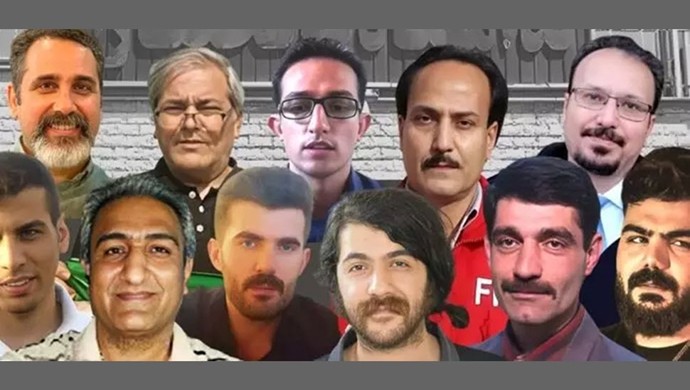

Thirteen political prisoners in Ghezel Hesar Prison, Karaj, have been deprived from making phone calls and visiting family since Wednesday, September 20, at the behest of the prison’s criminal director.
According to the human rights website HRANA, an informed source close to the family of one of the prisoners said that on Monday, September 25, “The families of these prisoners went to the prison to visit them. The families were told that Ashkan Kamali, the head of Ghezel Hesar prison, had forbidden these prisoners to visit and that they were not allowed to have contact with anyone outside the prison.
Authorities said that the prisoners “will serve their sentences without observing the principle of separation of crimes in Ghezel Hesar Prison in Karaj.”
The prisoners were removed from Unit 3 of Ghezel Hesar prison without prior notice and, under the prison warden’s order, were transferred to the Dar al-Quran Hall of Unit 4 of this prison, where drug-related offenders are held. They were not allowed to take their personal belongings.
On September 3, the regime forcibly transferred these political prisoners from the Evin Prison in Tehran to Ghezel Hesar in Karaj. They were beaten and handcuffed during the transfer. Prison authorities did not allow the prisoners to take their belongings, and the prisoners’ belongings were smashed or looted in Ward 8 of Evin prison.
The prisoner are Loghman Aminpour, Saeed Masouri, Afshin Baymani, Sepehr Emam Jomeh, Zartosht Ahmadi Ragheb, Mohammad Shafei, Saman Seyedi (Yasin), Hamzeh Savari, Kamyar Fakoor, Ahmadreza Haeri, Reza Salmanzadeh, Jafar Ebrahimi and Masoud Reza Ebrahiminejad. Some of these prisoners have been behind bars for decades while others were arrested and imprisoned during the 2022 uprising.
After the transfer to Ghezel Hesar, the prisoners were confined in two cells that are designated as quarantine cells for death row prisoners who are awaiting execution.
The cells were extremely small, with limited space for sleeping. The prisoners were forced to rest in the corridor and near the restrooms. The prisoners started a hunger strike in protest to the regime’s inhuman behavior.
In an open letter, Saeed Masouri, one of the political prisoners who was forcibly transferred to Ghezel Hesar, described the facility as a “black hole” in which the regime’s supreme leader and the head of judiciary “throw the people of this land from old to young to burn in their fire.”
According to Masouri, there is “no minimum provision for nutrition, hygiene, medical care, or even a half-meter space to sit. They pack 15 to 16 people in a room of approximately nine square meters. The prisoners have no right to even the slightest protest. There is no water, no food, and no decent human clothing.”