

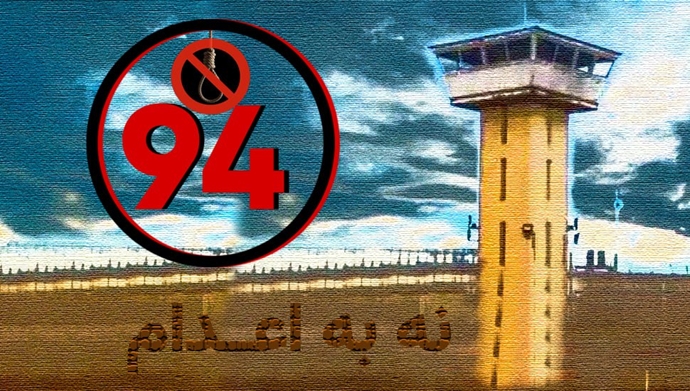

On November 11, 2025, the “No to Executions Tuesdays” campaign marked its 94th consecutive week of defiance against Iran’s ruling theocracy, expanding its reach as the men’s ward of Zahedan Prison joined the coordinated hunger strikes. The movement, which began in January 2024, now encompasses inmates in 54 prisons across the country.
In a powerful display of national solidarity, the prisoners’ protest was mirrored by street demonstrations in dozens of Iranian cities. Citizens, activists, and the families of political prisoners took to the streets to demand an end to the regime’s rampant use of capital punishment, transforming the weekly campaign into a nationwide movement of resistance.
A staggering surge in state-sanctioned killings
The growing protests come in response to a dramatic escalation in executions by the regime. According to figures released by the campaign, Iranian authorities have executed over 1,313 people since the start of the Persian year on March 21, 2025.
The pace of these killings has intensified alarmingly in recent weeks. Since October 23, 2025, at least 165 people have been executed. The past week alone saw the execution of 72 people, including one woman. On November 2 and 3, the state executed 29 people in just 48 hours, highlighting what the campaign’s statement called a “frenzied” use of the death penalty to instill fear and suppress dissent.
Voices of defiance from behind prison walls
In their statement for the 94th week, the prisoners honored the victims of the November 2019 uprising and highlighted the cases of individuals currently at risk. They raised alarm over the death sentence issued for Reza Abdali, an Ahvazi Arab political prisoner, and the unknown fate of security prisoners Ehsan Afreshteh and Mehdi Farid, who were beaten and transferred from Evin Prison.
The statement also connected the regime’s oppressive atmosphere to acts of desperation among ordinary citizens, citing the recent self-immolations of Kourosh Kheyri, a fired driver, and Ahmad Baledi, a student whose kiosk was destroyed by authorities. Declaring their unwavering opposition to the regime’s machinery of death, the prisoners stated, “No government can silence the loud voice of truth, justice, and freedom with executions.”
They issued a stark warning to the international community and the Iranian people, asserting that “inaction and silence are tantamount to the taking of innocent and defenseless lives in the prisons of the ruling, bloodthirsty mullah’s regime.”
Solidarity protests erupt across the nation
In tandem with the prisoners’ hunger strike, protests were held in dozens of cities, including Tehran, Ahvaz, Kermanshah, Rasht, Karaj, Dezful, and Sanandaj. Despite heavy security presence, demonstrators held placards with slogans such as “Stop the Executions” and “Freedom for Political Prisoners.”
Protesters also chanted more radical slogans, reflecting a hardening public stance against the regime. Chants like “We swear by the blood of our comrades, we will stand until the end to abolish the death penalty,” and a direct warning to the leadership—”We warn the tyrant [Dahhak], stop executing the youth and leave Iran”—were reported from the gatherings.
The synchronized protests inside and outside prison walls signal a significant shift, demonstrating that the demand to end capital punishment has transcended prison walls to become a unified national call for justice and human rights.
Prisoners are participating in the “No to Executions Tuesdays” hunger strike in the following 54 prisons: Evin (wards 6 and 7), Ghezel Hesar (units 2, 3, and 4), Karaj Central, Fardis, Greater Tehran, Qarchak, Khorin, Qazvin, Ahar, Arak, Qom, Khorramabad, Borujerd, Yasuj, Asadabad, Dastgerd, Sheiban Ahvaz, Sepidar Ahvaz (men’s and women’s), Nezam Shiraz, Adelabad Shiraz (men’s and women’s), Firozabad, Dehdasht, Zahedan (men’s and women’s), Borazjan, Ramhormoz, Behbahan, Bam, Yazd, Kahnuj, Tabas, Mashhad, Sabzevar, Gonbad-e Kavus, Ghaemshahr, Rasht (men’s and women’s), Rudsar, Havigh, Azbaram, Dizelabad Kermanshah, Ardabil, Tabriz, Urmia, Salmas, Khoy, Naqadeh, Miandoab, Mahabad, Bukan, Saqqez, Baneh, Marivan, Sanandaj, Kamyaran, and Ilam.