


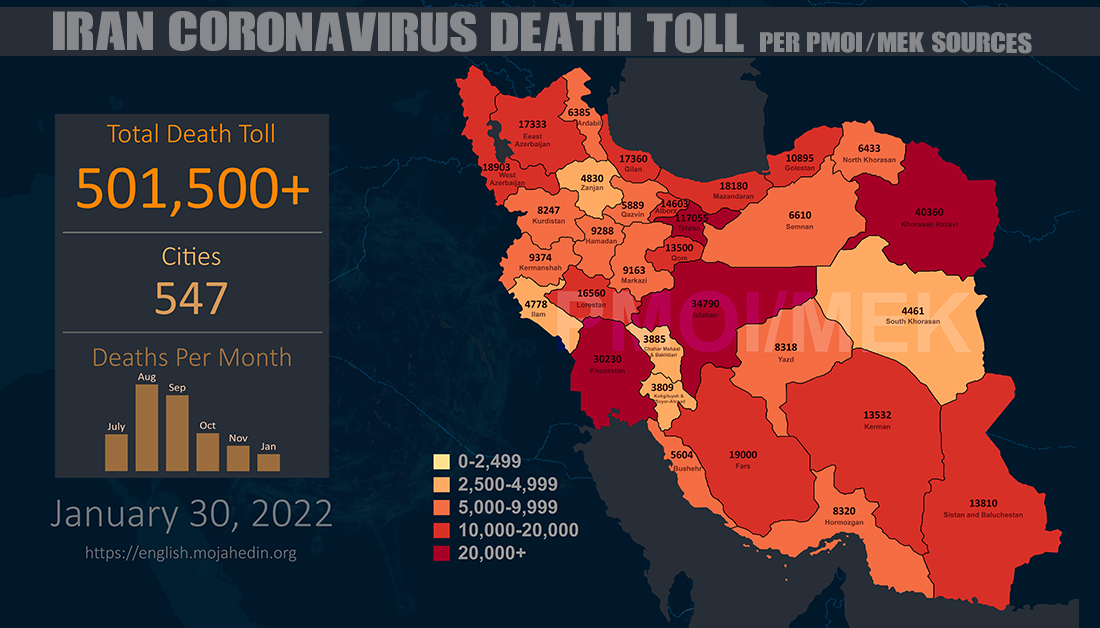
Over 501,500 people have died of the novel coronavirus in 547 cities checkered across all of Iran’s 31 provinces, according to reports tallied by the Iranian opposition People’s Mojahedin Organization of Iran (PMOI/MEK) as of Sunday afternoon local time, January 30. The official death toll declared by the regime stands at 132,274, around a fourth of the actual figure.
The coronavirus death toll in various provinces include: 117,055 in Tehran, 40,360 in Razavi Khorasan, 34,790 in Isfahan, 30,230 in Khuzestan, 19,000 in Fars, 18,858 in West Azerbaijan, 18,180 in Mazandaran, 17,360 in Gilan, 17,273 in East Azerbaijan, 16,560 in Lorestan, 14,603 in Alborz, 13,532 in Kerman, 13,500 in Qom, 10,895 in Golestan, 9288 in Kermanshah, 9258 in Hamedan, 9163 in Markazi (Central), 8318 in Yazd, 8320 in Hormozgan, 6610 in Semnan, 5604 in Bushehr, 4446 in South Khorasan, and 3809 in Kohgiluyeh & Boyer Ahmad. This is in addition to reports obtained from other provinces.
The regime’s Health Ministry announced the mullahs’ engineered Covid-19 numbers from the past 24 hours on Saturday as 21,996, indicating a 400 percent rise in comparison to last Sunday.
Following a new wave spreading across the country, regime President Ebrahim Raisi voiced a new emphasis on censorship of news in this regard. “Any reporting on coronavirus must be with the full and precise coordination in order to provide information while refraining from causing concern among the public,” he said on Saturday.
“At the beginning of this sixth coronavirus peak, all provinces are reporting Covid deaths and there is a significant increase in the number of people being hospitalized in some provinces. This increase can lead to an increasing number of ICU patients, and as a result, a rising number of coronavirus deaths,” according to a report wired on Sunday by the semi-official ISNA news agency.
“We are witnessing an escalating rise in the omicron wave”
A new rise of three-digit coronavirus death toll shouldn’t surprise us. Now is the time to make decisions. It will be too late once we reach the peak,” said the secretary of Iran’s Epidemiology Committee on Friday, according to the semi-official ISNA news agency.
“Tehran has entered the sixth coronavirus peak. The total number of people hospitalized stands at around 1300, of which one-fourth are in ICUs. Coronavirus contraction is increasing among kids under the age of ten,” said Nader Tavakoli, deputy chair of the Tehran Covid-19 Task Force on Sunday, according to the semi-official ISNA news agency.
“Coronavirus conditions are currently out of control and the number of new cases is rising. Our status quo is the result of wrong decisions making by the institutions in charge. Our circumstances were forecasted in the past weeks but unfortunately, as always, we have been caught off guard. The number of cases doubles every three days, and we will reach the peak in three or four weeks,” said the chair of the Mashhad Medical Apparatus Organization on Sunday, according to the semi-official ISNA news agency.
“During the past 24 hours, the number of people seeking initial medical care has reached the 1400 mark. The number of patients hospitalized has significantly increased to 237 people,” said the spokesperson of Alborz Medical Sciences University on Sunday, according to the semi-official ISNA news agency.
“The number of cases in the past ten days has risen by 275 percent and those being quarantined by 300 percent,” said the governor of Izeh, a city in Khuzestan province, southwest Iran, on Sunday, according to the Mehr news agency, an outlet linked to the regime’s Ministry of Intelligence and Security (MOIS).
“The record number of coronavirus cases has reached three digits again after a few months. Today we had 113 positive test results,” according to a report released on Sunday by the Ilam Medical Sciences University.
“Coronavirus has once again begun its spread across [Gilan] province and the number of people being hospitalized has doubled in the past days, indicating the threat of a returning wave,” according to a report wired on Sunday by the official IRNA news agency.
“Considering the fact that the cities of Natanz, Kashan, and Aran & Bidgol are registered as red and orange areas, elementary schools in these areas will be closed and classes conducted online. Isfahan is an orange (dangerous) zone. However, considering the concerns of negatively impacting the government’s general policies, holding classes online will be based on an agreement from Tehran,” said the deputy governor of Isfahan, according to the Mehr news agency.