

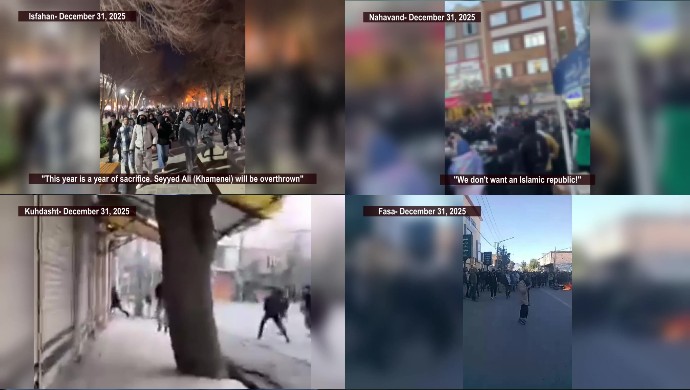

On Wednesday, December 31, 2025, the nationwide uprising of Iranian market merchants and youth entered its fourth consecutive day, intensifying in scope and ferocity. What began as an economic protest against the collapse of the national currency has rapidly transformed into a full-scale political confrontation with the clerical regime. Reports from across the country indicate that strikes have spread from the capital, Tehran, to major provincial hubs and smaller cities, defying a heavy security crackdown.
The situation escalated significantly in Fasa, Fars Province, where security forces opened fire on protesters who had stormed the governorate building. The regime’s attempt to quell the unrest with brute force, coupled with hollow promises of “dialogue,” appears to have only fueled the public’s resolve, as the traditional economic backbone of society joins the call for regime change.
Escalation and clashes: The battle for Fasa
On Wednesday, the city of Fasa became a flashpoint for the uprising. According to reports from the scene, the protests turned into a direct confrontation with suppression forces. Defiant youth and outraged citizens gathered in front of the governorate building, chanting slogans against the government. The situation deteriorated when protesters managed to break down the doors of the governorate and enter the building.
December 31—Fasa, southern Iran
On the 4th day of widespread protests across Iran, youth in Fasa held intense protests in front of the governorate building, clashing with security forces.#IranProtests pic.twitter.com/66qmhC2cYn— People's Mojahedin Organization of Iran (PMOI/MEK) (@Mojahedineng) December 31, 2025
In a desperate bid to regain control, Islamic Revolutionary Guard Corps (IRGC) units and security forces opened fire on the unarmed crowds. Video footage and reports indicate that agents fired directly at protesters. Despite the use of live ammunition, the people of Fasa continued to resist, forcing some armed security units to retreat in certain areas. To instill fear, the regime deployed military helicopters to patrol the skies over the city.
While the state-run Mehr News Agency, quoting an “informed source,” denied any deaths and claimed the situation was “managed,” they admitted that protesters had breached the entrance of the governorate. However, local reports suggest casualties.
December 31—Fasa, southern Iran
Security forces open fire on unarmed protesters who had gathered in front of the governorate.#IranProtests pic.twitter.com/77XsIIfD5k— People's Mojahedin Organization of Iran (PMOI/MEK) (@Mojahedineng) December 31, 2025
Nationwide strikes: The bazaar stands still
While street clashes erupted in Fasa, the economic heart of Iran remained in a state of paralysis. In Tehran, the Grand Bazaar saw a heavy deployment of security forces, particularly in the Hammam-Chal district and near the Parsian Passage. Reports indicate that the regime has flooded the market with agents to the point where even two people standing together are dispersed. Security forces fired tear gas in the Delgosha Passage to break the resolve of the merchants, but the strike held firm.
December 31—Iran
The fourth day of uprisings began with general strikes in multiple cities:
Tehran: Complete strike in the Cheragh Bargh bazaar
Isfahan: Complete strike in the mobile-phone market on Bozorgmehr St.
Ramhormoz: Mobile-phone market strike
Asadabad (Hamadan province):… pic.twitter.com/5zOayJK2QA— People's Mojahedin Organization of Iran (PMOI/MEK) (@Mojahedineng) December 31, 2025
Merchants in Tehran are paying a heavy price for their defiance. Shopkeepers in prime locations, who face monthly rents between 1.5 billion and 2.5 billion rials, are incurring daily losses of 100 to 150 million rials by keeping their shutters down. Yet, as one report noted, “This is real protest; when the entire market is in a state of strike and resistance.”
The strikes were not limited to the capital.
- Kermanshah: A total strike was observed across the Gold Market, Modarres Passage, Valiasr Passage, and the Islamic Bazaar. The regime deployed a line of suppression forces stretching approximately 8 kilometers from Ferdowsi Square to the Garage area. Reports confirmed the brutal beating of a shopkeeper near the Arg Passage, proving that the regime’s talk of “dialogue” is merely a cover for violence.
- Isfahan: Strikes hit the mobile phone market on Bozorgmehr Street and areas around Naqsh-e Jahan Square. A brave woman was filmed shouting “Death to the Oppressor” in the city center.
- Shiraz: The Vakilabad bazaar and markets on Kazemi Street were largely closed.
- Other Cities: Complete or partial strikes were reported in Tabriz (where merchants were threatened with arrest), Ramhormoz, Asadabad (Hamadan), Shirvan (where teachers joined the protests), Dorud, Yasuj, Arak, Dehloran, Kuhdasht, Ganaveh, and Dargahan (Qeshm).
December 31—Dehloran, western Iran
Bazaar merchants join strikes and protests on fourth day of nationwide protests.#IranProtests #IranRevolution #FreeIran pic.twitter.com/Qb1SFLGObP— People's Mojahedin Organization of Iran (PMOI/MEK) (@Mojahedineng) December 31, 2025
Regime’s panic: Militarization and hollow threats
The rapid spread of the uprising has triggered panic within the regime’s leadership. In a significant move on Wednesday, Supreme Leader Ali Khamenei appointed IRGC Brigadier General Ahmad Vahidi as the Deputy Commander of the IRGC. Vahidi is a notorious figure, the first commander of the terrorist Quds Force, and is wanted internationally for his role in the AMIA bombing in Argentina. His appointment signals the regime’s intent to crush the protests with military force.
Simultaneously, the regime is attempting to prevent university students from joining the uprising. Beheshti and Allameh Tabataba’i universities in Tehran announced that all classes would be held online until the end of the term, citing “cold weather” and “energy shortages.” Student organizations have dismissed these reasons as excuses to empty campuses and prevent gatherings.
December 31—Tehran, Iran
Regime is deploying armored vehicles to quell protests while the government claims that it intends to address the demands of the people who have been demonstrating for four days.#IranProtests pic.twitter.com/fe8SSynZez— People's Mojahedin Organization of Iran (PMOI/MEK) (@Mojahedineng) December 31, 2025
On the judicial front, Prosecutor General Mohammad Movahedi-Azad warned protesters that any action deemed as “security disruption” would be met with “decisive action.” Furthermore, the Basij organization announced “neighborhood-centered” drills scheduled to run from January 3 to April 2026, a clear attempt to militarize residential areas and intimidate the public.
Economic collapse fueling political fire
The current uprising is rooted in a catastrophic economic collapse. By late 2025, the value of the US dollar reached approximately 1,450,000 rials, and the official annual inflation rate surpassed 42 percent. Food prices have soared by 72 percent, destroying the purchasing power of the people and the viability of businesses. The elimination of subsidies and the introduction of a triple-tiered fuel pricing system have further enraged the public.
However, the slogans chanted in the streets prove that the grievances have moved far beyond economics. In Izeh, the mother of executed protester Mojahed Korkor joined the crowds chanting “Death to Khamenei.” In Kermanshah, youth chanted “No Gaza, No Lebanon, My Life for Iran” and “Death to the oppressor, be it the Shah or the Leader.”
December 31—Tehran, Iran
Mass demonstrations in Tehran bazaar as protesters refuse to back down in face of presence of repressive security forces.#IranProtests pic.twitter.com/9ZSq8xSIGR— People's Mojahedin Organization of Iran (PMOI/MEK) (@Mojahedineng) December 31, 2025
The Bazaar has now decisively turned against the regime. This shift represents a profound fracture in the regime’s traditional support base. As the government spokesperson speaks of “dialogue,” the people in the streets of Iran’s cities have a different answer: “Fire answers fire.”