

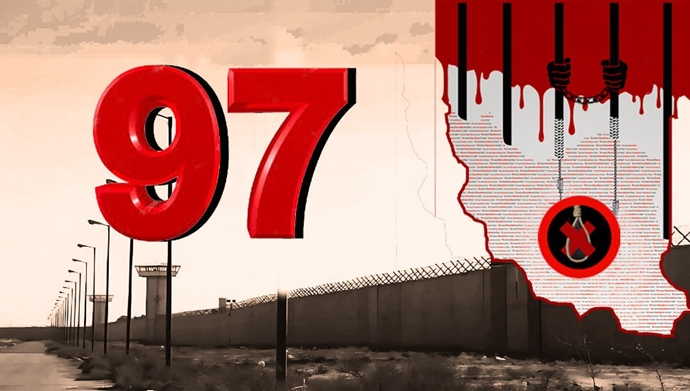

On Tuesday, December 2, 2025, political prisoners across Iran launched the 97th consecutive week of the “No to Executions Tuesdays” hunger strike. The campaign, which has expanded to 55 prisons nationwide, comes amidst a drastic surge in the implementation of death sentences by the Iranian regime. According to the campaign’s latest statement, the judiciary has executed nearly 100 individuals, including two women, in just the last ten days alone.
The striking prisoners reported that since the beginning of the Persian calendar year in March 2025, the total number of recorded executions has reached 1,564. The statement described this figure as “unprecedented in the past three decades,” noting that authorities even carried out a public execution recently to instill terror in society.
Student day and the targeting of youth
As the country approaches Student Day on December 7 (16 Azar), the campaign emphasized the pivotal role of university students in the struggle against dictatorship. The prisoners’ statement highlighted the case of Ehsan Faridi, a 23-year-old student and political prisoner currently facing a death sentence on charges of “seeking freedom.”
97th Week of #NoToExecutionTuesdays | Dec 2, 2025
24 executed this week across 13 cities.
Student prisoner Ehsan Faridi, 23, now faces a death sentence.
“Repression has not stopped the struggle for freedom.”
#Iran pic.twitter.com/9NGRaoMdg9— SIMAY AZADI TV (@en_simayazadi) December 2, 2025
“Repression, imprisonment, and execution have not been able to stop students on the path of fighting for freedom,” the statement read. “Right in these days, the university is once again the target of tyranny’s attack… Ehsan Faridi’s life is in danger.”
The prisoners also paid tribute to victims of “enforced disappearances,” specifically naming Saeed Zeinali, a student who disappeared following the raid on the University of Tehran dormitories in July 1999 and has not been heard from since.
Protests spread to city streets
While prisoners observed their hunger strike, citizens in dozens of cities organized protests in solidarity with the campaign. According to human rights monitors, rallies took place in Tehran, Karaj, Mashhad, Tabriz, Shiraz, Isfahan, Rasht, and numerous other locations.
Demonstrators chanted slogans directly challenging the regime’s use of capital punishment as a tool for political survival. Slogans recorded on Tuesday included “Death to the dictator executioner,” “Execution is the regime’s tool for survival,” and “No prison, no exile, no execution.”
Protesters also raised the names of specific political prisoners at risk, chanting “Student prisoner Ehsan Faridi must be freed,” “No to the execution of boxing champion Mohammad Javad Vafaei Thani,” and “No to the execution of Babak Alipour.”
December 2—Iran
In the nationwide "No to Executions Tuesdays" campaign, citizens in Tehran, Isfahan, Mashhad, Shiraz, Tabriz and other cities rally to reject death sentences, chanting "No to executing anyone" and "Stop the executions."#IranProtests pic.twitter.com/4PukYRC9DR— People's Mojahedin Organization of Iran (PMOI/MEK) (@Mojahedineng) December 2, 2025
A national demand for justice
The “No to Executions Tuesdays” campaign, which began in January 2024, has evolved from a prison-based protest into a nationwide movement. Analysts cited in reports from inside Iran suggest that the persistence of the weekly strikes represents a qualitative shift in society, where “the demand for justice has replaced revenge, and the cry for life has replaced the culture of execution.”
In their statement, the prisoners urged international bodies and student activists to support those on death row to ensure that “the main lever of repression is taken out of the hands of the Velayat-e Faqih regime.”