

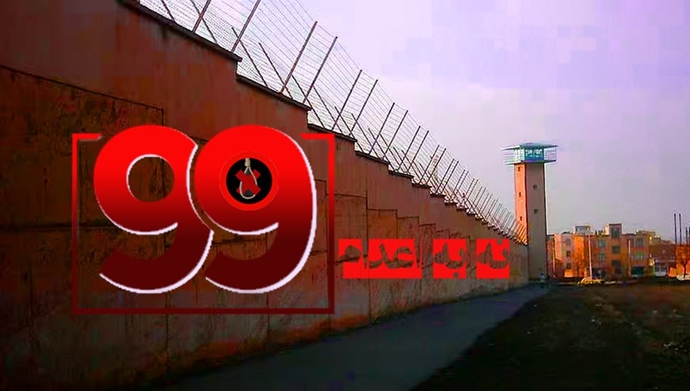

In a coordinated act of defiance against the Iranian regime’s accelerating use of capital punishment, political prisoners across 55 detention centers launched a hunger strike on Tuesday, December 16, 2025. Marking the 99th consecutive week of the “No to Executions Tuesdays” campaign, the strike comes as authorities carried out at least 67 executions in the past week alone.
While December 16 is observed globally as a day for reconciliation and ending violence, the campaign’s latest statement highlighted the stark contrast inside Iran. “In Iran, the despotic government continues to replace justice and dialogue with the noose at a terrifying speed,” the prisoners wrote. They emphasized that the regime’s actions have nullified any chance of social peace, stating, “Reconciliation is impossible without truth and justice, and execution is the negation of justice and the absolute negation of any possibility of social reconciliation.”
Surge in death sentences and executions
The judiciary’s use of capital punishment has intensified significantly in recent weeks. Since November 22, 2025—the beginning of the Persian month of Azar—the regime has sent approximately 271 individuals to the gallows. The statement notes that these executions are carried out “without fair trials, without effective access to independent lawyers, and in media silence,” characterizing the trend as the “institutionalization of execution as a tool for political and social repression.”
The campaign highlighted several specific cases of political prisoners targeted this week. Ramin Zaleh, a political prisoner in Naqadeh Prison, was sentenced to death by the Mahabad Revolutionary Court on charges of “Baghi” (rebellion). Additionally, the death sentences for six members of the “No to Executions” campaign detained in Ghezel Hesar Prison—Babak Alipour, Pouya Ghobadi, Vahid Bani Amerian, Akbar (Shahrokh) Daneshvar-Kar, Mohammad Taghavi, and Abolhassan Montazer—were re-issued by Branch 26 of the Tehran Revolutionary Court.
Protests spread to city streets
Simultaneous with the prison strikes, protests erupted in numerous cities on Tuesday, turning the prisoners’ demand into a nationwide call for justice. Demonstrations were reported in dozens of locations, including Tehran, Karaj, Isfahan, Shiraz, Tabriz, Rasht, Yazd, and Zahedan.
Participants, including students and families of political prisoners, held placards bearing the names of those at risk of execution, such as Manouchehr Fallah, Zahra Tabari, and Karim Khojasteh. The protesters chanted slogans directly challenging the regime’s reliance on capital punishment, including “This is the last message; if you execute, there will be an uprising” and “The hangman’s noose no longer works.”
The “No to Executions Tuesdays” campaign, which began in January 2024 as a reaction to a wave of executions, has evolved into a resilient social movement. According to human rights activists, the consistent participation of diverse social groups—from “seeking families” demanding justice for their loved ones to university students—demonstrates that the demand to abolish the death penalty has transcended prison walls and become a central demand of Iranian society.
Prisoners participating in the 99th week of the hunger strike are incarcerated in 55 facilities, including Evin (Women’s and Men’s wards), Ghezel Hesar, Greater Tehran, Karaj Central, Mashhad, Zahedan, Urmia, Tabriz, Rasht, Shiraz (Adelabad and Nezam), and Ahvaz (Sheiban and Sepidar).