

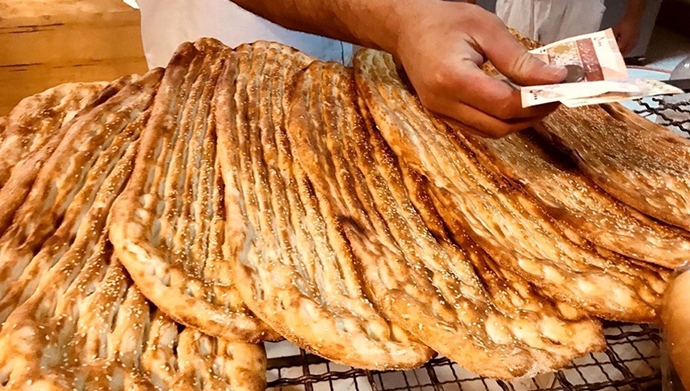

After several months of instability, deception, and gradual price increases in many provinces of Iran, on September 9 state-run media outlets announced a “40 to 66 percent increase in the official price of Lavash, Barbari, and Sangak bread in Tehran.”
On September 9, ISNA news agency wrote, “The price of Sangak bread, which was 3,000 tomans, has now reached 5,000 tomans… Lavash bread made with first-grade flour has increased from 5,000 to 7,000 rials… Barbari bread, which is made with government-subsidized first-grade flour, has risen from 18,000 to 25,000 rials… Khorasani Taftoon bread made with subsidized first-grade flour has also increased from 10,000 to 14,000 rials.”
What is shocking and painful is that even these new figures are unreliable, and a regime-affiliated website revealed that “the bread prices in Tehran announced by officials differ from what is actually sold, and the price of bread is higher than what the authorities claim” (Source: Aftab News website, September 9).
The Government’s Double-Dealing
The official increase in bread prices in the capital comes at a time when the government is buying wheat from farmers at an extremely low price and has not paid the full amount owed for the received wheat for months. This means the government sells wheat at higher prices to bakers and the public, while simultaneously purchasing it from farmers below its real value.
The deputy head of the Agricultural Commission of the regime’s Chamber of Commerce exposed the government’s theft from farmers, revealing that although some payments were made to wheat farmers, “the method of payment ended up being to the detriment of the farmers.”
This regime official disclosed that first, “The former minister, without any justification or expert explanation, reduced the price approved by the pricing council by 20,000 rials.” In other words, the approved price of 190,500 rials per kilogram of wheat was bought at 170,500 rials per kilogram, effectively stealing billions of tomans from farmers. Secondly, “Due to the challenges faced by this group, disorganized payments prevented them from properly investing these amounts,” and thirdly, even though the new farming season is about to begin, “unfortunately, even with this partial payment method, some of last year’s payments remain unpaid” (Source: Bazaar news website, September 9).
According to the regime’s laws, the guaranteed purchase price of wheat from farmers for the new agricultural year should have been announced by the end of July. However, through delaying tactics and exerting pressure on farmers, the regime sought to lower the wheat price as much as possible. Finally, after several unproductive meetings, on Sunday, September 8, the regime’s Minister of Agriculture announced that the purchase price for wheat for the coming year was set at 205,000 rials.
Farmers have responded by saying that given the inflation and high costs, selling wheat for less than 300,000 rials would result in losses. In summary, under these conditions, farmers will only experience more poverty and deprivation. Meanwhile, the regime, as it increases bread prices, continues to exploit hardworking wheat farmers without the slightest compassion or mercy.
Snatching “Dry Bread” from People’s Mouths
In recent years, the tables of Iranian households have become increasingly empty due to growing poverty. In many protests and demonstrations held by various groups in front of the regime’s exploitative centers, workers and retirees spread out long, empty tables to symbolically and visibly display their cries for justice. Yet, the regime has turned a deaf ear to these protests, responding to every dissent with repression.
In this miserable situation, bread has become the only available food and the primary source of energy—or survival—for most of the Iranian population. Without it, even the empty tables lose their purpose. Those living several steps below the poverty line cannot afford other essential food items like meat, dairy, and vegetables, making the rising cost of bread a matter of life and death for them.
There is no doubt that this price increase will affect all food items and intensify the anger and unrest across various social classes. Retirees, nurses, workers, oil industry laborers, farmers, and all other groups who have taken to the streets in recent months will become poorer due to the rise in the cost of their basic staple, and thus more enraged. With this criminal act, the Pezeshkian government is actively creating more explosive conditions for a nationwide uprising.
A few years ago, the regime Supreme Leader Ali Khamenei instructed the Iranian people to learn from the Yemenis, saying, “They wear rags instead of clothes and eat dry bread.” Now, the reactionary president is intent on taking even that “dry bread” from the mouths of the nation.