

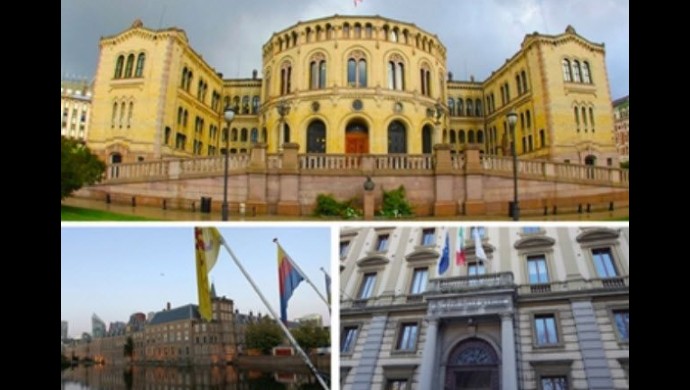

As we approach of the annual grand gathering of the Iranian Resistance, parliamentary majorities in the legislative bodies of Estonia, the United Kingdom, Italy, Belgium, Malta, Moldova, Norway, Wales, the Netherlands, and the Canton of Geneva supported the democratic alternative for regime change in Iran and the establishment of peace in the Middle East.
The parliamentary majorities, which generally include representatives of various parties in these countries as well as the heads of parliamentary committees, condemned the gross violations of human rights, particularly the suppression of women in Iran, and have called for accountability for those responsible for the 1988 massacre of more than 30,000 political prisoners.
These statements emphasized the following:
– The Iranian people deserve a democratic state. We urge all governments to support the Ten-Point Plan proposed by Mrs. Maryam Rajavi, the President-elect of the NCRI, for a democratic republic based on the separation of religion and state and gender equality.
– The Iranian regime has blocked all avenues for political activity aimed at change; therefore, the free world must recognize the Iranian people’s right to uprising and the right of Resistance Units to counter the IRGC.
– We strongly condemn the Iranian regime’s destructive role in the Middle East and its warmongering policies, and call for the designation of the IRGC as a terrorist organization and the implementation of oil sanctions against the regime.
– We strongly condemn the Iranian regime’s actions against Iranian dissidents at Ashraf-3 in Albania and affirm their rights under the 1951 Geneva Convention and the European Convention on Human Rights.
– Iran holds the world record for executions relative to its population. In 1988 alone, following a decree by Supreme Leader Khomeini, 30,000 political prisoners were massacred within weeks for their devotion to the People’s Mojahedin Organization of Iran (PMOI).
– The Iranian regime, through a sham and in-absentia trial, aims to pave the way for terrorist actions against the leadership of the resistance and 100 members of the PMOI, particularly in Europe. It also pressures Europe to restrict the opposition, especially at Ashraf-3 in Albania. The regime’s judiciary is Supreme Leader Khamenei’s tool for suppression, murder, and terrorism.
– The ruling religious dictatorship in Iran cannot be reformed. The Iranian people rejected all forms of dictatorship, both monarchical and religious, during the 2022 uprising and called for regime change to establish a democratic republic.
– The people of Iran have been deprived of all political and civil rights. The preface of the Universal Declaration of Human Rights emphasizes that “human rights should be protected by the rule of law so that man is not compelled to have recourse, as a last resort, to rebellion against tyranny and oppression.”
– Europe has become a hotbed for Iranian state terrorism. In February 2021, a Belgian court in Antwerp sentenced an Iranian diplomat in service to 20 years in prison for attempting to bomb the annual gathering of the National Council of Resistance of Iran (NCRI) near Paris.
– The Iranian regime is a driving force in Middle Eastern conflicts and attacks on free shipping and trade in the Red Sea. The head of the snake lies in Iran. The Islamic Revolutionary Guard Corps (IRGC) and its proxy groups are spreading terror and hindering peace and security in the region and the world.