

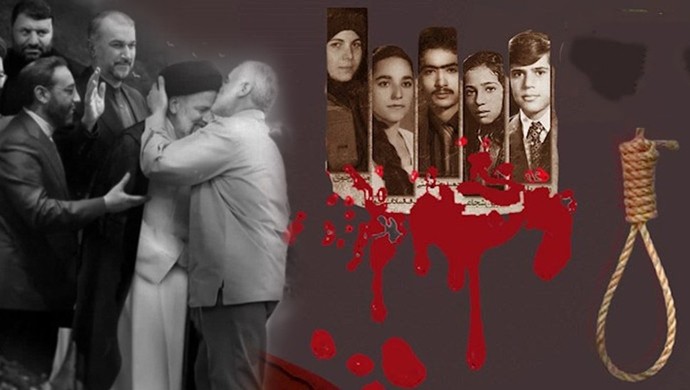

The collective memory and socio-political recollections of the Iranian people regarding the rule of the mullahs have become a curse to their existence and credibility.
The officials of Iran’s regime have so thoroughly destroyed humanity, words, and human rights that no amount of their propaganda will amend the reputation of the living or dead officials of this regime.
The current frenzied propaganda to restore the reputation of a deceased executioner has this exact nature.
The media of the mullahs’ regime are fully engaged in propagandizing to sanitize Iranian regime president Ebrahim Raisi to portray him as free of any crime or atrocity and to create a mythological figure out of him.
The extent of this propaganda is so unnatural and sometimes excessive that we have not seen a similar case for other deceased officials of the regime.
What truly is the reason and objective behind this?
By launching propaganda around Raisi, the regime is acknowledging the deep-rooted problem it has with the public memory toward him.
Iranian regime supreme leader Ali Khamenei knows that, in the collective memory of the Iranian people, Raisi in general and the Death Committee of the 1988 massacre specifically are deeply hated and regarded as criminals.
By spreading propaganda around Raisi, the regime intends to deviate the collective memory of Iranians and rewrite history.
The regime understands the “Justice Seeking Movement” for the victims of the 1988 massacre has made significant inroads domestically and internationally, with witnesses and legal evidence suggesting that bringing the executioners to an international court is not far-fetched.
The regime has the precedent of the fate of Hamid Noury, a key figure in the 1988 massacre in Gohardasht prison, and the widespread domestic and international Iranian support for his conviction before their eyes.
Moreover, Noury was a mere agent of the 1988 Death Committee. Hence, one can understand the extent of hatred for Ebrahim Raisi and the frenzied propaganda efforts by Khamenei.
To mock the collective memory of the Iranian people regarding the executioners of political prisoners, the regime appointed Raisi as president and purged the regime from anyone who was not absolutely loyal to the supreme leader.
The hysterical propaganda these days to sanitize Raisi and mythologize him is precisely regime’s declaration of war against the memory of the Iranian people.
Now, the regime has turned to frenzied propaganda for a member of the Death Committee, and ironically, the Iranian people are disgusted and repulsed by this very propaganda for an executioner.
The fear and terror of the mullahs’ regime regarding the indomitable public memory of the Iranian people is the result of a comprehensive 45-year-long resistance movement.
The unwavering efforts to expose and illuminate the details of the regime’s atrocities, specifically the Death Committee of the 1988 massacre, the undeniable evidence of thousands of political prisoners and victims of misogyny, bringing the Death Committee’s role to international forums, and the expansion of the justice-seeking movement in these areas, all have contributed to the collective memory of Iranians.
No army, technology, or propaganda machine, regardless of the staggering costs, can defeat or destroy it. The propaganda to sanitize executioners has no effect on the will of the Iranian people to overthrow the regime.