


Since seizing power in Iran 1979, the mullahs’ regime has been ruling on chaos and disorder. This reached the point where, during Mahmoud Ahmadinejad’s presidency (2005-2013), they even dissolved the National Planning Organization, and everyone recognized this blatant foolishness.
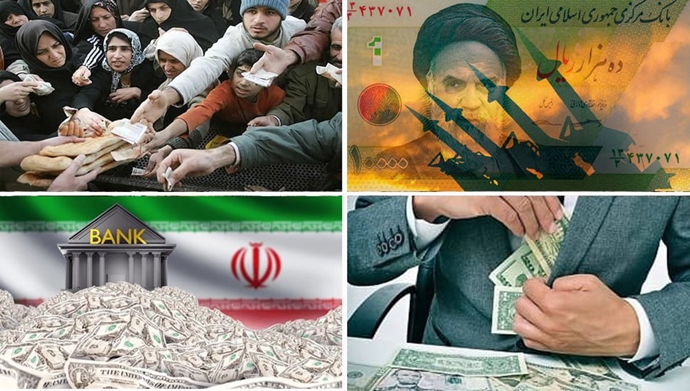
Although this decision has eroded the pillars of a society living in the 21st century, with all its complexities and challenges, the mafia supporting the regime Supreme-Leader Ali Khamenei, along with the clerics and the Islamic Revolutionary Guard Corps (IRGC), have not wasted a single moment in looting and systematically plundering the nation’s wealth and underground resources. Millions living below the survival line, shocking imbalances in the oil and gas sectors, the destruction of agriculture, the crippling of industry, and making people’s livelihoods dependent on imports controlled by the privileged children of officials all highlight the destructive order in a crisis-ridden Iran.
A decade ago, before today’s economic mega-crises became as apparent, economic stakeholders exposed the deceptive facade of rival mafia gangs to create space for themselves. On December 10, 2014, SHANA, the energy sector news agency, wrote, “The most significant application of chaos and disorder theory in economics is predicting monetary and financial variables and global markets, especially the oil market, and the macroeconomic models applied in various countries. But how can the theory of disorder be used to manage a country’s economy so that illegal revenue streams are facilitated, and billions of dollars of national wealth can be looted without concern?”
These analyses show that the regime’s officials have used blocking access to accurate information and fabricating false statistics to achieve their desired outcomes, leading to confusion in policymaking and, consequently, poor decisions.
SHANA added, “What has been observed in Iran’s economy over the years is the inaccuracy of announced statistics and the lack of transparency, which has not only prevented researchers from obtaining accurate data but has also institutionalized economic corruption. As a result, we see that even with the country’s $800 billion foreign exchange earnings, economic growth has turned negative.”
Therefore, the life and livelihood of a nation in the age of human societal complexities, if governed by a reactionary regime, cannot adapt to the levels and dimensions necessary for alignment with the evolving global society. This indicator manifests itself in the ranking of established governments in various countries, allowing everyone to understand their country’s situation.
Iran ranks 101 in “Economic Complexity”
“Economic complexity” is a new term in global competition and refers to a country’s ability to produce a diverse range of products at a globally competitive level. The importance of economic complexity in increasing wealth and developing countries has been increasingly confirmed by studies and empirical evidence.
Organized complexity stands in opposition to simplicity and disorder. The imbalance of Iran’s economy under the clerical regime ruling Iran is in a disastrous state, and the burden is bore by the people of Iran, who have to suffer the plunder, oppression, and injustice of rulers steeped in wealth, power, and deceit.
The ruling mullahs and the IRGC have brought a disastrous calamity on Iran. The evidence of this is the astonishing imbalances in water, electricity, oil, gas, gasoline, and other energies, which can no longer be hidden.
All oil revenues are spent on covering the pension fund deficits
It is evident that this embarrassing economic complexity is visible in various areas of livelihood, labor, and production across society. The budget crisis, various imbalances, and pension fund deficits are so severe that even fake reformists like Abbas Abdi have been forced to admit: “Almost all oil revenues are spent on covering the pension fund deficits. This means that Iran’s budget is calculated without considering the payments to non-oil retirees” (Etemad, October 1, 2024).
The collapse of Iran’s economy is increasingly evident in the disintegration of the livelihoods of millions of our fellow citizens. “According to statistics, 30% of the population is below the poverty line. Six percent of Iran’s population lives in extreme poverty, and this number increases every year. Statistics show that 10 million people have joined the ranks of the poor from 2011 to 2024. This figure is several times larger than the population of many countries and cannot be hidden” (Shahrvand, September 27, 2024).
There is no one left who denies the ultimate fate of the religious fascism ruling Iran. The connection between widespread protests by the impoverished and the revolutionaries who have ignited the flame of revolution marks the end of a dysfunctional system heading towards disintegration.