

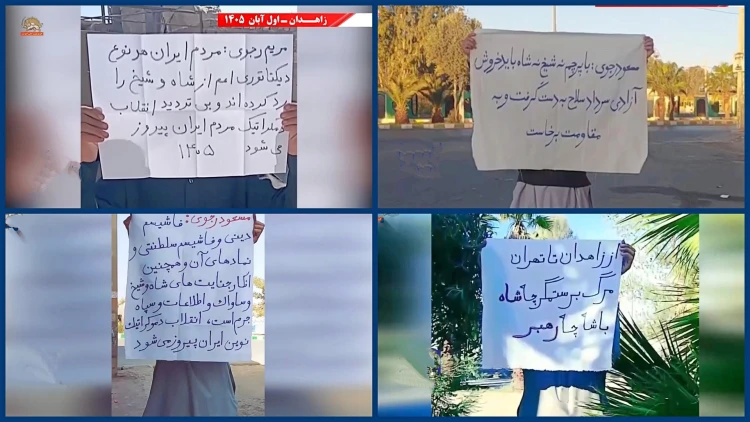

On October 23, 2026, PMOI/MEK Resistance Units resumed their weekly anti-regime activities in Zahedan, southeastern Iran, displaying placards in public places despite the regime’s security measures. Their messages rejected both the ruling clerical dictatorship and attempts to revive the deposed monarchy, while calling for freedom, equality, and a democratic republic.
“From Zahedan to Tehran, down with the oppressor, be it the shah or the supreme leader,” read one placard.
October 23—Zahedan, southeast Iran
PMOI/MEK Resistance Units resume their weekly anti-regime activities, spreading messages of resistance against dictatorship and stressing the rejection of all kinds of tyranny, be it the shah or the mullahs. pic.twitter.com/2wBWAqLJH7— People's Mojahedin Organization of Iran (PMOI/MEK) (@Mojahedineng) October 24, 2026
The campaign emphasized that replacing one dictatorship with another would not fulfill the democratic aspirations of the Iranian people.
Rejecting dictatorship, whether under a crown or a turban
A central theme of the campaign was the rejection of both monarchical and religious dictatorship.
“A dictator is a dictator, whether with a turban or a crown,” declared one placard. Others stated, “No to monarchy, no to the rule of the supreme leader, yes to freedom and equality,” and “Monarchy and mullahs’ rule, 100 years of crime.”
These slogans reflect Iran’s experience of successive dictatorships. The 1979 revolution ended the Pahlavi monarchy, but the establishment of clerical rule under Ruhollah Khomeini replaced one authoritarian system with another.
"Since this regime sees its own destruction in freedom and democracy, it has chosen the path of domestic suppression, intervention in regional countries, warmongering, and terrorism." pic.twitter.com/6B06gJpEhn
— People's Mojahedin Organization of Iran (PMOI/MEK) (@Mojahedineng) October 24, 2026
The Resistance Units stressed that genuine democratic change cannot be achieved by restoring the former monarchy. Their messages presented the rejection of both systems as essential to establishing a political order based on the sovereignty of the people.
Warning against attempts to restore the former monarchy
Another prominent theme was opposition to attempts to promote Reza Pahlavi, the son of Iran’s deposed shah, as an alternative to the ruling clerical establishment.
“The Shah’s son represents a manufactured alternative that sabotages the Iranian people’s popular movement and is in practice serving as a lifeline to the ruling regime,” one placard declared.
Another warned that Pahlavi represented foreign dependence and an effort to resurrect monarchical dictatorship.
Referring to the wars involving Iran’s regime and the United States and Israel in 2025 and 2026, the messages emphasized that political change must emerge from the Iranian people rather than foreign intervention or attempts to revive a discredited political system.
"The reality is clear: every manufactured spectacle by the Shah’s son and his entourage of court heralds ultimately plays right into the hands of the ruling mullahs" pic.twitter.com/5ySFPjVurE
— People's Mojahedin Organization of Iran (PMOI/MEK) (@Mojahedineng) October 24, 2026
The campaign thus connected opposition to dictatorship with the demand for national independence and self-determination.
Condemning executions, repression, and warmongering
The Resistance Units also addressed the clerical regime’s reliance on executions, domestic repression, and regional confrontation.
“Since this regime sees its own destruction in freedom and democracy, it has chosen the path of domestic suppression, intervention in regional countries, warmongering, and terrorism,” one placard stated.
Another accused Khamenei’s son of viewing the execution of political prisoners and participants in uprisings as the regime’s only solution.
"The Shah’s son represents a manufactured alternative that sabotages the Iranian people's popular movement and is in practice serving as a lifeline to the ruling regime" pic.twitter.com/4BEfwU3QYz
— People's Mojahedin Organization of Iran (PMOI/MEK) (@Mojahedineng) October 24, 2026
These messages came amid continued executions in Iran, including those of protesters arrested during the January 2026 uprising.
In contrast to the regime’s repressive policies, the Resistance Units declared: “We fight to build a society free of torture and executions—a democratic republic rooted in fundamental human rights.”
The continuity of organized resistance against dictatorship
Several placards emphasized the PMOI’s historical role in confronting the clerical regime and the continuity of organized resistance.
One stressed that the PMOI has delivered major blows against the regime over the past 45 years.
"One must recognize and uphold the fiery red line demarcating our cause from both dictatorship and foreign dependency, and pay the price for it." pic.twitter.com/lzWiiGDZ3w
— People's Mojahedin Organization of Iran (PMOI/MEK) (@Mojahedineng) October 24, 2026
Another traced the struggle to June 20, 1981, when Revolutionary Guards violently suppressed a large PMOI-organized demonstration in Tehran, followed by mass arrests and executions.
The Resistance Units presented their activities as a continuation of this decades-long struggle, emphasizing the role of organized resistance and young Iranians in opposing both monarchical and clerical dictatorship.
A democratic republic as the alternative to dictatorship
Beyond rejecting the two dictatorships, the Resistance Units outlined the political alternative they advocate for Iran.
“The National Council of Resistance of Iran fights to establish a democratic republic and a society grounded in free elections and the separation of religion and state,” one placard declared.
The messages emphasized fundamental human rights, freedom, equality, and the right of Iranians to determine their political future.
Another called on the international community to recognize the right of Iranian youth to resist repression and defend themselves.
"No to monarchy, no to the rule of the supreme leader, yes to freedom and equality" pic.twitter.com/wQByYFrlxH
— People's Mojahedin Organization of Iran (PMOI/MEK) (@Mojahedineng) October 24, 2026
These demands contrasted a democratic republic founded on popular sovereignty with systems based on hereditary rule or religious authority. They also reinforced the campaign’s central argument that democratic change must be achieved through the Iranian people’s own struggle, independently of foreign powers.
Sustaining the message of resistance
Through their October 23 activities in Zahedan, the Resistance Units reiterated their determination to continue challenging the clerical regime while rejecting a return to monarchy.
Their placards conveyed a consistent message: Iran’s future must be free from dictatorship in all its forms.
“No to mullahs, no to shah, yes to freedom and a democratic republic.”