

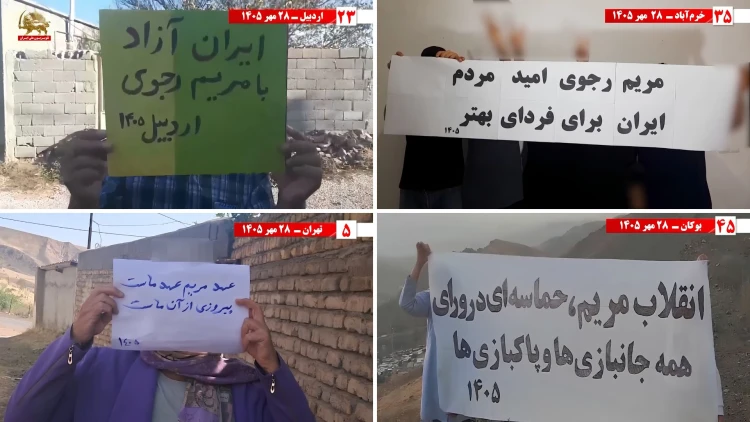

On October 20, 2026, PMOI/MEK Resistance Units marked the upcoming 33rd anniversary of the introduction of Mrs. Maryam Rajavi as the president-elect of the National Council of Resistance of Iran (NCRI) with activities across Iran.
The campaign featured 50 reported activities, including the display of posters and portraits, handwritten slogans, and messages calling for freedom, democracy, and popular sovereignty. The anniversary activities demonstrated the continued presence of organized resistance inside Iran despite the regime’s security and surveillance apparatus.
October 20—Iran
PMOI/MEK Resistance Units mark the anniversary of the introduction of Mrs. Maryam Rajavi as the president-elect of the National Council of Resistance of Iran (NCRI) for the transfer of sovereignty to the people of Iran. pic.twitter.com/zkNR0Pa8iY— People's Mojahedin Organization of Iran (PMOI/MEK) (@Mojahedineng) October 21, 2026
Resistance Units spread messages of freedom across Iran
In Tehran, Resistance Units displayed colorful portraits of Maryam Rajavi alongside handwritten and printed messages. One slogan declared, “The mullahs must go; sovereignty belongs to the Iranian people.” Another called for establishing a democratic republic based on Maryam Rajavi’s Ten-Point Plan.
In Eslamshahr, activists displayed handwritten messages demanding democracy and freedom while rejecting both the Shah’s dictatorship and the clerical regime.
Tehran
"Maryam Rajavi is the symbol of a free Iran" pic.twitter.com/4OZIOIGscN— People's Mojahedin Organization of Iran (PMOI/MEK) (@Mojahedineng) October 21, 2026
In Mashhad, Resistance Units installed posters featuring Maryam Rajavi and wrote slogans on walls declaring that the movement for freedom would not stop. In Isfahan, activists displayed printed and handwritten leaflets proclaiming, “A free Iran with Maryam Rajavi,” and pledging to free Iran from the mullahs’ rule.
In Shiraz, a four-member group displayed posters and portraits of Resistance leaders. Their slogans rejected both monarchical and religious dictatorship, including the declaration, “Neither crown nor turban.”
In Ahvaz, a two-member team displayed printed messages and wrote slogans on walls. Similar activities were documented in Bandar Abbas, where a two-member team displayed a message expressing determination to continue the struggle.
Mashhad
"Nothing can stop the rebellious youth of this movement who fight for regime change" pic.twitter.com/m75oS13paM— People's Mojahedin Organization of Iran (PMOI/MEK) (@Mojahedineng) October 21, 2026
In Kermanshah, activists displayed photographs and messages calling for an end to clerical rule. In Sanandaj, handwritten slogans highlighted the role of Iranian women in confronting dictatorship.
Further activities were reported in Khorramabad, Bushehr, Hamedan, Arak, Lahijan, Baneh, Bukan, and Javanrud, illustrating the geographical breadth of the campaign.
Slogans promoting popular sovereignty and a democratic future
Beyond the anniversary itself, the slogans expressed a common political message: rejecting dictatorship and presenting a democratic alternative for Iran.
Additional commemorative displays reinforced this message. On Galayel Street in Tehran, activists promoted Maryam Rajavi’s Ten-Point Plan as a guarantee for a free Iran. In Mashhad, similar messages appeared on Azizi Boulevard, while displays in Karaj emphasized freedom, equality, and perseverance.
Tehran (Galayel Street)
"Maryam Rajavi's Ten-Point Plan is the guarantee of a free Iran" pic.twitter.com/T6cTIqIz1v— People's Mojahedin Organization of Iran (PMOI/MEK) (@Mojahedineng) October 22, 2026
At Eskandari Square in Karaj, the slogan declared, “We can and must free Iran.”
Other messages emphasized the role of women in political change. In Sanandaj and Baneh, activists described Iranian women as an enduring challenge to the clerical dictatorship.
Maryam Rajavi’s election and the vision for a democratic Iran
On August 28, 1993, the NCRI unanimously elected Maryam Rajavi as its president-elect for the transitional period following the overthrow of the clerical regime. The decision was publicly announced on October 22, 1993.
The election represented an important milestone in the Iranian Resistance’s political strategy, placing a woman at the forefront of the movement confronting the regime’s institutionalized discrimination against women.
Mashhad (Azizi Blvd)
"Maryam Rajavi's Ten-Point Plan is the guarantee of a free Iran" pic.twitter.com/98R4I5G9OY— People's Mojahedin Organization of Iran (PMOI/MEK) (@Mojahedineng) October 22, 2026
Under the NCRI’s proposed transitional framework, a provisional government would organize free elections for a constituent assembly within six months of the regime’s overthrow, transferring sovereignty to elected representatives of the Iranian people.
Maryam Rajavi’s Ten-Point Plan sets out the principles of a democratic republic, including universal suffrage, political pluralism, gender equality, separation of religion and state, abolition of the death penalty, judicial independence, and a non-nuclear Iran.
The Resistance Units’ slogans connecting Rajavi’s leadership to this program therefore carried a message extending beyond commemoration: a proposed roadmap for the country’s future.
An organized resistance that the regime has failed to silence
The anniversary activities underscore three essential dimensions of the Iranian Resistance: an organized presence inside Iran, an independent strategy for political change, and a defined vision for democratic governance.
The NCRI has consistently advocated change through the Iranian people and their organized resistance, rejecting both foreign military intervention and the continuation of religious dictatorship.
By carrying their messages into public spaces despite the risks of arrest and repression, the Resistance Units demonstrate that the struggle for freedom has not been extinguished.
The campaign shows that the Iranian Resistance’s political alternative is accompanied by activists operating on the ground. Its messages of popular sovereignty, equality, and democratic change continue to challenge the regime’s attempts to silence dissent and suppress organized opposition.