

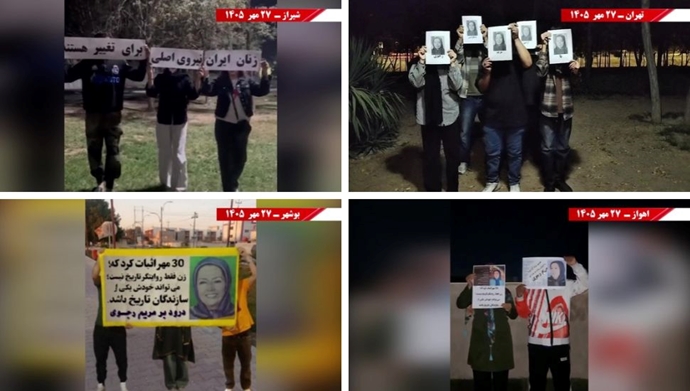

On October 19, 2026, PMOI/MEK Resistance Units carried out 50 activities across 18 Iranian cities to mark the upcoming 33rd anniversary of the introduction of Mrs. Maryam Rajavi as president-elect of the National Council of Resistance of Iran (NCRI).
From Tehran and Karaj to Mashhad, Shiraz, Isfahan, Ahvaz, and Iranshahr, Resistance Units displayed portraits, posters, banners, and handwritten slogans promoting democracy, popular sovereignty, and a free Iran. The nationwide campaign was carried out despite the regime’s repressive security apparatus being on full alert.
October 19—Iran
PMOI/MEK Resistance Units mark the anniversary of the introduction of Mrs. Maryam Rajavi as the president-elect of the National Council of Resistance of Iran (NCRI) for the transfer of sovereignty to the people of Iran. pic.twitter.com/QWCel3PcHr— People's Mojahedin Organization of Iran (PMOI/MEK) (@Mojahedineng) October 20, 2026
In Tehran, a five-member group displayed Maryam Rajavi’s portrait with the slogan, “Democracy, freedom with Maryam Rajavi.” Other posters declared that the voice of freedom would never be silenced and described Rajavi as a symbol of national solidarity for Iran’s freedom.
In Mashhad, two-member teams organized nighttime displays and held handwritten banners expressing support for the Resistance leadership. In Shiraz, three Resistance Unit members displayed messages emphasizing women’s role in bringing about change. In Bushehr, another three-member group carried a banner celebrating women’s ability to shape history.
Tehran
"With Maryam Rajavi, the voice of freedom fighters will never be silenced" pic.twitter.com/wnRFK3Hk2b— People's Mojahedin Organization of Iran (PMOI/MEK) (@Mojahedineng) October 20, 2026
In Kermanshah, Rafsanjan, Bukan, and Iranshahr, small groups held similar public displays. Elsewhere, Resistance Units placed posters on walls, trees, and benches in Karaj, Rasht, Shahriar, Isfahan, and other cities. In Bandar Abbas, they also wrote slogans on walls.
The variety and geographical distribution of these activities demonstrated the Resistance Units’ continued organizational presence across Iran.
Rejecting dictatorship and demanding popular sovereignty
The campaign’s slogans directly challenged the clerical regime’s claim to political authority.
In Karaj and Kashan, posters demanded that the mullahs relinquish power, declaring that sovereignty belongs to the Iranian people. In Rafsanjan, a two-member team held a banner reading, “Tomorrow’s Iran with Maryam Rajavi—No Shah, No Mullahs.”
In Iranshahr, a three-member group displayed a banner calling for “Freedom, justice, and national sovereignty with Maryam Rajavi.”
Tehran
"Free Iran with Maryam Rajavi" pic.twitter.com/S2zjIcpfBM— People's Mojahedin Organization of Iran (PMOI/MEK) (@Mojahedineng) October 20, 2026
These messages reflected the Iranian Resistance’s rejection of both the former monarchical dictatorship and the ruling theocracy. They emphasized that the goal is more than removing the current rulers: establishing a democratic republic in which the Iranian people determine their political future.
Women’s leadership and a democratic vision for Iran
Women’s leadership was another prominent theme of the activities. Posters in Tehran and Shiraz emphasized the role of Iranian women as the main force for change.
In Bushehr, a banner conveyed the message that women need not merely recount history but can become its makers. This emphasis on women’s political leadership contrasted with the institutionalized discrimination imposed by the clerical regime.
Shiraz
"The women of Iran are the force for change" pic.twitter.com/vYvsVXwx9P— People's Mojahedin Organization of Iran (PMOI/MEK) (@Mojahedineng) October 20, 2026
In Ahvaz, two-member Resistance Unit teams displayed portraits of Mrs. Rajavi alongside messages promoting her Ten-Point Plan for Iran’s future.
The plan calls for a democratic republic based on universal suffrage, separation of religion and state, gender equality, abolition of the death penalty, an independent judiciary, and a non-nuclear Iran committed to peaceful coexistence.
The significance of Maryam Rajavi’s election as president-elect
The anniversary commemorates October 22, 1993, when the NCRI publicly announced its decision, adopted on August 28 of that year, to unanimously elect Maryam Rajavi as president-elect for the transitional period following the overthrow of the clerical regime.
Her mandate is to oversee the transfer of sovereignty to the Iranian people. Under the NCRI’s plan, a provisional government would organize free elections for a National Legislative and Constituent Assembly within six months, transferring authority to the people’s elected representatives.
The decision also marked an important milestone in the Iranian Resistance’s commitment to women’s leadership and its vision of a democratic alternative to the ruling theocracy.
An alternative the regime has failed to silence
The October 19 activities took place against a backdrop of executions and repression. Yet the Resistance Units continued to make their presence visible across Iran, promoting an independent political alternative with an organized network inside the country and a democratic program for its future.
Thirty-three years after Maryam Rajavi’s introduction as president-elect, the activities connected that political vision with the ongoing struggle inside Iran.
Despite the regime’s intimidation and security threats, the Resistance Units’ continued activities demonstrate that the mullahs have failed to silence the voice of freedom and those determined to bring democratic change to Iran.