

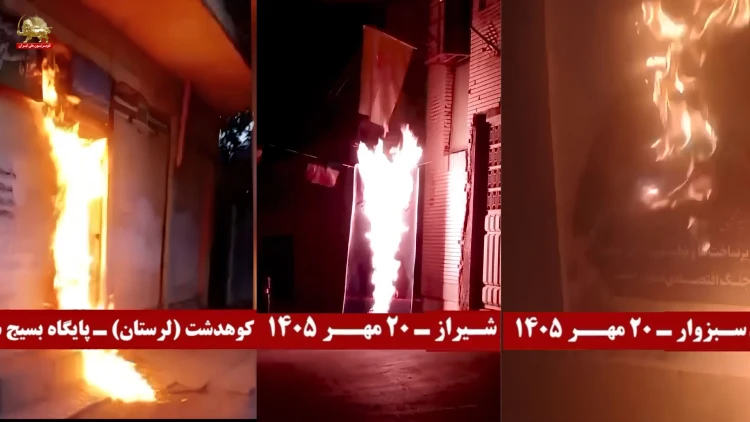

On October 10, World Day Against the Death Penalty, PMOI/MEK Resistance Units carried out ten operations across nine Iranian cities amid a mounting campaign of executions and repression.
The operations targeted facilities and signs of the Islamic Revolutionary Guard Corps (IRGC) Basij, regime-linked institutions, and propaganda featuring regime leaders. From Qazvin and Kermanshah to Mashhad, Bandar Abbas, and southeastern Iran, the campaign challenged symbols and institutions of state power.
October 10—Iran
Marking the World Day Against Death Penalty, PMOI/MEK Resistance Units carried out 10 daring operations across Iran in response to the regime's growing wave of executions. Their message: The regime's machinery of death will not stop the people's uprising and the… pic.twitter.com/RSkLhxQepd— People's Mojahedin Organization of Iran (PMOI/MEK) (@Mojahedineng) October 16, 2026
The operations carried a central message: the regime’s machinery of death has not ended the struggle for freedom.
Resistance Units target IRGC Basij facilities
Five operations involved IRGC Basij facilities, highlighting an institution the regime relies on to suppress protests and enforce political control.
In Dehloran, Resistance Units set fire to the entrance of a Basij base. Two separate operations took place in Iranshahr: one targeted a signpost identifying a Basij base, while another set fire to a Basij base itself. In Khash, Resistance Units burned the entrance of another Basij installation. A similar operation was reported in Mashhad, where the entrance of a Basij base was set on fire.
The operations against bases and their identifying signs stretched across widely separated cities, including several in southeastern Iran. By directing their actions toward the Basij, the Resistance Units challenged an organization central to the regime’s response to dissent. Their continued activities also challenged the regime’s attempt to deter resistance through executions and surveillance.
Kermanshah
Resistance Units target one of the branches of the Khomeini Foundation, responsible for plundering public wealth for the regime's nefarious projects. pic.twitter.com/1MVAlsGmTK— People's Mojahedin Organization of Iran (PMOI/MEK) (@Mojahedineng) October 16, 2026
Operations against regime institutions and symbols of power
Other operations focused on institutions and symbols associated with clerical rule.
In Qazvin, Resistance Units targeted a center identified as disseminating fundamentalism and terrorism. In Kermanshah, they struck a branch of the Khomeini Foundation, which is tasked with diverting public wealth toward regime projects.
In Bandar Abbas, Resistance Units set fire to a regime building. In Chabahar, they torched a billboard featuring former supreme leader Ali Khamenei, while in Zahedan, they set fire to a propaganda banner displaying regime leaders.
Dehloran
Resistance Units set fire to entrance of IRGC Basij base pic.twitter.com/Ju4X5kSNRJ— People's Mojahedin Organization of Iran (PMOI/MEK) (@Mojahedineng) October 16, 2026
Together, the ten actions illustrated the Resistance Units’ geographical reach and challenge to clerical rule.
The regime’s escalating campaign of executions
The October 10 operations unfolded against an accelerating wave of executions. Figures compiled by the Iranian Resistance show that the regime executed 2,657 prisoners between March 20, 2025, and March 19, 2026, approximately 130 percent more than in the preceding Iranian year.
Of those executions, 1,730 took place in the months surrounding the January 2026 nationwide uprising. From March 19 through October 6, 2026, at least 46 political prisoners were executed, including nine PMOI members and 37 people arrested during uprisings and social protests.
Iranshahr
Resistance Units set fire to signpost of IRGC Basij base pic.twitter.com/9OBzs87757— People's Mojahedin Organization of Iran (PMOI/MEK) (@Mojahedineng) October 16, 2026
In August, the UN High Commissioner for Human Rights raised concerns over 27 executions in protest-related cases and warned that more than 100 others faced imminent execution. The regime uses capital punishment to intimidate a society that has repeatedly risen against its rule.
The regime’s machinery of repression has failed to silence resistance
The October 10 operations brought this confrontation into sharp relief. Even as the regime expands executions, imprisonment, and intimidation, Resistance Units continue to challenge its security apparatus and symbols of power across Iran.
The campaign demonstrates the limits of a strategy built on fear. The regime can raise the cost of dissent, but it has not extinguished the spirit of resistance among Iran’s youth or their determination to continue the struggle for freedom.