

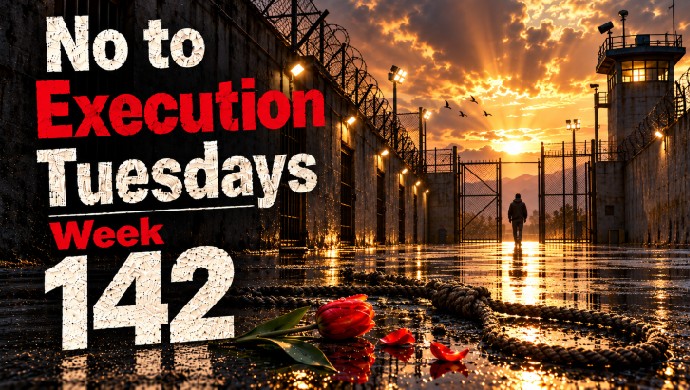

Prisoners across Iran held the 142nd week of the “No to Executions Tuesdays” campaign on Tuesday, October 13, 2026, with inmates holding hunger strikes in 66 prisons to protest the widespread use of the death penalty by the Iranian regime.
The campaign, which has been active for nearly three years, continues to grow despite escalating suppression by prison authorities. In their weekly statement, the striking prisoners emphasized that participants in recent weeks have faced “security pressures, threats, restriction of contacts and connection with outside the prison, and punitive measures.” Despite these crackdowns, the inmates stated that their continued defiance is a testament to an organized resistance defending the right to life.
Alarming spike in executions and looming death sentences
Marking the World Day Against the Death Penalty on October 10, the prisoners highlighted the massive scale of state-sanctioned killings. According to their statement, between October 2025 and October 2026, at least 2,230 people were executed in Iran. The victims included 54 women, 47 political prisoners, and four children.
“These figures narrate the story of lost lives, grieving families, and a society that faces the fear of death and suppression every day,” the statement read.
The regime continues to disproportionately target political prisoners and minorities. Over the past week, authorities executed political prisoner Jaber Khosravi in Damghan and Baluch citizen Omar Dorostaran.
The threat of execution also looms over young protesters. The Supreme Court recently upheld the death sentence of 23-year-old student and political prisoner Amirhassan Akbari Monfared, placing his life in imminent danger. Additionally, a new death sentence was issued in recent days for 19-year-old political prisoner Ali Zakani.
Extrajudicial killings and murder under torture
Beyond the formal use of the death penalty, the prisoners warned of “insane suppression and violence” resulting in the extrajudicial deaths of citizens in state custody.
The statement documented the case of Omid Ghanouni, a 17-year-old boy arrested in Khansar, Isfahan province. The day after his arrest, authorities handed his dead body back to his family, with visible signs of beatings on his corpse. In a similar case in Mashhad, a citizen named Farid Mokari was killed after enduring severe torture following his arrest.
Growing global solidarity and an urgent call for action
The 142nd week of the campaign garnered notable international attention when Gina Romero, the UN Special Rapporteur on the rights to freedom of peaceful assembly and of association, officially joined the prisoners’ strike.
#Iran On Tuesday the 13th, I am joining the 'No Execution Tuesdays' hunger strike.
The death penalty is being used against people for exercising their rights to freedom of assembly, association, and expression, as well as their political rights. 1/ pic.twitter.com/Ld2kAj1Djq
— Gina Romero (@Ginitastar) October 11, 2026
Announcing her participation on X, Romero wrote: “It is 3:30 PM on Monday, October 12th in Colombia, which means it’s midnight in Iran and Tuesday, October 13th has just begun. I have just finished my last meal, as my 24-hour hunger strike starts now. I join #NoToExecutionTuesdays in solidarity with the brave people of Iran.”
The striking prisoners welcomed Romero’s support, calling it a “great source of encouragement for prisoners who stand up for human dignity under the shadow of the threat of execution.”
In their concluding remarks, the campaign members issued an urgent plea to the international community: “We, the members of the ‘No to Execution Tuesdays’ campaign, who have been shouting for 142 consecutive weeks that no human being should fall victim to the gallows, call on all awakened human consciences, international institutions, and human rights defenders to go beyond verbal condemnations and take action to establish a practical and immediate mechanism to stop executions in Iran. Do not leave the Iranian people alone in these dark days of suppression.”