

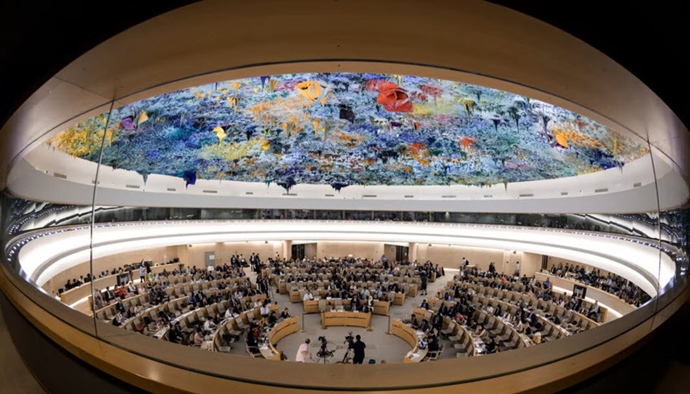

A cross-regional group of 46 countries condemned the escalating use of the death penalty in Iran at the 63rd session of the United Nations Human Rights Council in Geneva on September 30, drawing particular attention to the execution of protesters arrested following the nationwide protests that began in late December 2025.
The joint statement, delivered by Liechtenstein, cited the findings of the UN High Commissioner for Human Rights, the Special Rapporteur on Iran, and the Independent International Fact-Finding Mission on Iran. The statement was delivered on behalf of forty-six participating countries, including Italy, Germany, the United Kingdom, Canada, Switzerland, Spain, Albania, France, Australia, Denmark, Greece, Ireland, and Belgium.
The statement warned that at least 31 protesters had been executed following the January crackdown and that dozens more, including women and children, had been sentenced to death or remained at imminent risk of execution. It also expressed alarm over public executions and reports of proceedings involving closed hearings, denial of due-process guarantees, torture and ill-treatment, enforced disappearances, and coerced confessions.
Condemnation builds across the Human Rights Council
The September 30 statement followed a series of interventions by governments during the Human Rights Council’s September 21 dialogue with the Independent International Fact-Finding Mission on Iran.
Germany said it “condemn[s] in the strongest terms” the continuing executions of protesters and called on Iran to end the practice. Canada said it was “appalled by the executions” and death sentences imposed on protesters and called for all pending executions to be halted. Speaking on behalf of the Nordic-Baltic states, Denmark described the recent increase in executions, including those involving protesters, as “deeply alarming,” while drawing attention to due-process violations, forced confessions, and restrictions on access to chosen lawyers.
Italy condemned the “recent acceleration in executions,” linking it to the suppression of dissent, while France described the increase as “alarming” and called for an immediate end to the practice. Belgium said the use of capital punishment to silence dissent “can never be justified” and demanded an immediate halt to protester executions.
The United Kingdom similarly pointed to Iran’s “abhorrent use of the death penalty,” alongside torture, ill-treatment, nationwide internet shutdowns, and restrictions on fundamental freedoms, saying these practices fuel cycles of repression.
UN findings document protest-linked executions
The diplomatic statements were backed by findings presented by the Independent International Fact-Finding Mission on September 21.
The Mission reported that from March through August 31, Iranian authorities executed at least 29 men in cases connected with the protests, five of them publicly. More than 70 other people—including at least five women and three boys—were at imminent risk of receiving death sentences or being executed in protest-related cases.
The Mission said capital cases had proceeded through trials marked by violations of fair-trial and due-process guarantees, forced confessions, and denial of access to lawyers of the defendants’ choosing. It concluded that Iran’s repression of the 2025–2026 protests involved gross human rights violations, many amounting to crimes against humanity, including murder, imprisonment, torture, and other inhumane acts.
The current investigation follows the Human Rights Council’s January 23 resolution A/HRC/RES/S-39/1, which extended the mandate of the Fact-Finding Mission for two years and the mandate of the Special Rapporteur on Iran for one year.
Executions continue as diplomats meet in Geneva
The September 30 condemnation coincided with new executions inside Iran. On the same day, Iranian authorities executed Ali Hemmati, 21, and Majid Nik-Andish, 25, who had been arrested in connection with the January uprising in Mashhad. The judiciary described the two as protest “leaders” and “field elements” in Mashhad’s Tabarsi district and said their death sentences had been upheld by the Supreme Court.
The two executions came amid a broader pattern documented during the preceding months. Iran Human Rights Monitor recorded 92 executions in August 2026, including six women. Separately, the NCRI reported at least 78 executions across 24 prisons from August 23 through September 22, including six women and nine Baluch prisoners.
Prisoners and the Iranian Resistance call for action
Opposition to the executions has also continued inside Iran’s prisons. On September 29, the “No to Executions Tuesdays” campaign entered its 140th consecutive week, with hunger strikes reported in 66 prisons. The participating prisoners warned of an increase in death sentences against political and ideological prisoners, including people detained during the 2025–2026 protests.
The Iranian Resistance has repeatedly called for international measures to halt executions. Following the executions of Hemmati and Nik-Andish, NCRI President-elect Maryam Rajavi called for immediate action to stop executions, particularly those of political prisoners and people detained during the uprising, and called for Iran’s human rights dossier to be referred to the UN Security Council.
In its September 25 statement on the execution figures, the NCRI also called for political and economic relations with Tehran to be conditioned on an end to executions and torture.
The September 30 joint statement therefore comes against the backdrop of continuing executions in Iran. Execution and torture is the regime’s main means of survival, and they will only stop when this regime is no longer in power.