

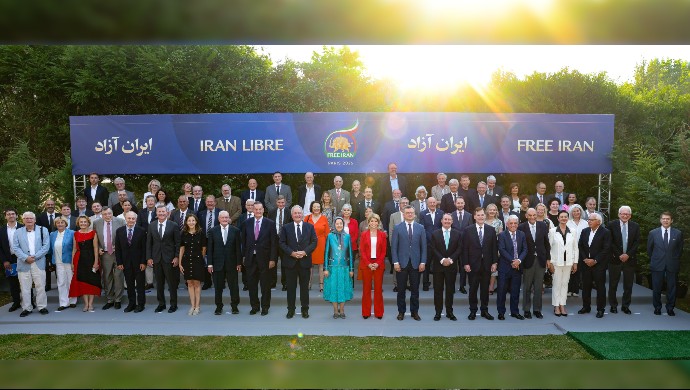

On June 21, 2026, the second day of the Free Iran Summit convened in Paris, gathering an international coalition of current and former world leaders, lawmakers, and human rights advocates.
Held on the 45th anniversary of the June 20, 1981 turning point—the Day of Martyrs and Political Prisoners—the conference unfolded against a backdrop of unprecedented geopolitical transformation and domestic volatility in Iran. Following the massive nationwide uprisings of December 2025 and January 2026, which shook the religious dictatorship to its core, the regime has found itself navigating an existential crisis. The death of Supreme Leader Ali Khamenei in the wake of the February 2026 military strikes, the succession of his son Mojtaba Khamenei, and a fragile international ceasefire have left the ruling clerics weakened but deeply dangerous.
Day 2: Free Iran Summit 2026 – Onward to a Democratic Republic
With a deep knowledge of the nature of the religious dictatorship, supporters of the Iranian Resistance have concluded that backing the democratic alternative is the key to change in Iran and to global peace and… pic.twitter.com/O5oTC0gf4m— Maryam Rajavi (@Maryam_Rajavi) June 21, 2026
Desperate to project power and terrorize a restless population, the regime under President Masoud Pezeshkian has unleashed a brutal execution spree of political dissidents.
Yet, as the speeches and testimonies at the summit demonstrated, the Iranian people’s drive for a free, secular, and democratic republic remains unbroken. The conference illuminated a clear consensus: the regime’s structural collapse is irreversible, and the organized Resistance remains the sole viable catalyst for returning sovereignty to the Iranian people.
Keynote Address by Maryam Rajavi: A Pledge to Transfer Sovereignty
In a powerful keynote address, Maryam Rajavi, President-elect of the National Council of Resistance of Iran (NCRI), commemorated the 45th anniversary of the June 20, 1981 uprising, framing it as the starkest choice in the nation’s history: “existence or extinction, freedom or dictatorship, resistance or surrender.” Emphasizing the enduring philosophy of the movement, she recalled Massoud Rajavi’s foundational message: “I resist for freedom; therefore, I am.”
Mrs. Rajavi firmly condemned the French authorities’ last-minute ban on the planned Resistance rally in Paris, interpreting it as a product of behind-the-scenes appeasement that ultimately failed to silence the 100,000 Iranians who gathered across the city. She dismantled the illusion that the current regime could be reformed or that its crisis could be solved through external military intervention or the artificial revival of the Shah’s deposed dictatorship.
Scenes from two days of the glorious Free Iran 2026 gathering and campaign, commemorating June 20, the day of Iran’s martyrs and political prisoners, and the beginning of the Iranian people’s nationwide resistance to establish a democratic republic pic.twitter.com/Knxac0f6jH
— Maryam Rajavi (@Maryam_Rajavi) June 21, 2026
Instead, she pointed to the 100,000 martyrs of the Resistance and the defiant generation currently filling the ranks of the PMOI Resistance Units inside Iran as the true force for democratic change. Noting the unprecedented weakness of the regime following Khamenei’s death and his son’s lack of legitimacy, Mrs. Rajavi reaffirmed the mission of the NCRI’s Provisional Government. She promised that the Resistance does not seek power for itself, but aims solely to facilitate free elections within six months of the regime’s fall, ensuring that sovereignty is permanently transferred from the tyrannies of the Shah and the mullahs to its rightful owners: the people of Iran.
The Paris Rally Ban and the Specter of Appeasement
The summit’s atmosphere was profoundly shaped by the events of the previous day. More than 100,000 members of the Iranian diaspora had converged on Paris to participate in a massive demonstration condemning the wave of executions in Iran. However, in an unexpected move driven by what attendees described as an enduring culture of appeasement, the French police banned the rally in its original location less than 48 hours before it was scheduled to begin, utilizing riot gear and corralling attendees in soaring temperatures.
Former MEP @StruanStevenson: What happened yesterday in Paris was an absolute outrage and a stain on the French government. Forcing tens of thousands of peaceful protesters onto buses for hours in 36°C heat and wrestling them to the ground will not be forgotten! #NCRIAlternative…
— NCRI-FAC (@iran_policy) June 21, 2026
The abrupt cancellation drew sharp rebukes from international dignitaries, who framed the decision as a capitulation to Tehran’s extortion tactics. Former Member of the European Parliament Struan Stevenson did not mince words, directing his ire at the host nation’s leadership. “Liberté, égalité, fraternité, but apparently not here in Paris. Lafayette will be turning in his grave,” Stevenson remarked, condemning the use of riot gear against the peaceful Iranian diaspora as “an absolute outrage, and it will not be forgotten.”
British MP David Jones contextualized the ban within the broader failure of Western foreign policy, citing the French legal philosopher Montesquieu: “There is no tyranny more cruel than that which is perpetrated under the shield of law and in the name of justice.” He noted that the use of legal injunctions to silence dissidents reflects a dangerous naivety among Western governments who hope that concessions will moderate a regime that holds fundamental freedoms in contempt.
David Jones, MP: For too long, Western govts pursued appeasement. The correct policy is the third option: neither war nor appeasement, but democratic change brought about by the Iranian people themselves. #NCRIAlternative https://t.co/ta0xXodcXh
— NCRI-FAC (@iran_policy) June 21, 2026
The ban was also deeply personal for former Colombian Senator and presidential candidate Ingrid Betancourt, who expressed profound shame over her second home’s actions. “When those who speak against executions are silenced, we must ask ourselves, not only as French citizens but as world leaders: Are these rights still universal principles, or have they become mere words on paper?” she asked.
Betancourt warned that silencing a peaceful rally in Paris equates to silencing worldwide outrage against executions, sending a message that democratic nations are willing to confront tyranny only when their own security is directly threatened, abandoning their values in the process.
Former U.S. Assistant Secretary of State Lincoln Bloomfield Jr. drew a stark historical contrast, reminding the audience of the 2018 plot by agents of Iran’s Ministry of Intelligence and Security to detonate a bomb at the very same Resistance gathering in Paris. “The Tehran regime spent months planning a mass casualty terror attack in the heart of Europe while the nuclear JCPOA was still in full effect,” Bloomfield noted. He challenged Western capitals—Washington, London, Berlin, and Paris—asking if they remain afraid of offending an unelected junta by inviting a serious dialogue with Iran’s organized Resistance.
.@LBJunior: Tehran planned a mass terror attack against the #NCRIAlternative in 2018 while the JCPOA was in full effect. The French court noted a recent threat from remnants of SAVAK under the Pahlavi monarchy, which was expelled half a century ago, never to return.…
— NCRI-FAC (@iran_policy) June 21, 2026
The overriding consensus among the speakers was that the lengths to which the regime goes to suppress the MEK and NCRI—even utilizing diplomatic leverage to ban protests on European soil—are the most glaring indicators of its vulnerability. The regime governs through the imposition of fear globally because it completely lacks genuine legitimacy domestically.
A Dying Regime’s Final Weapon: The Execution Spree and Human Rights Abuses
As the regime grapples with the fallout from the massive December 2025 uprisings and the ensuing geopolitical crisis, it has reverted to its most familiar tool of statecraft: the gallows. The recent execution of eight PMOI members alongside protesters underscores the clerics’ desperate attempt to preempt further public revolts. The conference heavily spotlighted these atrocities, transforming the statistics into visceral indictments of the ruling theocracy.
Ingrid Betancourt brought the grim reality of Iran’s prisons into the hall in Paris. “Tomorrow, somewhere in Iran, another young prisoner may hear footsteps approaching his cell. He will know what those footsteps mean. He will know that the regime wants him to choose between fear and surrender,” she said.
Betancourt invoked the final testaments of the recently executed PMOI members Babak Alipour and Pouya Ghobadi. She highlighted Alipour’s final pledge to fight until the establishment of a democratic Republic, and Ghobadi’s defiant declaration rejecting both the mullahs and the shahs. “Their words reveal a profound truth: the struggle for Iran is not a struggle between the past and the present… It is the struggle of a new generation determined to build a democratic Republic,” she stated.
.@IBetancourtCol: The path to freedom is the organized resistance of the people, not a puppet imposed from outside. The regime heavily fears the youth, brave women, and #MEKResistanceUnits who continue to organize despite unimaginable repression. #NCRIAlternative…
— NCRI-FAC (@iran_policy) June 21, 2026
For Geir Haarde, former Prime Minister of Iceland, the surge in executions is not a display of authority, but a terminal diagnosis. “The shocking surge in executions since late March, including the targeted hanging of dozens of political prisoners and brave members of the PMOI, is not a demonstration of power. It is the ultimate confession of fear,” Haarde observed, adding that confident governments do not rule through the gallows.
This sentiment was echoed by Dr. Margot Käßmann, a prominent German theologian, who emphasized the human toll of the regime’s brutality. Representing a coalition of religious dignitaries condemning the executions, she noted that the crisis in Iran is often discussed in terms of geopolitics and nuclear threats, but at its core, “it is about people.” Käßmann drew parallels between the defiance of the Iranian youth and the historical resistance against National Socialism in Germany, expressing her admiration for the prisoners whose resistance reaches “even into the prisons, torture chambers, and execution sites.”
The demographic shift within the resistance movement was brought to life by Mahan Taraj, an Iranian jurist who grew up in the French diaspora after his parents fled the violence of 1981. Taraj spoke of Vahid Bani Amerian, an executed engineer and physics teacher, to illustrate the unrelenting courage of the population inside Iran. “He knew the price. He knew that torture and execution were real possibilities. Yet he chose to stand up,” Taraj said, illustrating how the blood spilled in 1981 continues to run in the veins of the third generation fighting today.
Dr. Käßmann: True change must come from within Iranian society itself. I am deeply convinced by the #FreeIran10PointPlan of President @Maryam_Rajavi: the separation of state and religion, and absolute equality between men and women. #NCRIAlternative https://t.co/yCFEp5XGXe
— NCRI-FAC (@iran_policy) June 21, 2026
Former FBI Director Louis Freeh pivoted the discussion from condemnation to legal accountability. Pointing to the glaring omissions in the international community’s recent agreements with Tehran, Freeh demanded that personal accountability for war crimes, murders, and state-sponsored terrorism be central to any future policy. He noted that the victims of the regime’s brutality are the key witnesses and evidence required to hold the ruling clerics personally accountable in the future.
Geopolitics, Disarmament, and the Illusion of Externally Imposed Change
The Free Iran Summit took place in a vastly altered geopolitical environment. The military strikes in June 2025 and February 2026 decimated the regime’s nuclear infrastructure, eliminated top military commanders, and structurally altered the balance of power in the Middle East. However, while the speakers acknowledged that the regime is now at its weakest point in nearly half a century, they issued a unified, unequivocal warning: foreign military interventions and diplomatic memorandums of understanding will not bring about democratic regime change. Freedom cannot be imposed from the outside; it must be won from within.
.@generalkellogg: That is why this hour belongs to the men and women of Iran, and why disarmament must be understood as the first step of something far larger, the foundation on which the #FreeIran10PointPlan, the future of Iran, can be built.https://t.co/9OJ5l49Pvw
— NCRI-FAC (@iran_policy) June 21, 2026
General Joseph Keith Kellogg highlighted the unprecedented degradation of the regime’s military and nuclear capabilities, arguing that stripping the regime of its ambition and ability to acquire a nuclear weapon makes it highly vulnerable. “A weak regime is one the Iranian people can finally confront on their own,” Kellogg noted, emphasizing that the disarmament process must be strictly verified and recognized merely as a first step.
However, the prevailing sentiment among the dignitaries was that freedom in Iran will be achieved by the people of Iran and their organized resistance movement. Drawing a parallel to the Ukrainian resistance, Chavez asserted, “You cannot impose freedom by dropping bombs. It was useful… But it isn’t enough, and it cannot be imposed from the outside. What has to happen is the Iranian people have to stand up and fight.”
Sir Liam Fox, former British Secretary of State for Defence, provided a sobering analysis of the conflict’s aftermath. He sharply criticized those who believed the conflict alone would organically generate a new government. “Regime change does not fall from the skies, even from the world’s most powerful bombers. That is a lesson from history,” Fox stated. He reaffirmed that the internally driven factors for regime change—a failing economy, sickening violent repression, and a massive, disillusioned youth population—remain the true engines of transformation.
.@LiamFox: Factors driving internal change remain: a failing economy, violent repression, and a lack of legitimacy. Only the Iranian people have the authority to determine who governs—not foreign govts, tyrants, or monarchs. It is only the Iranian people themselves, and it's our…
— NCRI-FAC (@iran_policy) June 21, 2026
Ambassador Robert Joseph, former U.S. Under Secretary of State, shared his concern that the regime has learned dangerous lessons from the recent military engagements, specifically the realization that it can hold the global economy hostage by closing the Strait of Hormuz and use negotiations merely to buy time. Joseph warned that the international community’s commitment to non-interference in the MOU “will be seen by the mullahs as a green light for more executions and more mass murders.” He stressed that the only effective means to achieve national security goals is to actively support the organized resistance.
General Tod Wolters, former Supreme Allied Commander Europe, encapsulated the strategic reality of the situation. He recognized that while neutralizing the regime’s nuclear capability and terrorism is critical, comprehensive prosperity and stability can only begin by representing the good people of Iran. “Working by, with, and through you remains a strategic imperative,” Wolters declared, acknowledging the Resistance Units operating across all 31 provinces of Iran as the vital strategic asset for ultimate success.
The True Catalyst for Change: Resistance Units and the Ten-Point Plan
With the illusion of externally imposed change thoroughly dismantled, the summit focused heavily on the practical mechanics of the Iranian transition. The speakers pointed to the PMOI Resistance Units—the organized network operating inside Iran under the harshest repression—as the tip of the spear in the fight for liberation. Coupled with Maryam Rajavi’s Ten-Point Plan, the National Council of Resistance of Iran provides the structured, cohesive, and democratic alternative that Western policymakers have long claimed was missing.
.@CarlaHSands: The NCRI under @Maryam_Rajavi offers a viable alternative. Her #FreeIran10PointPlan provides a practical blueprint for transition: free elections, freedom of religion, gender equality, a free market economy, and a non-nuclear republic. #NCRIAlternative…
— NCRI-FAC (@iran_policy) June 21, 2026
Carla Sands, former U.S. Ambassador to Denmark, articulated the viability of this alternative. She observed that the international community has long trapped itself in a false dichotomy of war or appeasement, ignoring Mrs. Rajavi’s “third way” of change from within. “This alternative is structured, cohesive, resilient, and democratic, and the network of organized Resistance Units on the ground has shaken the regime,” Sands remarked. She highlighted the Ten-Point Plan as a practical blueprint for transition, specifically praising its commitments to free elections, freedom of religion, gender equality, and a free market economy, noting that Mrs. Rajavi has already implemented this blueprint within the movement’s ranks by championing women’s leadership.
The international legitimacy of the NCRI’s platform was a recurring theme. British MP Bob Blackman proudly announced that more than 3,000 parliamentarians across the world, including former heads of state and distinguished personalities from 55 countries, have endorsed a joint declaration supporting the Iranian people’s struggle and welcoming the NCRI’s provisional government. Blackman emphasized that “genuine democratic change can only come through an organized resistance with popular support, a democratic vision, and a willingness to make sacrifices for freedom.”
.@ifedezg: The Iranian regime is the primary enemy of stability in the Middle East and a danger to global peace by funding terror and seeking atomic bombs. The youth of Iran want to choose their future and live in the 21st century, not the Middle Ages. #NCRIAlternative…
— NCRI-FAC (@iran_policy) June 21, 2026
Spanish Senator Íñigo Fernández García brought a physical manifestation of this support to the stage, holding up a resolution passed by the Spanish Senate endorsing the Ten-Point Plan as the solution for the Iranian people. García emphasized that supporting the Iranian Resistance is not solely a matter of human rights, but a fundamental prerequisite for global security. “The Iranian regime is the primary enemy of stability in the Middle East… we are thinking of our own security, too,” he explained, pledging to invite Mrs. Rajavi to address the Spanish Senate.
Former Member of the European Parliament Paulo Casaca reflected on the decades-long battle for recognition, recalling the arduous fight to remove the MEK from Western terrorist lists in the early 2000s—a designation born purely out of appeasement to Tehran. Casaca noted that the regime’s current attempts to crush the Resistance through executions and diplomatic pressure are doomed to fail, just as they did two decades ago. The deep-rooted organization of the Resistance Units ensures that the movement can withstand the regime’s brutality and eventually facilitate the peaceful transition of power.
Rejecting the Dictatorships of the Past and Present: A Democratic Republic
A foundational pillar of the 2026 Free Iran Summit was the unequivocal rejection of all forms of dictatorship. As the clerics’ grip on power has weakened, a coordinated, media-driven campaign has sought to promote the return of the deposed Pahlavi monarchy through the Shah’s son, Reza Pahlavi. The speakers at the conference systematically dismantled this narrative, exposing the monarchists as a disruptive force that ultimately serves the survival of the current regime.
Carla Sands warned against the illusions promoted by the remnants of the Shah’s dictatorship, pointing out their reliance on propaganda, online bots, and the sinister imagery of SAVAK—the Shah’s notorious secret police. She noted that the monarchists hold no actual power on the ground in Iran and possess no constituency willing to sacrifice for their cause. “Even more troubling, Reza Pahlavi has recently called on the US and its leadership to ‘finish the job’, meaning he wants the US to overthrow the regime for him, and such displays play into the regime’s hands,” Sands observed. She reiterated the unmistakable chant of the Iranian people on the streets: “No to the Shah, no to the Supreme Leader, no to oppression.”
.@paulocasaca1: This regime has completely lost its legitimacy and the Iranian people have shown their hatred for them on the streets. Both the tyrants in Tehran and the clowns pretending to be the opposition are completely finished. #NCRIAlternative https://t.co/yoxx8bFcii
— NCRI-FAC (@iran_policy) June 21, 2026
Bob Blackman further exposed the monarchist faction’s lack of democratic credibility. He highlighted that Reza Pahlavi has never condemned his father’s brutal dictatorship and has even publicly claimed to rely on the support of the Islamic Revolutionary Guard Corps (IRGC)—the very entity responsible for massacring Iranian protesters today. “Democracy in Iran will not be delivered by those who seek to inherit power as a family entitlement or depend on foreign powers to restore yet another dictatorship,” Blackman declared.
General James L. Jones similarly dismissed the false narratives surrounding the Pahlavi candidacy, condemning any partnership with the regime and the shameful resurrection of SAVAK’s legacy. He called for a concentrated effort to educate governments and media organizations about the true history and capabilities of the NCRI, distinguishing it from the hollow media campaigns of the monarchists.
Gen. James Jones, former US National Security Advisor: Anyone that appeases Iran, the regime, and the Pahlavi network is not helpful to our goals for Iran's future, which is destined to be aligned with @Maryam_Rajavi's #FreeIran10PointPlan. https://t.co/SsknI9or5B
— NCRI-FAC (@iran_policy) June 21, 2026
The consensus was clear: the Iranian people are not fighting, bleeding, and dying to turn back the clock to a one-party monarchical rule. They are looking to the future. As Geir Haarde articulated, the Iranian people’s right to self-determination must be absolute. They reject both the tyranny of the crown and the turban, demanding a society where the rule of law replaces the whims of autocrats.
The Inevitability of a Free Iran
The second day of the Free Iran Summit 2026 concluded with a profound sense of historical inevitability. Despite the oppressive heat in Paris, the unjust legal barriers erected by foreign governments, and the horrific shadow of the gallows operating at full capacity in Iran, the spirit of the Resistance remains unassailable.
The conference made it abundantly clear that the era of managing the Iranian threat through appeasement, diplomatic concessions, or the blunt force of foreign military campaigns has unequivocally failed. The structural collapse of the religious fascism ruling Iran is already underway. Driven by a resilient population, spearheaded by the organized Resistance Units, and guided by the democratic vision of Maryam Rajavi’s Ten-Point Plan, the transition to a secular, democratic republic is not a distant dream. It is an impending reality.