

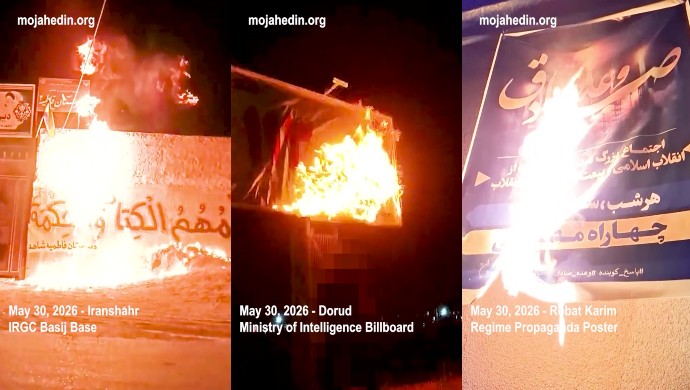

On May 30, 2026, the PMOI/MEK Resistance Units carried out coordinated operations across Iran to defy the regime’s escalation of executions. The operations also served as a direct response to proponents of the former Shah’s secret police, SAVAK, who have threatened Iranian freedom fighters.
Demonstrating a clear stance against authoritarianism, the Resistance Units targeted state centers and symbols of repression under the unifying slogan, “Down with the oppressor, be it the shah or the supreme leader.” This message reflects a complete rejection of both the past monarchical system and the current religious dictatorship.
Coordinated strikes against state symbols and security bases
The activities spanned major cities and towns throughout the country. In Tehran, Karaj, Mashhad, Ilam, and Baghmalek, Resistance Units set fire to large posters of the former Supreme Leader Ali Khamenei. In Shiraz, a poster of regime founder Ruhollah Khomeini was set on fire, while in Zahedan, a poster featuring both Ali Khamenei and the new Supreme Leader Mojtaba Khamenei was torched.
May 30—Iran
PMOI/MEK Resistance Units carry out daring operations across Iran in defiance of the regime's executions and in response to the promoters of the shah's brutal SAVAK police who threaten Iran's freedom fighters.They targeted centers and symbols of repression with the… pic.twitter.com/SNErsleKVV
— People's Mojahedin Organization of Iran (PMOI/MEK) (@Mojahedineng) June 2, 2026
Several operations focused on the regime’s security and intelligence apparatus. Resistance Units targeted IRGC Basij bases in Kahnuj, Karaj, Iranshahr, and Zahedan, and set fire to a prominent billboard promoting the Ministry of Intelligence in Dorud. In Robat Karim and Sabzevar, propaganda banners were torched, and in Shiraz, a unit member set fire to a Khamenei banner while chanting, “Salute to Rajavi, Salute to the National Liberation Army of Iran.”
The context of escalating executions and state repression
These operations took place against a backdrop of severe state repression. Following the nationwide uprisings of January 2026 and the subsequent massacres, the Iranian regime has found itself in an impasse, unable to return to the status quo or move forward.
Consequently, authorities have intensified their crackdowns, using arbitrary street searches, and a “strategy of the noose” to carry out a bloody purge of prisons. The regime recently sent eight members of the PMOI and seventeen rebellious protesters to the gallows. Since the outbreak of the war, dozens of young people have been executed for participating in uprisings or fighting the Revolutionary Guards.
Karaj
Resistance Units torch a large poster featuring Ali Khamenei pic.twitter.com/UDU5s1AkkX— People's Mojahedin Organization of Iran (PMOI/MEK) (@Mojahedineng) June 2, 2026
Furthermore, the chief of the State Security Force reported that 6,500 people have been arrested since the war began, with 567 of them connected to the PMOI. The regime remains in a state of terror following an assault by 250 MEK freedom fighters on Khamenei’s headquarters five days prior to the forty-day war, realizing this offensive has galvanized a new generation toward the National Liberation Army.
Rejecting the dual threats of monarchy and the clergy
The struggle of the Iranian public faces challenges from both the current religious regime and the remnants of the Shah’s monarchy. While the ruling clergy carries out executions, the remnants of the monarchical dictatorship have undermined the movement by advocating for the resurrection of the SAVAK intelligence service.
This faction has labeled the aspirations of Kurdish, Baluchi, Turkmen, and Arab populations as “separatism” and has called for the implementation of martial law in Iranian cities. Additionally, the opposition movement faces betrayal from those who have sought the path of appeasement to preserve the regime.
In response, the domestic resistance continues to push for a democratic republic. The National Council of Resistance of Iran (NCRI) has announced a provisional government based on its Ten-Point Plan, promoting a democratic republic with gender equality, the separation of religion and state, and autonomy for oppressed nationalities, establishing a path forward that avoids both the current autocracy and a return to monarchy.