

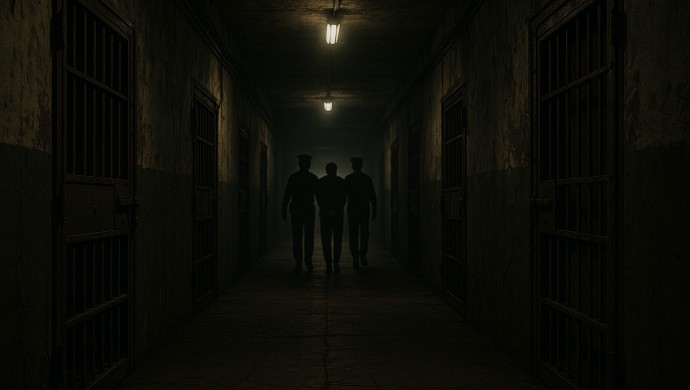

On April 13, 2026, the Iranian regime’s judiciary authorities orchestrated a sudden and violent transfer of political prisoners from Ward 7 of Evin Prison to solitary confinement in Unit 3 of the notoriously brutal Ghezel Hesar Prison. This violent relocation, characterized by severe physical abuse and absolute secrecy, exposes the regime’s deep-seated fear of prisoner solidarity and its systematic use of psychological and physical torture to break the will of dissidents, particularly those affiliated with the People’s Mojahedin Organization of Iran (PMOI/MEK).
The horrific details of the transfer
The transfer of the prisoners was carried out with extreme brutality. On April 12 and 13, 2026, Evin’s guards moved the prisoners while they were handcuffed, shackled, and blindfolded. Before their departure from Evin, the guards forcibly shaved their heads and severely beat them with water hoses, inflicting serious injuries. The beatings left the political prisoners, including Mehdi Vafaei Sani and Mir Yousef Younesi, severely injured.
Following this abuse, they were transferred to Unit 3 of Ghezel Hesar, a section directly overseen by regime intelligence agencies that is known for harsh solitary confinement and a complete lack of basic amenities.
The pretext for this sudden crackdown was a simple act of remembrance. According to informed sources, the political prisoners had organized a memorial to honor six recently executed political prisoners, distributing food among inmates. Following the recent wave of executions, the regime’s security apparatus is terrified of any collective action or protest within the prison walls. They responded to the memorial with disproportionate violence to instill fear and control the prison environment.
The persecution of Mehdi Vafaei Sani and his family
One of the primary targets of this cruelty is Mehdi Vafaei Sani, a 40-year-old political prisoner who was arrested in May 2022 and sentenced to six years in prison on charges of “propaganda against the regime,” “assembly and collusion,” and connections to the PMOI.
Mehdi is no stranger to regime brutality; during the Evin Prison fire on October 15, 2022, he was shot and injured by regime agents. The regime is also collectively punishing his family. His mother, Shiva Esmaeili, is currently serving a 10-year sentence in the Women’s Ward of Evin Prison. Furthermore, his cousin, Mohammad Javad Vafaei Sani, is imprisoned in Vakilabad Prison in Mashhad and sits on death row on charges of membership in the PMOI.
Cruelty against Mir Yousef Younesi
The regime’s ruthlessness extends to the elderly, heavily impacting Mir Yousef Younesi, a political prisoner in his seventies. Arrested without a warrant in late December 2022 during the nationwide protests, Younesi has spent over three years and four months in limbo.
His detention included three and a half months in solitary confinement under severe interrogation in Wards 209 and 240 of Evin Prison. The regime has continually denied him necessary medication, ignoring fundamental human rights standards that demand specialized medical care for elderly inmates.
A broader crackdown on the Iranian Resistance
The violence at Evin was not an isolated incident. Simultaneously, regime authorities transferred three other political prisoners—Abolfazl Rahbar, Omid Rahbar, and Farshid Dolatyari—from Fashafuyeh Prison (Greater Tehran Prison) to Ghezel Hesar.
The stated charge for these three men is membership in the PMOI, highlighting the regime’s targeted campaign to eradicate the organized resistance. These men are now crowded into a small, ill-equipped cell in Ghezel Hesar alongside Mehdi Vafaei Sani, completely cut off from the outside world and facing dire health and safety risks.
The secret relocation, physical torture, and denial of medical care to PMOI members and other dissidents in Ghezel Hesar’s slaughterhouse put their lives in imminent danger. The international community cannot remain silent. The Iranian Resistance calls on the UN Special Rapporteur, the Human Rights Council, and the International Fact-Finding Mission to take immediate action. International bodies must demand an emergency visit to Unit 3 of Ghezel Hesar to ascertain the physical conditions of these prisoners, protect their lives, and ultimately work toward the unconditional freedom of all political prisoners in Iran.