

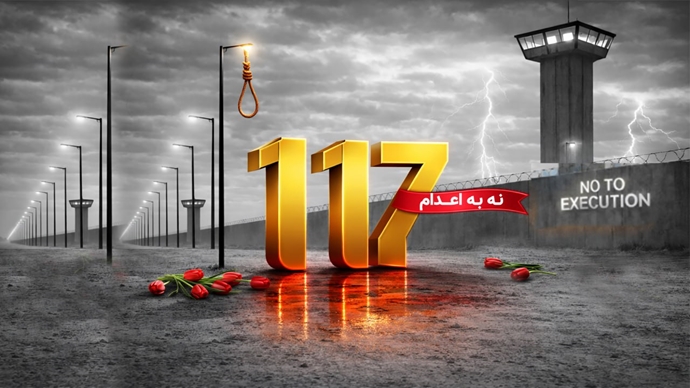

Prisoners across 56 facilities in Iran held the 117th week of the “No to Executions Tuesdays” hunger strike on April 21, 2026. The campaign released its first statement after a 52-day internet and digital blackout, revealing that Iranian authorities utilized the shadow of recent regional conflicts to systematically execute at least 12 political prisoners between late March and mid-April.
In their statement, the campaign condemned the execution of PMOI members Hamed Validi and Mohammad Masoum-Shahi, on April 20.
They also expressed their outrage to the incident on the night of March 29, where prison guards in Ghezel Hesar prison, led by Ashkan Kamali, Hassan Ghobadi, and Ghasem Sahraee violently raided the political prisoners’ ward in Unit 4. The guards severely beat the inmates—most of whom were campaign members—before removing them from the ward and transferring them to solitary confinement.
Following the raid, authorities hanged six members of the “No to Executions Tuesdays” campaign, PMOI members Vahid Bani-Amerian, Pouya Ghobadi, Shahrokh (Akbar) Daneshvarkar, Babak Alipour, Mohammad Taghavi, and Abolhassan Montazer.
The prisoners, who were sentenced to death by the criminal Judge Iman Afshari, were executed before their legal proceedings had concluded and without being granted final visits with their families. During this same period, the regime executed four political prisoners from the December 2025–January 2026 nationwide uprisings: Amirhossein Hatami, Mohammad-Amin Biglari, Shahin Vahedparast, and Ali Fahim. None of their families received a final visit, and the state has continued to psychologically torture the families by refusing to hand over the victims’ bodies.
The striking prisoners accused the government of exploiting the recent regional war and domestic martial law to eliminate political opponents through fabricated charges. “The executioner government, fearing public sentiment and anger over these executions, is desperately attempting to accuse these prisoners and other recent detainees of espionage and links to Israel to justify its executions under wartime conditions,” the statement read. The prisoners described the ruling establishment as “the heir of Khomeini, who saw war as a blessing and an opportunity to kill and hang.”
The campaign warned that many protesters detained during the December 2025–January 2026 uprisings remain in total incommunicado detention. According to the statement, dozens of young detainees are currently held in solitary confinement in Ward 35, Unit 3 of Ghezel Hesar prison, where their lives are in grave danger. “Now that war and its tragedies have cast a shadow over Iran and all attention is focused on it, the illegitimate ruling government is carrying out systematic executions to create a climate of fear and terror in society to prevent an uprising and revolution,” the prisoners wrote.
Calling on international human rights bodies to intervene and save those on death row, the campaign also expressed its solidarity with the families of the executed who have continuously protested “in the heat and cold.” The campaign urged domestic activists, unions, and the public not to be intimidated by the heavy security presence and to protest the long lines of executions by any means necessary, concluding: “Undoubtedly, the future belongs to those who have paid the price of freedom.”
The April 21 hunger strikes took place across 56 facilities, including Evin Prison (women’s and men’s wards), Ghezel Hesar Prison (units 2, 3, and 4), Karaj Central Prison, Greater Tehran Prison, Qarchak Prison, Zahedan Prison (women’s and men’s wards), Mashhad Prison, Tabriz Prison, Urmia Prison, Sanandaj Prison, Rasht Prison (women’s and men’s wards), Adelabad Prison in Shiraz (women’s and men’s wards), and dozens of other prisons nationwide.