

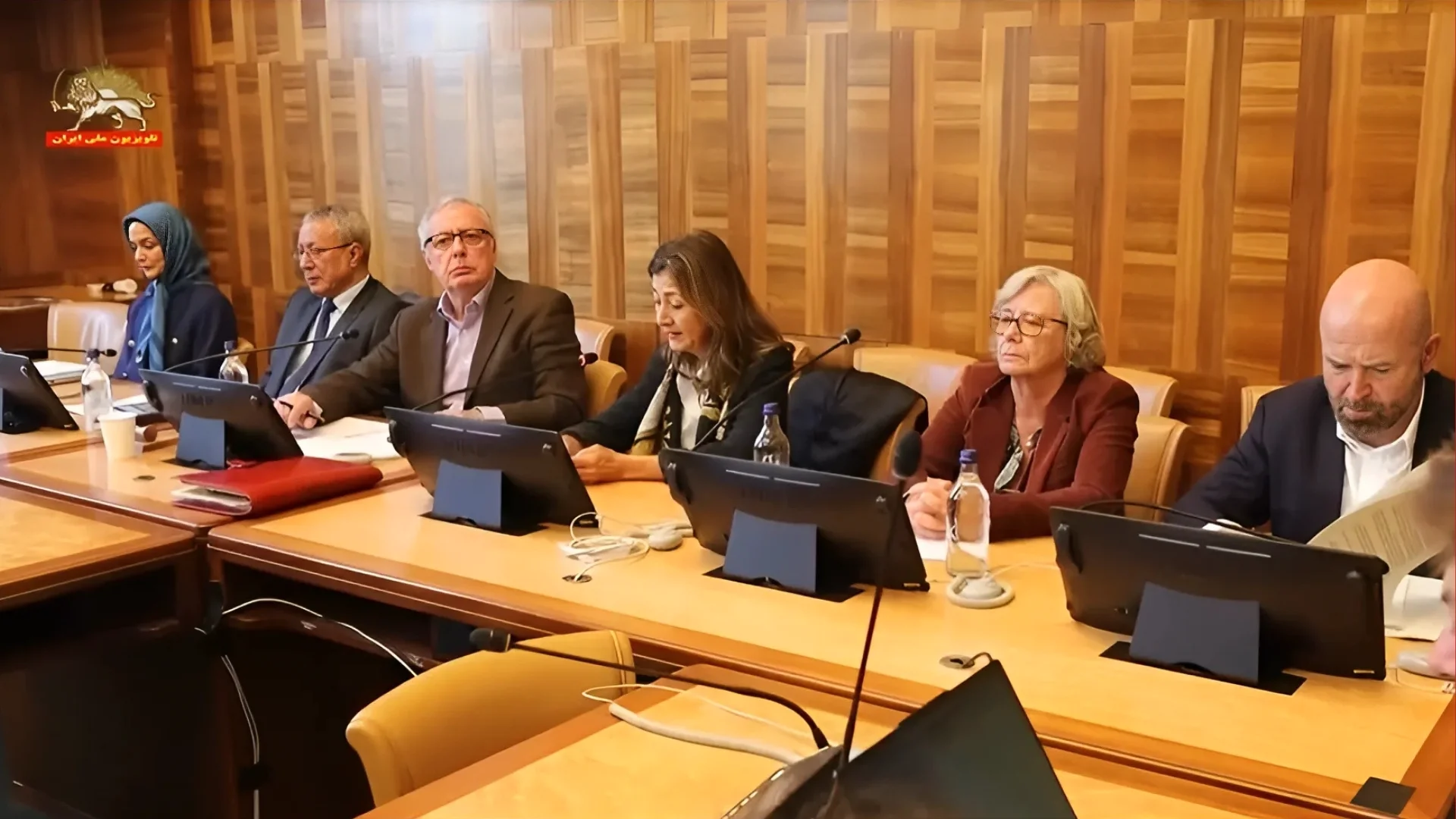

Against the backdrop of the 60th session of the UN Human Rights Council, a conference at the United Nations European headquarters sounded the alarm on the escalating human rights crisis in Iran. The event brought together prominent political figures, international jurists, parliamentarians, and human rights advocates to address the Iranian regime’s surge in executions and its culture of impunity, with a particular focus on the unpunished 1988 massacre of political prisoners.
A stark warning on the state of human rights in Iran
In a video message, Maryam Rajavi, the president-elect of the National Council of Resistance of Iran (NCRI), delivered a stark assessment of the situation, stating that human rights in Iran “urgently demand the world’s attention.” She detailed a horrifying wave of executions, noting that since early July, at least 450 people had been executed, bringing the total over the past 14 months to 1,850, including 59 women.
Mrs. Rajavi highlighted that the regime’s repression specifically targets members and supporters of the People’s Mojahedin Organization of Iran (PMOI/MEK), with courts using the charge of bagh-ye (rebellion against the regime) to issue death sentences without exception.
Inside prisons 87 weeks have passed with the campaign of “No to Execution Tuesdays.” In this campaign prisoners in 52 prisons stage hunger strikes every Tuesday.
Some one and a half to two million people are arrested in Iran every year.#StopExecutionsInIran… pic.twitter.com/e9GiFapjaL— Maryam Rajavi (@Maryam_Rajavi) September 30, 2025
She pointed to the recent executions of Behrouz Ehsani and Mehdi Hassani on this charge and warned that fourteen more face the same fate. Despite the regime’s brutality, she noted the resilience of the Iranian people, highlighting the growing “No to Execution” social movement and the weekly hunger strikes held by prisoners in 52 prisons across the country.
Mrs. Rajavi issued a clear call to action, urging the international community to break its silence. “Governments and United Nations bodies must end this unjustified impunity,” she declared, adding that states should use universal jurisdiction to issue arrest warrants for regime leaders. She concluded by linking the domestic struggle to global security, stating, “The Iranian people’s struggle for freedom is also a struggle for peace in the region and the world. It is upon the international community to stand with them and to recognize their fight for freedom, justice, and human rights.”
The death penalty as a tool of political repression
Speakers at the conference condemned the Iranian regime’s use of capital punishment not as a judicial measure, but as a systematic tool for political control and suppression of dissent. Tahar Boumedra, a legal expert and president of Justice for Victims of the 1988 Massacre in Iran (JVMI), explained that the regime has used the death penalty “from the very beginning… as a means of persecuting anybody who opposes that regime.” He noted that Iran officially rejected a 2007 UN resolution calling for a moratorium on the death penalty, a decision whose consequences are seen today in the staggering execution figures.
Laurence Fellman Rielle, a Swiss Member of Parliament, echoed this sentiment, pointing out that public hangings are used “to sow fear among the population” and that the death penalty has become “a tool of political repression.” She stated bluntly, “In Iran, criminality is often synonymous with opposition to the regime.”
The conference also shed light on the complete lack of due process in Iran’s judicial system. Mr. Boumedra detailed how fundamental legal safeguards are ignored, with the “presumption of innocence” replaced by a “presumption of guilt.” He explained that arrested individuals are denied access to lawyers and time to prepare a defense, making the resulting executions a form of extrajudicial killing. He recalled the 1988 massacre, where political prisoners were condemned to death by commissions after hearings lasting only a few minutes.
The shadow of the 1988 massacre and warnings of its repetition
A central theme of the conference was the enduring legacy of the 1988 massacre, in which an estimated 30,000 political prisoners, the vast majority affiliated with the PMOI, were executed over a few months. Speakers warned that the impunity for that crime against humanity has emboldened the current regime to threaten a repeat of such atrocities. Maryam Rajavi noted that “state-controlled media openly call for repeating the major crimes of the past,” a point powerfully reinforced by other panelists.
Ingrid Betancourt, former Colombian Senator and presidential candidate, issued a chilling warning: “Today, Iranian officials and state-controlled media openly glorify the 1988 massacre as a positive and successful experience, and they call for it to be repeated. This is a chilling declaration of criminal intent.”
Safora Sadidi, a member of the NCRI whose father was executed in the 1988 massacre, explained the direct link between past impunity and present crimes. “The question is why does this continue?” she asked. “Because the crime of 1988 was never investigated and because the perpetrators were never held accountable, and because the international community chose silence over justice.” She revealed that the IRGC-affiliated Fars News Agency recently published an editorial describing the 1988 massacre as a “successful historical experience” just before the regime executed two PMOI supporters.
A UN conference in Geneva highlighted Iran’s rising mass executions & lack of int’l accountability.@Maryam_Rajavi reiterated the call for an arrest warrant for Khamenei, stressing that democracy in Iran affects peace & stability in Middle East &the worldhttps://t.co/XTqOJtlPLB
— Safora Sadidi (@SaforaSM) October 1, 2025
In a deeply moving testimony, Elham Sajedian spoke of her father, Mohammed Sajedian, an engineer and PMOI supporter who was publicly executed in 1985 after being held for only fifteen days. “His body bore clear marks of torture from head to toe,” she recounted. “We were not allowed to put his name on the tomb. I grew up seeing my father’s unnamed grave.” Her story provided a personal and devastating glimpse into the regime’s long history of brutality against its opponents.
The regime’s attempt to erase evidence of its crimes
Beyond ongoing executions, the conference highlighted the regime’s systematic efforts to erase the memory of its past crimes. Nicolas Walder, a member of the National Council of Switzerland, drew attention to a report from Amnesty International concerning the destruction of graves of political prisoners at the Behesht-e Zahra cemetery in Tehran. He described the construction of a parking lot over a memorial site as “not just an insult to the victims, it is an attempt to make all evidence of past crimes against humanity disappear.” Mr. Walder underscored the regime’s direct culpability, noting that Tehran’s Deputy Mayor confirmed the destruction was authorized by the authorities, which he called a “chilling admission of the impunity enjoyed by those responsible for these atrocities.”
An urgent call for international accountability
Throughout the event, speakers issued a unified and urgent call for the international community to move beyond condemnation and take concrete action to hold the Iranian regime accountable. Ingrid Betancourt challenged the UN Human Rights Council directly, stating, “Words of condemnation are no longer enough. Action is required.” She called upon member states “to table a resolution mandating an international investigation into the ongoing executions in Iran and into the 1988 massacre.”
Gianfranco Fattorini, representing the Mouvement contre le racisme et pour l’amitié entre les peuples (MRAP), reminded the audience of a previous UN Special Rapporteur’s report which concluded that the 1988 massacre constituted “crimes against humanity and genocide.” He quoted the report’s recommendation for the international community “to establish an international investigative and accountability mechanism” to gather evidence for future criminal prosecutions of all perpetrators.
Safora Sadidi made a direct appeal to the current UN Special Rapporteur on Iran, Ms. Mai Sato, “to urgently investigate the threat of mass executions of political prisoners in Iran,” warning that dozens are currently at imminent risk.
The Iranian people’s struggle for freedom is also a struggle for peace in the region and the world. It is upon the international community to stand with them and to recognize their fight for freedom, justice, and #HumanRights.https://t.co/Co55B86TPD pic.twitter.com/a8Ajn3Ac3G
— Maryam Rajavi (@Maryam_Rajavi) September 29, 2025
Support for the Iranian resistance and its democratic alternative
The conference also served as a platform to voice strong support for the organized Iranian Resistance and its vision for a free and democratic Iran. The courage of those resisting from within Iran’s prisons was powerfully illustrated by Tahar Boumedra, who shared a translation of a chant from inmates on death row in Evin Prison: “To defy that penalty, we sacrifice our lives, but we will not abandon freedom. We swore by the blood of our companions, we shall stand firm until the very end.”
Ingrid Betancourt paid tribute to the executed PMOI members Behrouz Ehsani and Mehdi Hasani, quoting their final, defiant statements. Mehdi Hasani had declared, “I proudly declare that I am very happy to give my life for the freedom of my homeland… I am a supporter of the PMOI and nothing else.” For Ms. Betancourt, these words “embody the resilience of a people who refuse to bow to tyranny.”
Swiss MPs Nicolas Walder and Laurence Fellman Rielle both explicitly endorsed the Ten-Point Plan for a future Iran articulated by Mrs. Rajavi. Mr. Walder expressed his “support for the Ten-Point Plan of Madam Rajavi… that defends a democratic and secular future, based on gender equality, the abolition of the death penalty, and the respect for fundamental rights.” Ms. Fellman Rielle also declared her firm support for the plan and its vision for a secular, democratic republic. Their endorsements signaled growing international political recognition of the NCRI as a viable alternative to the current theocracy.