

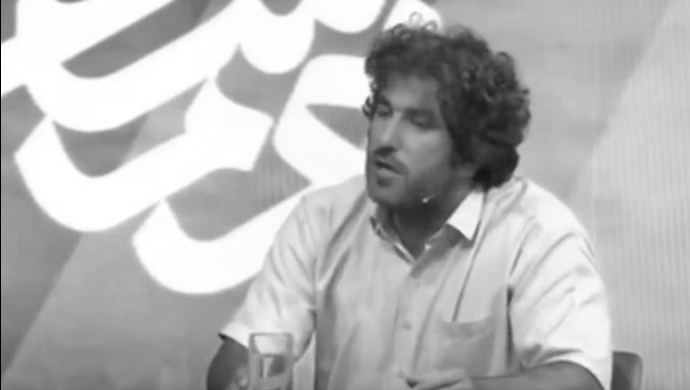

In a moment of startling candor on state television, a regime-linked propagandist has inadvertently confessed to Tehran’s four-decade failure to extinguish its main opposition, the People’s Mojahedin Organization of Iran (PMOI/MEK). The comments reveal a deep-seated fear within the ruling establishment, confirming that the PMOI remains the principal and most organized threat to its survival.
On June 25, 2025, documentary maker and security apparatus mouthpiece Javad Mogoui appeared on state television and compared the regime’s current precarious state to 1981, a year he described as “the worst year in the history of the revolution.” He recounted the era with a sense of dread, reminding viewers of the PMOI’s formidable power.
“On June 20, 1981, the Monafeghin [a pejorative term for the PMOI] declared armed struggle and poured into the streets,” Mogoui said. “The head of Evin prison had no security inside Evin itself… 100,000 members of the Mojahedin-e Khalq organization, armed, poured into the streets… They hit the room of Mohsen Rezaei, the commander of the IRGC’s intelligence.”
While he attempted to conclude with a note of false confidence, claiming the regime is stronger today after 45 years, his historical framing exposed the leadership’s current anxieties.
His attempt at bravado is starkly contradicted by his own, more honest assessment from two years ago. In an interview with Etemad Online on July 18, 2023, he admitted that the regime’s decades-long propaganda campaign to erase the PMOI from public consciousness had utterly failed.
“There were policies on television in the 1990s to stop talking about the Mojahedin, that they are finished,” he confessed. “[But we saw that] in the 2000s, they completely rebuilt themselves in public opinion.” He pointed to the 2017 presidential election as proof, noting, “What was the issue of the 2017 election? The executions of 1988.” This admission confirms that the 1988 massacre of 30,000 political prisoners, the vast majority of whom were PMOI members, is not a forgotten historical event but a living issue that continues to define the political landscape and haunt the regime.
In the same 2023 interview, Mogoui explained precisely why the PMOI threat endures: it is embedded in the social fabric of Iran through the families of its martyrs. “Someone who was executed in 1981, or was killed in Mersad [Operation Eternal Light] or in various other incidents, has a family,” he stated. “And they have a stronger motivation to overthrow the system that killed their child.”
To illustrate his point, he offered a powerful example from his home province of Lorestan. “In Dorud, which is only 15 kilometers away from Azna, when unrest breaks out, there are seven or eight fatalities. What is the reason? The main reason is that Dorud has people who were executed in the 1980s, and the area is volatile.” He concluded that the sacrifice of these individuals created fertile ground and a powerful “motivation for overthrow,” which can turn any protest into a full-scale uprising. This network of families, he acknowledged, has the power to transform dissent into revolution.
This is not a new revelation but a truth the regime’s leadership has understood from the beginning. During the 1988 massacre, Khomeini’s then-deputy, Hossein-Ali Montazeri, issued a stark warning against the mass execution of PMOI prisoners. In a letter to Khomeini, he wrote, “The Mojahedin-e Khalq are not individuals. They are a way of thinking, a line of logic… It cannot be resolved by killing; rather, it will be promoted.”
Montazeri, a high-ranking cleric who understood the regime’s inner workings, foresaw that brutal repression would only ensure the survival and spread of the PMOI’s ideology. His warning went unheeded, and today, Mogoui’s words prove him right.
Mogoui’s unwitting confession on state television is a clear sign of the regime’s desperation. It acknowledges that after four decades of executions, torture, and demonization, the PMOI not only endures but stands as the most significant force for change in Iran. If Khomeini’s genocidal fatwa in 1988 failed to crush the movement, the current, crisis-ridden regime stands no chance of doing so. The spirit of resistance, nurtured by generations of sacrifice, is alive and well, proving that the greatest threat to the mullahs is the unyielding will of the Iranian people and their organized opposition.