

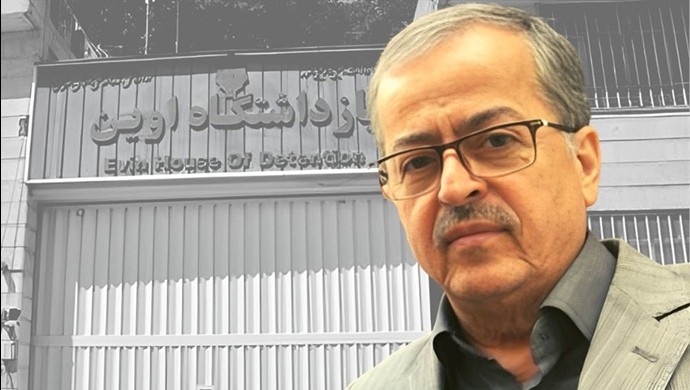

Mir-Yousef Younesi, a 70-year-old political prisoner with a long history of enduring the Iranian regime’s brutality, began a hunger strike on Tuesday, May 13, 2025. His protest is a response to his forced and violent transfer to Ward 7 of Evin Prison, a section designated for inmates convicted of common criminal offenses, further endangering his already precarious health. This move is another vindictive measure by the clerical regime to increase pressure on dissenting voices.
The transfer occurred a week prior, on Tuesday, May 6, 2025. Mr. Younesi was returning from a visitation with his son, Ali Younesi—himself a detained elite student—when repressive security forces “forcibly and violently transferred” him to Ward 7, according to a statement by the National Council of Resistance of Iran (NCRI). The authorities callously informed them that father and son “could not remain in the same ward and must be held in separate sections,” abruptly severing their limited contact.
A life marked by resistance and repression
Mir-Yousef Younesi is no stranger to the Iranian regime’s dungeons. He has spent a staggering total of 14 years incarcerated for his support of the PMOI. He also served time in prison during the Shah’s dictatorship for his political activities. He was also imprisoned during the 1980s under the mullahs. Since December 2022, he has been held in the notorious Evin Prison.
Compounding his unjust imprisonment are severe health issues. Mr. Younesi suffers from diabetes and significant hearing loss. Despite his age and these conditions, the regime has systematically “denied [him] access to a doctor, medication, and medical care,” according to the NCRI, a cruel tactic often employed against political prisoners, tantamount to a slow execution. During the sudden transfer to Ward 7, he was reportedly not even allowed to take his essential medication with him.
Solidarity from fellow prisoners and broken promises
The regime’s attempt to further isolate and demoralize Mr. Younesi was met with immediate defiance from his fellow inmates. On the same day as his transfer, political prisoners in Evin’s Ward 4 courageously “staged a sit-in in front of the guard officer’s office and the criminal head of the ward, Ghasemi, to protest the sudden and forced transfer.” Their demand was clear: the immediate return of Mir-Yousef Younesi to Ward 4.
In a typical deceptive maneuver, prison authorities promised the protesters that he would be brought back. However, as of May 13, a full week had passed, and Mr. Younesi remained in the ward for common criminals, prompting his hunger strike. This is another instance of the regime’s utter disregard for the basic rights and dignity of political prisoners.
A family targeted
The persecution of Mir-Yousef Younesi is intertwined with the regime’s targeting of his family. His son, Ali Younesi, a 25-year-old award-winning computer engineering student from the prestigious Sharif University of Technology, was arrested in May 2020. Along with another elite student, Amirhossein Moradi, Ali was sentenced to 16 years in prison on politically motivated charges after enduring severe torture and long periods of solitary confinement. According to the regime’s own laws, their sentences should have been significantly reduced after five years, leading to their release, but the judiciary has deliberately refused to implement this.
The case of Mir-Yousef Younesi is a stark reminder of the escalating pressure on political prisoners in Iran, a tactic employed by a regime terrified of its own people and the growing organized resistance.
In response to these developments, the NCRI called on “the UN Human Rights Council, the UN High Commissioner for Human Rights, the UN Special Rapporteur on the situation of human rights in Iran, and all international human rights bodies to condemn the regime’s brutal treatment of political prisoners and to take urgent action for the release of ailing detainees.”