

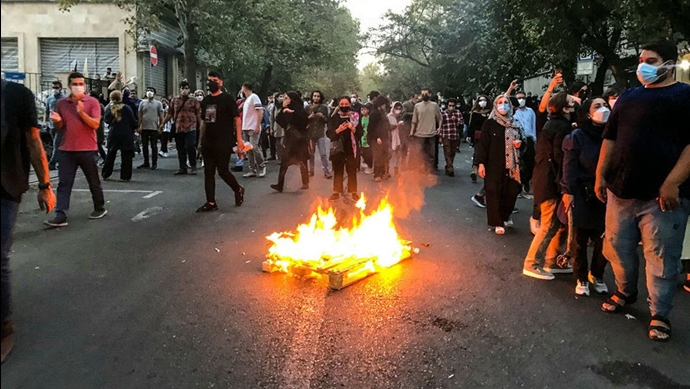

At the beginning of the new Persian year, Iran’s regime finds itself surrounded by multiple crises: a pivotal and high-stakes negotiation with the United States, the repeated collapse of its proxy forces in the region, the intensification of internal conflicts and fractures within the regime’s structure, a deepening economic crisis, a society enraged by inflation and poverty, and a rapidly escalating class divide poised for a sudden eruption.
Among these concurrent crises, which one truly threatens the regime and evokes the most fear within it? The outcome of the negotiations will affect the other crises, but the immediate and primary concern of the regime Supreme Leader Ali Khamenei and the regime is the angry society on the verge of explosion. There is no doubt that while advancing negotiations, the regime’s main preoccupation is how society will react to the outcome and how that connects with the volatile atmosphere. That’s why, in parallel with the talks, the regime has ramped up executions to intimidate a society ready to explode.
There is no doubt that the rapid worsening of the economic crisis, marked by the exponential widening of the class divide, has become an uncontrollable monster threatening the regime. This monster is steadily moving toward a final reckoning with the regime. In recent weeks, regime officials and media outlets have spoken and warned about the link between the rising dollar exchange rate and foreign policy. Now, all these issues have merged into a unified crisis, becoming highly sensitive to the outcome of negotiations with the United States.
The tangible and measurable indicators of an explosive society as the main ambush point against the regime are increasing polarization, deep class divides, and uncontrollable prices under current conditions. Regime-aligned media have highlighted these realities as warnings to the regime’s operatives.
In the April 15, Arman-e Melli newspaper quoted a political sociologist, as saying, “Polarization in our society is increasing. These divisions are now apparent even to the officials.”
What has become “apparent to officials” is that this polarization feeds directly into the simmering social anger. The same newspaper quoted the regime’s interior minister stating that their entire “effort” is to prevent these “polarized and social phenomena” from becoming security issues:
“We have tried to prevent society from becoming polarized. At the Ministry of Interior, we are working to ensure that social phenomena do not turn into security issues.”
Also, on April 14, Arman news website warned about the lurking monster in the regime’s path and stated:
“The class divide is deep… The main cause of violence that exists in our society today is economics.”
On April 15, Jahan-e Sanat news website reported examples of price controls spiraling out of control and fueling public and class-based anger:
“Buying fruits and vegetables individually or in small bundles now seems normal and rational. Each apple costs nearly 150,000 rials on average. A single potato is 125,000 rials. A banana costs 250,000 rials. A Filipino banana goes for around 2.4 million rials. Organic bananas, sold in bunches, cost 3.4 million rials.”
All the crises are converging from different directions. Among them, the angry society poised to erupt remains the central and ultimately decisive factor. This is a society in which the outcome of negotiations, the escalation of infighting among power-hungry and wealth-seeking factions, and the worsening class divide have become intimately tied to daily personal and social survival—and have taken on the nature of a response to a historic opportunity. That is why, at the negotiating table, Khamenei’s foremost concern is the explosive society—not the outcome of the negotiations.