

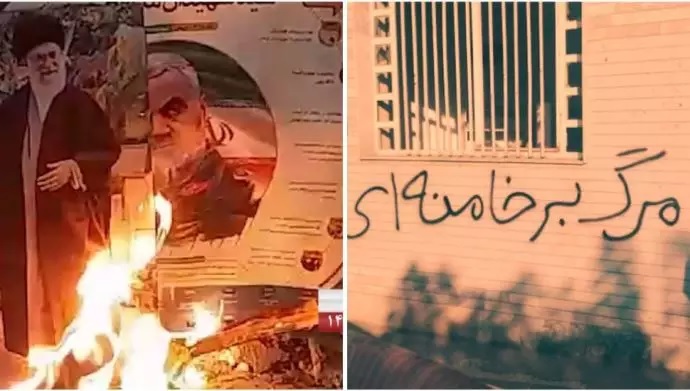

What is the main challenge between the people of Iran and the ruling regime? The core issue lies in the fundamental conflict between the needs and demands of the people and the structure, policies, and nature of this regime. This deep divide stems not only from managerial decisions or executive policies but from the regime’s inherent nature and philosophy, which presents itself as a totalitarian ideology. This ideology, along with all its political, social, economic, and regional outputs, has now reached a deadlock and failure.
On December 25, Etemad newspaper explicitly described the regime’s arrival at a thick wall of deadlock: “Iran today faces a multitude of complex, intertwined, and structural crises. These crises require fundamental changes in policymaking, structural reforms in the economic, social, and cultural systems, and a redefinition of power relations and governance.”
One method to examine the regime’s nature and “power relations” is to compare news events with the identity and behavior of its structure. For example, the increase in executions over a short period is not merely a judicial occurrence but reflects the regime’s latest resort to controlling an explosive society. The following example is a clear testament:
During the first 150 days of Masoud Pezeshkian’s presidency, 683 executions were carried out—an average of 4.5 per day. These figures highlight a deep challenge between the regime and most of the people. This challenge reveals that despite Pezeshkian’s pleading rhetoric, people no longer differentiate between the regime’s various factions because both ultimately uphold structural principles and frameworks that ignore the demands of the majority.
A Wound That Won’t Heal
The solidarity of public discontent has turned into a deep wound against the regime. This wound is the result of accumulated repression, disregard for human rights, widespread corruption, and economic inefficiencies. While mass repression and executions delay calling for justice from various groups, they have never succeeded in halting or ending them. This process shows that healing the social and political wounds in Iran has become inseparable from rejecting the regime’s structure.
The conflict between the people and the regime is not a manageable one within the existing framework. As such, public calls for justice can only succeed if they result in the complete rejection of this structure. When the scope of rejecting the clerical regime’s dominance reaches millions, it signifies that there is no hope for fundamentally rebuilding the power structure to establish a system that represents the rights and demands of the majority.
In reflecting the deadlock of any change within regime through the lens of Iranian scientific elites emigrating abroad, the state-run Hamdeli newspaper, on January 25, wrote, “Scientific elites, university graduates, winners of domestic and international scientific festivals, doctors, and nurses, as well as unskilled and skilled labor forces, are among the groups most inclined to emigrate from the country. Migration is taking on new dimensions daily… The Financial Times has published new information on the emigration of Iranians abroad, indicating that between 2020 and 2021, Iranian emigration increased by 141%, marking the fastest growth rate in the world.”
The Critical Wounds Between the People and the Regime
The critical wounds between the people and the regime have transformed from a series of black dots into a continuous red line.
On December 25, Jahan-e Sanat news website wrote: “In 2024, according to official reports, the poverty line was estimated and announced at 200 million rials, while the monthly minimum wage for workers this year was 71,661,840 rials. Over 60 to 70% of the population is below the poverty line, which is a major alarm for the country.”
This reality is an unstoppable flood, a wound that refuses to heal. Justice will remain elusive unless the entirety of the regime is overturned and dismantled.