

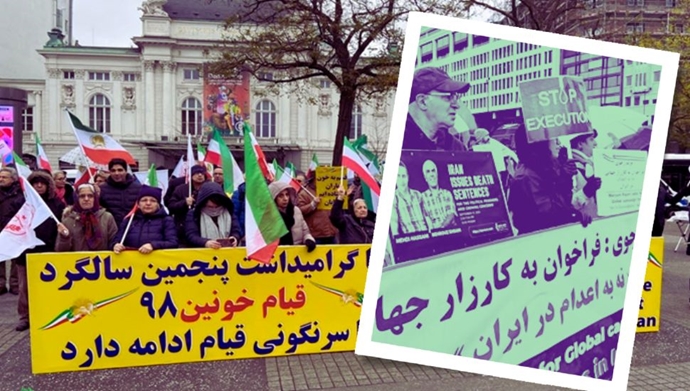

These days, all domestic, regional, and international conditions have combined to shift the balance of power between the Iranian people and the clerical regime in favor of the people.
Domestic dynamics
On the domestic front, just over 100 days after the inauguration of the Masoud Pezeshkian as the regime’s president, his failures have become apparent to everyone. After increasing the prices of bread, eggs, dairy, housing, cement, cars, road tolls, plane and train tickets, and cutting off the electricity supply, he is now working around the clock to raise fuel prices.
Of all his false promises, the only one he has truly delivered on is his commitment to continue the path of former president Ebrahim Raisi in fulfilling the directives of regime Supreme Leader Ali Khamenei, intensifying executions, amputations, and other brutal acts.
As a result, the patience of various social groups has worn thin, and they have taken to the streets. The massive demonstration of thousands of honorable retired teachers on November 20 in front of the regime’s Majlis (parliament), chanting “Cry out, cry out, against all this oppression,” is a clear example of the people’s near-explosive rage.
Regional dynamics
In the regional arena, the blows dealt to the regime’s proxies have exposed the regime itself—the root of all regional problems. The false smoke and mirrors of the “Axis of Resistance” have dissipated, and the regime’s weakness has become increasingly evident to political analysts.
Consequently, the wave of disillusionment has spread not only among the regime’s forces inside Iran but also among its regional proxies, who now angrily demand, “Where are you, Iran?” These betrayed proxies now realize their masters have treated them like disposable tools, much like the Islamic Revolutionary Guard Corps (IRGC) Basij forces who were used as cannon fodder during the Iran-Iraq war.
International dynamics
On the international stage—closely tied to the regime’s domestic and regional situation, the regime’s isolation grows day by day. The relative gap between Europe and the United States has narrowed, leaving the regime unable to exploit divisions between them.
In addition to the 71st UN resolution condemning the regime for gross human rights violations in the Third Committee of the United Nations General Assembly, the regime must also face the consequences of the IAEA Board of Governors’ resolution against its nuclear program.
The importance of the alternative
In such turbulent times, the importance of an alternative is greater than ever. Without a viable alternative to replace the regime, the Iranian people have no guarantee to overthrow the regime and establish peace and stability. A look at the past century shows that at crucial turning points, the lack of a movement that truly fights for the people of Iran and their interest can detract revolutions from their true paths and steer the country toward despotism.
The presence of a comprehensive alternative in the National Council of Resistance of Iran has dispelled all clouds of doubt and “what ifs,” presenting a clear horizon to the people.
This alternative not only assures the people of Iran but also instills confidence in the peoples and nations of the region and beyond that post-clerical Iran, under a popular government, will possess the talents and capable forces necessary to transform the country into a center of peace and reconciliation in the region.
An alternative that for over four decades has been at the forefront of the struggle against the mullahs’ reactionary regime, paying the highest costs and sacrifices with numerous martyrs. All its political stances have served the cause of the people and have aimed at undermining the clerical regime’s interests. It is a well-organized entity with experienced cadres. It maintains a organized force on the streets of most Iranian cities, has attracted numerous specialists and educated individuals eager for Iran’s liberation abroad, and is internationally recognized through hosting major gatherings. It has received endorsement from numerous prominent political figures and offers a comprehensive 10-point plan for Iran’s future, which ensures democracy and freedom.
With such an alternative, the regime’s toxic propaganda about imaginary threats following its downfall—such as the absence of an alternative, Syria-like chaos, or the disintegration of Iran—has lost its impact.
Anyone who raises their head and opens their eyes can see the solid presence, effectiveness, and extensive dimensions of this people’s alternative, which has flourished in various arenas and is ready to take on the responsibility of the transition period and transfer of power to the people of Iran.
This crucial reality was highlighted by Maryam Rajavi, the President-elect of the National Council of resistance of Iran (NCRI (in her recent remarks on November 20 at the European Parliament, where she outlined “three key points”:
“First, the religious dictatorship and its supporters claim that there is no alternative. This is an outright lie. As I have previously mentioned, world people and leaders have already stood against this falsehood.
“In addition, the mullahs argue that without them, Iran, Syria, or Libya would descend into chaos. This is the flip side of their claim that no alternative exists. When a viable alternative is present, there is no place for chaos. Millions of Iranians living abroad will return to Iran.
“Third, they falsely claim Iran will be partitioned, but this too is a lie. During the uprisings, our fellow Kurds and Baluchis chanted, “From Kurdistan to Tehran, and from Zahedan to Tehran, I sacrifice my life for Iran.” They are seeking their rights, not secession.”