

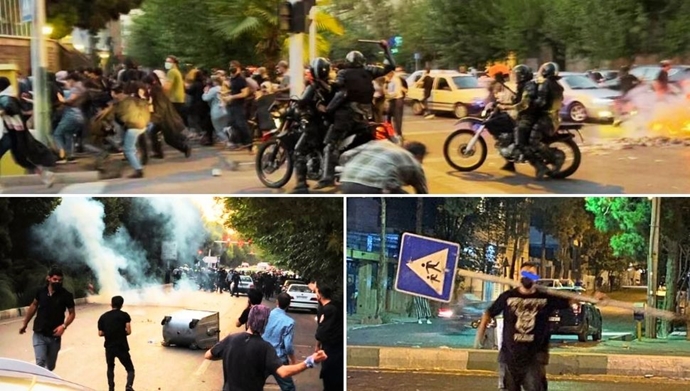

Two years have passed since Iran’s nationwide uprising of 2022. At that time, the regime was facing numerous crises, and society was in an explosive state. Four days before the protests triggered by the murders of Zhina-Mahsa Amini at the hands of the so-called “morality police,” a regime media outlet wrote:
“The people are under pressure. The people are pessimistic. They insult you, and for every insult, they hurl ten at Islam, ten at the leadership, and ten at the Imam [regime founder Ruhollah Khomeini]. You’ve made the people not only severely distrustful of the Imam, the revolution, and the system, but also angry. They are showing their anger in their words and actions. If you don’t believe it, give the people a day of freedom and see what happens” (Khabar Fouri, September 12, 2022).
Today, on the regime’s chessboard, after the death of Ebrahim Raisi, the former president of the regime known as the “Butcher of Tehran”, and after the “purified” government became trapped in endless problems, and after the relentless blows of sanctions, the leader of the Iranian regime finds himself with no way forward and no way back, stuck in a situation of “checkmate.”
On September 10, former vice president Mostafa Hashemitaba wrote an article for Shargh newspaper published an article titled “We Are Checkmate,” in which he said: “Everything, both outwardly and inwardly, shows that we are checkmate. This is not tied to one government or another, and everyone knows we are in checkmate, but they pretend not to acknowledge it and say ‘hopefully, it’s nothing.'”
He further explains to those within the regime who are looking to the West or East, seeing the solution in lifting or neutralizing sanctions:
“This checkmate is not just because of U.S. sanctions or those from Europeans and Far Easterners, but even if today we cozy up to the U.S., accept the FATF (Financial Action Task Force), and if the International Atomic Energy Agency leaves us alone, this checkmate will continue.”
Hashemitaba, who also served as the Minister of Industry, understands what he is saying. He continues: “Let’s see why we are checkmate. Gas company officials say they need at least $100 billion just to maintain the current level of gas production, and electricity officials say they need at least $100 billion to maintain the current electricity capacity. Even the honorable president himself has said we need at least $200 billion to achieve 8% GDP growth. It’s clear that when this amount of currency flows into the economy, 8% growth will happen somehow, but at the same time, everything in the country will be on the decline because numbers are lifeless—they show quantity, not quality.”
The former industry minister wants to show that even if gold were to rain from the sky, in this corrupt system, the equation cannot be changed. He writes:
“So, if this $200 billion of foreign currency enters the country, what do we plan to do with it? Electricity and gas alone need this currency. We also need $25 billion annually to buy essential goods. At least $10 billion in currency and gold will be sold in the free market to benefit smugglers and capital exporters under the illusion of unifying exchange rates, $6 billion will go toward importing gasoline, and we have to import industrial goods, medicines, medical equipment, and countless other problems, so how can this imbalance be turned into a balance?”
The historical death sentence of this bizarre, stillborn entity that calls itself the “Islamic Republic,” but in which there is neither a trace of a republic nor Islam, was issued by the people of Iran 43 years ago, on June 20, 1981, when the regime put an end to any kind of freedom and openly suppressed all forms of opposition. So, the question is, why are these realities, which the regime always tried to hide, now being acknowledged and admitted by both factions of the regime? The reality is that with the major political and social earthquakes during the uprisings of December 2017, November 2019, and 2022, Iranian society has entered a new phase.
Now, two years after the uprising, the regime’s desperate leader faces a society that has moved beyond the uprising, a society whose slogan “Death to the oppressor, be it the Shah or the Leader” has shaken the foundations of the regime. It has protesters who continuously and relentlessly cry out “Fire responds to fire.” A fire that, with a spark of popular anger, could ignite and turn the regime’s structure in its “checkmate” into ashes.