

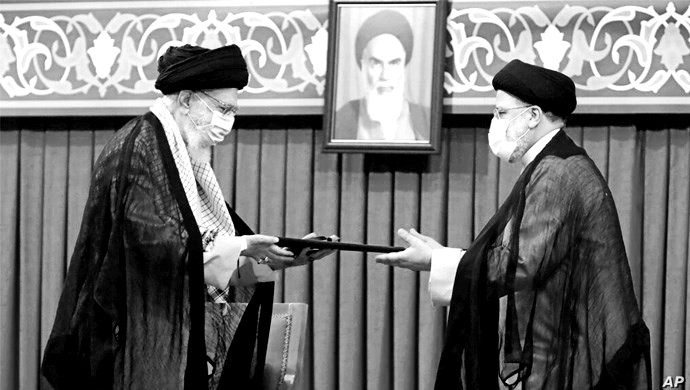

The death of Iranian regime president Ebrahim Raisi is a heavy and crushing blow in the most sensitive political and social conditions to the decaying regime of the mullahs, irreversibly disrupting the regime’s internal balance.
Raisi, due to his extensive history of execution, repression, and crime, as well as his absolute obedience to regime supreme leader Ali Khamenei, held a special role and position in the Supreme Leader’s strategy of maximum suppression.
Khamenei had earmarked Raisi years ago to advance his policy of suppression and block uprisings. Raisi started his career in Khomeini’s repressive apparatus at the age of 18. In 1984, at the age of 24, he replaced Asadollah Lajevardi as deputy prosecutor of the Revolutionary Court in dealing with “groups.” Then, in 1988, Khomeini appointed him as one of the members of the Death Committee responsible for the massacre of political prisoners. In this position, he demonstrated his cruelty and bloodthirstiness, especially in executing members of the People’s Mojahedin Organization of Iran (PMOI/MEK).
Due to these backgrounds, Khamenei took notice of him and appointed him as the custodian of Astan Quds Razavi, one of the richest economic powerhouses and centers of looting in the clerical regime. Khamenei intended to have him emerge victorious in the 2017 elections to replace Hassan Rouhani. However, the boycott of the sham election and the slogan “Neither executioner, nor charlatan” foiled this plan. Nevertheless, Khamenei did not abandon his plan to consolidate his regime through Raisi and continually looked for an opportunity to elevate him.
On May 22, 2019, in his meeting with Basij student members, Khamenei introduced the idea of a “young Hezbollahi government” as the end of his and their woes. During Nowruz 2021, Khamenei also outlined characteristics for his preferred president, which matched Raisi.
The Supreme Leader then appointed Raisi as the head of the judiciary. In the next step, Khamenei, in the 2021 election charade, eliminated rival candidates and endured the disgrace of an election where the regime had to announce a turnout below 50% for the first time, finally placing Raisi at the helm of the executive branch.
All these measures were because Khamenei saw only one way to save the regime’s shattered ship from sinking in the stormy and turbulent sea of Iranian society: maximum suppression by unifying the regime, surgically removing parts of it, and placing three discredited criminals at the heads of the three branches of government, as the last chance and final card for the regime’s survival. Among these three heads, Raisi had the primary role.
Mohammad Reza Pour-Ebrahimi, the head of the Economic Commission of the regime’s parliament, stated: “The country’s situation had become so perilous that if someone like Raisi had not entered, the system would have reached an impasse” (Resalat newspaper – June 30, 2021).
Thus, Raisi, the executioner, was the main pillar of Khamenei’s unification and suppression scheme. His main characteristic was his absolute obedience to the Supreme Leader. A lack of this trait in his predecessors led to their expulsion from the core of power. This conflict at the highest level of governance was so severe that Khamenei briefly considered abolishing the presidential system, removing the president from the government structure, and replacing it with a so-called parliamentary and prime ministerial system. However, this idea was initially shelved due to opposition from Akbar Hashemi Rafsanjani.
Raisi was the only pawn who, due to his pliability, saved Khamenei from this predicament. According to Ahmadreza Radan, a long-time IRGC commander and head of the State Security Forces, Raisi had no concern for reputation or considerations for elections, making him capable of executing Khamenei’s dirtiest and repressive policies, from mandatory hijab to maximum plundering. Under his plundering policies, during his two and a half years of presidency, he inflicted such hardship on the deprived people that few parallels can be found in Iran’s history.
Therefore, Raisi’s death, as a major and irreparable strategic blow, shatters all of Khamenei’s dreams and plans. This blow brings about chain reactions and crises throughout the religious dictatorship, paving the way for popular uprisings and the advancement of freedom-fighters and rebels.