

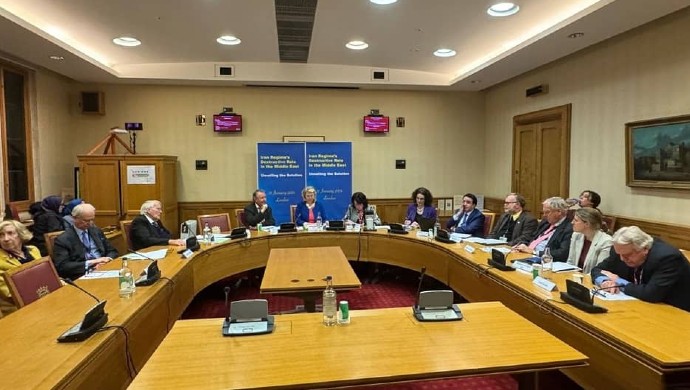

The Iranian regime is intensifying its meddling in the Middle East. This action is not driven by strength, but rather by its weakness. On the one hand, it seeks to conceal its suppressive actions inside the region by engaging in war. This can be seen from the sham trial brought forward by the judicial authorities against more than 100 members of the People’s Mojahedin Organization of Iran (PMOI/MEK). These fabricated charges pave the way for the regime to carry out further terrorist conspiracies against the Iranian Resistance, expand internal oppression and torture of dissidents, and pursue its conspiracies against the members of the resistance across the globe.
This was one of the main themes of a conference held in the British Parliament on January 31. Prominent members of the British Parliament, including former ministers and shadow government ministers, participated in this conference.
Lord David Alton said, “It’s clear that the regime has mobilized the entire state from the police, the IRGC and the armed forces, judiciary, and intelligence ministry to wage a war against the Iranian people and the resistance movement. The regime has done this while enjoying impunity both at home and abroad for these last four decades.”
The speakers discussed the regime’s situation and its warmongering tendencies, the alternative democratic situation, the explosive state of Iranian society, the role of organized resistance and Resistance Units in guiding internal developments in the country, and the necessity of correcting the policies and strategies of Western countries regarding the Iran issue.
The speeches delivered regarding the destructive role of the regime in the region have indeed substantiated the validity of the viewpoints of Iran’s resistance, as repeatedly expressed over the years by Mrs. Maryam Rajavi, The President-elect of the National Council of Resistance of Iran (NCRI). Throughout these years, she has repeatedly warned about the destructive dangers of the regime’s influence in the region and has emphasized the necessity of adopting a firm policy against religious fascism.
Regarding this matter, Mrs. Ana Frith, the senior representative of the House of Commons who chaired the session, said, “I believe that the path to peace in the Middle East begins with a firm and united stand against the Iranian regime.
“I pay tribute to the younger generation of Iranian men and women organized in the form of Resistance Units who have qualitatively and quantitatively expanded their activities nationwide.”
Regarding the current situation in Iran, the common theme of the speeches was the acknowledgment of the revolutionary conditions within the vibrant and tumultuous society of Iran. It is a situation where women and Resistance Units play a defining role.
On this matter, Baroness Eaton stated, “Women leadership of Resistance Units inside Iran and of the uprising shows the power of women in Iran. Our government should support them and recognize the right of the Iranian women and youths in the Resistance Units to fight back against this brutal IRGC.”
Mrs. Frith said that the activities of Resistance Units are “strengthening the spirit of resistance and demoralizing the regime’s suppressive forces.”
Regarding the progress of the democratic alternative and growing support the Ten-Point plan of Mrs. Maryam Rajavi, Jim Shannon, a representative of the House of Commons, underscored the urgent need for a firm policy towards the Iranian regime, advocating for a unified and strong voice from the government.
“Let us demand that the IRGC be immediately listed as a terrorist organization, and let us demand that the Iranian people’s right to fight the IRGC is recognized because it should be. The atrocities we are seeing today in this region must end,” he said.
The Shadow Minister from the Labour Party, MP Rachael Maskell, emphasized the need to support Mrs. Rajavi’s Ten-Point plan and proscribe the IRGC as a terrorist organization.
Former Minister of Environment of the United Kingdom, Ms. Theresa Villiers, urged for global recognition of the Iranian people’s quest for a democratic, secular republic that respects human rights and freedoms. She also emphasized the IRGC’s role in fomenting instability and terrorism across the Middle East and said, “Like many others here, I would like to see that sanctions regime supplemented with the proscription of the IRGC. And I hope one day that that will happen here.”
Another point of agreement among speakers and participants at the Parliament summit in the UK was the failure of Western countries’ policies towards the mullahs’ regime on the one hand, and the necessity of adopting a new policy and strategy on the other.
Member of the UK House of Lords Baron Bellingham said, emphasized the urgent need to proscribe the IRGC as a terrorist organization. He criticized past policies of containment and engagement with Iran, advocating for a new strategy that focuses on thwarting terror activities and engaging with the Iranian people, particularly the youth, civil society, and the opposition.
Lord Larry Whitty, a member of the UK House of Lords, highlighted the regime’s overreach as a potential turning point for Western powers’ policies towards Iran. He also asserted that the program of containment and engagement has failed, emphasizing Tehran’s threat not only to its citizens but to global peace.
The speakers also discussed the necessary steps to implement this new strategy.
Lord Whitty also called for substantive changes in the UK government policies, including the proscription of the IRGC and sanctions against the Iranian regime’s leadership. He advocated for broader measures such as sanctions on Iranian trade, including a ban on Iranian oil sales, given the regime’s destabilizing activities in the Middle East.
Baroness Verma said, “The IRGC, we’ve talked about it over and over again to be proscribed, we need to get that action done. The thing we all lack is the continuity of the message.”