

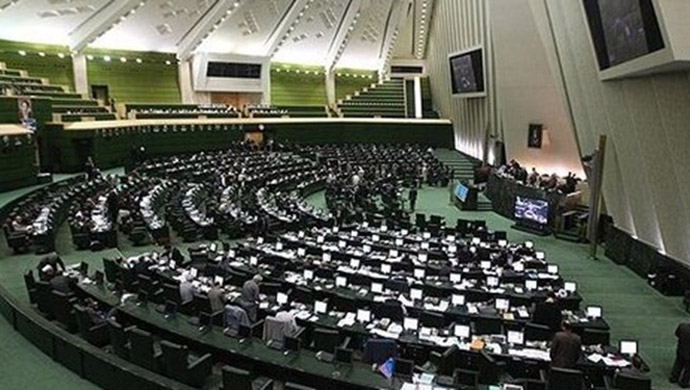

The public session of the Iranian regime’s majlis (parliament) on Sunday reflected the ruling theocracy’s increasing infightings and utter fear of a restive society.
While acknowledging the country’s financial calamity and the regime’s ineptitude, MP Massoud Pezeshkian warned, “People are shouting, and we should hear their voices, not to ignore this warning and prevent people from protesting. We shouldn’t arrest protesters and accuse them of conspiracy against national security. We should take this alarm seriously.”
Previously, the state-run Did-e Ban-e Iran warned on May 16 that “The revolt of the poor is not like protests to the mandatory veiling. We cannot control those who starve.”
While Pezeshkian warned the clerical regime to hear the “alarm,” the state-run Asr-e Iran website on May 29 mocked the “Seventh Development Plan” of Ebrahim Raisi’s government, and wrote, “instead of thinking about development, we should find a way to prevent the [regime’s] downfall.”
On May 27, former MP Hamid Rasai, a close figure to the regime’s supreme leader Ali Khamenei, acknowledged the “90 percent increase in point-to-point inflation” on his Telegram channel, adding that “unfortunately, all government officials, in the second half of their term, have made promises and suggestions that have made the situation worse, and the inflation rate is the highest since the revolution.”
What provoked Rasai, Pezeshkian, other officials, or state media about Khamenei’s failure to “consolidate power” in the regime and its negative effects is not the Iranian people’s deplorable conditions. They fear a restive society and how people would react to the current cries.
In a May 28 article, “The destructive cycle of poverty,” the state-run Etemad acknowledged that the current economic crises “spark popular revolts. If natural causes had caused poverty, people could tolerate it. But when it is due to the government’s incompetence leads to massive migration and revolt. This is a catastrophe and, once coupled with other problems, can have dangerous results.”
It is worth noting that on March 26, Mohammad Mohajeri, a close associate of Khamenei, told the state-run Eghtesad news that Iran’s society “is on a faultline… It is unknown whether a social earthquake will occur in a month, two months, or six months from now… Repression cannot have permanent effects.”
Seven years ago, Khamenei had warned about these “social faults and gaps.” “Earthquakes will not occur as long as these social faults are not activated; There is nothing wrong with it. There is nothing wrong with having differences. If these faults are activated, then an earthquake will occur; The enemy is trying to activate these faults, be careful,” he said on June 5, 2016.
In a bid to counter the consequences of those “social faults,” the supreme leader visioned and promoted a so-called “Young and Hezbollahi government.” Aiming to “consolidate power” in his regime, Khamenei appointed Ebrahim Raisi as president and handpicked the MPs during the sham elections while purging the rival faction.
Yet, the nationwide uprising and its persistence disrupted Khamenei’s plan and once again laid bare his regime’s soon-approaching demise.