

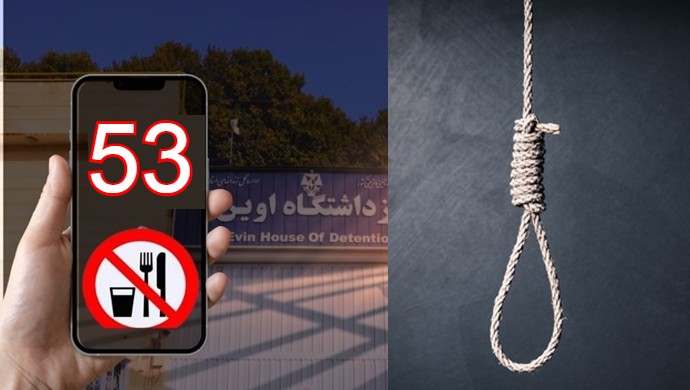

Prisoners across Iran marked the 53rd week of the “No to Executions Tuesdays” campaign on January 28, 2025. The “No to Executions Tuesdays” campaign is a coordinated protest movement initiated by political prisoners across Iran to oppose the regime’s extensive use of the death penalty. Since it began in early 2024, the campaign involves weekly hunger strikes and statements condemning executions, aiming to raise awareness and mobilize both national and international support against capital punishment in Iran. It has now expanded to 34 prisons across the country.
The participants marked the beginning of the second year of the “No to Executions Tuesdays” campaign with greater vigor and by staging a hunger strike on its 53rd Tuesday. “May our voices transcend the thick prison walls and unite with the voices of Iran’s women, men, and youth, contributing to the defense of human rights and the elimination of execution ropes,” the prisoners wrote in their weekly statement. “We begin the second year of this campaign under circumstances where, in the past year alone, over 1,000 prisoners were executed, and in the past month of Dey [December 21 – January 19], the number of executions exceeded 110.”
In their statement, the campaign participants warned about the conditions of political prisoners Behrouz Ehsani and Mehdi Hassani, sentenced to death, who were violently removed from Evin Prison and transferred to Ghezel Hesar Prison on January 26. This occurred despite their lawyers filing a request for a retrial on Monday, January 27, 2025.
“However, according to information received by the campaign, these two political prisoners are currently held in the cells of the Secure Ward 3 in Ghezel Hesar Prison, a ward designated for prisoners on the verge of execution, where they face the imminent threat of execution,” the prisoners warn.
The political prisoners of Ghezel Hesar Prison announced their first hunger strike on Tuesday, January 30, 2024, and since then, they have steadfastly continued their Tuesday hunger strikes for a year. Initially, several political prisoners from Wards 4 and 8 of Evin Prison joined, followed by the women’s ward of Evin, Karaj Central Prison, Lakan Prison in Rasht, and, subsequently, other prisons in the following weeks. To date, marking the start of the second year of the campaign, the number of prisons participating in this movement has reached 34.
The “No to Executions Tuesdays” campaign began last year in response to a wave of executions that were so widespread and unprecedented globally. “This could not have been coincidental or merely a matter of legal or judicial procedures,” the prisoners wrote in their statement. “At the outset of this wave of executions, a plea letter was published by ordinary prisoners on death row, calling on all prisoners and the people of Iran to help save their lives and those of the many others awaiting execution.”
The start of the “No to Executions Tuesdays” campaign coincided with the seventh day after the executions of the Mohammad Ghobadlou and Farhad Salimi, political and ideological prisoners in Ghezel Hesar. The campaign’s founding members initiated hunger strikes to protest the executions. Prisoners chose Tuesday for the strikes because death row inmates are typically moved to solitary confinement on Mondays and executed at dawn on Wednesdays.
“This protest movement, which now encompasses most prisons across the country, has crossed prison walls and geographic borders, thanks to the efforts of our compatriots inside and outside Iran,” the statement reads in part. “Numerous human rights organizations, activists, international institutions, and even political groups have lent their support to the campaign. Many media outlets and news agencies, in a responsible act of advocacy for human rights, publish weekly statements and reports on the ‘No to Executions Tuesdays’ campaign to inform the public.”
Professor Javaid Rehman, the former United Nations Special Rapporteur on Human Rights in Iran at the time, commended this campaign in a message. Likewise, the current Special Rapporteur, Ms. Mai Sato, in a video message on October 10, 2024, described the Tuesdays campaign as an unwavering commitment to justice and human rights that has shone in the face of the regime’s repressive measures.
On the same day, October 10, 2024, coinciding with the World Day Against the Death Penalty, Iranian compatriots in the United States and most European countries held events in support of the “No to Executions Tuesdays” campaign, amplifying the movement’s voice against executions across the globe.
“In recent weeks, we have witnessed domestic support from students, teachers, workers, and women. The general strike in Kurdistan was a significant milestone, deserving of recognition, and should be expanded to encompass all of Iran,” the prisoners write in their statement.
The prisoners conclude their statement by writing, “According to Article 3 of the Universal Declaration of Human Rights, ‘Everyone has the right to life, liberty, and security of person,’ and according to Article 5, ‘No one shall be subjected to torture or to cruel, inhuman, or degrading treatment or punishment.’ Moreover, execution is an irreversible and irreparable punishment, and opposing and resisting it is the duty of every free and honorable human being.
“However, in Iran, under the rule of a religious dictatorship, executions have reached unimaginable levels and have become a tool for intimidating the populace, effectively taking the entire population hostage. In Iran, the death sentence is not a legal punishment but a political tool used to suppress and exact revenge on the people of Iran. This reality doubles our responsibility to oppose repression, torture, and executions, and we hope to fulfill this duty.”
The prisons taking part in the 53rd week of the “No to Executions Tuesdays” campaign are Evin Prison (women’s ward, wards 4 and 8), Ghezel Hesar Prison (units 3 and 4), Karaj Central Prison, Greater Tehran Prison, Arak Prison, Khorramabad Prison, Asadabad Prison in Isfahan, Dastgerd Prison in Isfahan, Sheiban Prison in Ahvaz, Nezam Prison in Shiraz, Bam Prison, Kahnuj Prison, Mashhad Prison, Qaemshahr Prison, Lakan Prison in Rasht Prison (men’s and women’s wards), Ardabil Prison, Tabriz Prison, Urmia Prison, Salmas Prison, Khoy Prison, Naqadeh Prison, Saqqez Prison, Baneh Prison, Marivan Prison, Kamyaran Prison, Tabas Prison, Khorin Prison in Varamin, Rudsar Prison in Gilan, Sepidar Prison in Ahvaz, Ramhormoz Prison, Talesh Prison, Adelabad Prison in Shiraz (men’s and women’s wards), Joveyn Prison, and Borazjan Prison.