

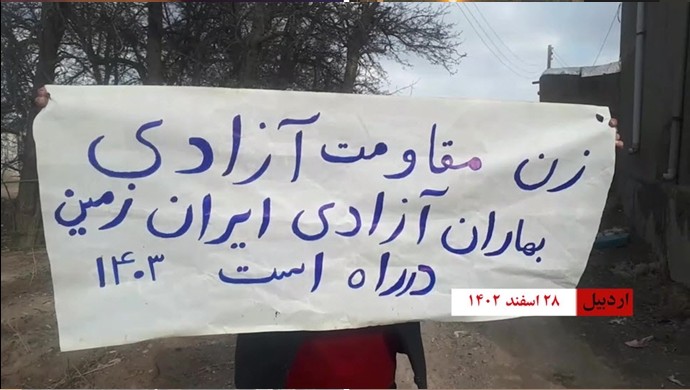

On the eve of Nowruz, the Iranian New Year, the Resistance Units, a widespread network of PMOI activists inside Iran, intensified their activities across the country, indicating a significant increase in their efforts to challenge the mullahs’ regime. These activities, which take the form of banners, graffiti, and public demonstrations, aim to spread messages of uprising and resistance against the regime of Ali Khamenei, which is responsible for regional conflicts and bloodshed through the actions of its proxy forces.
In the city of Rasht, in northern Iran, Resistance Units distributed banners bearing the slogan “Our arena is Iran, and the head of the snake is in Tehran.” This phrase directly challenges Khamenei’s leadership, symbolically referring to him as the “head of the snake” causing turmoil and conflict in the region. The message affirms the resistance’s commitment not only to overthrow the current regime but also to restore peace and stability throughout the Middle East.
In the city of Karaj, in Alborz province, banners featuring the image of Iranian resistance leader Massoud Rajavi were distributed. These banners carried Rajavi’s messages for extending the revolution and uprisings to overthrow the mullahs as the only way to liberate the Iranian people. The banners highlighted the necessity of continuing the uprising to thwart Khamenei’s plots, amplifying calls for ongoing resistance.
In the capital, Tehran, flyers featuring Maryam Rajavi, the president-elect of the National Council of Resistance of Iran (NCRI), were distributed. These flyers carried the slogan “Woman, resistance, freedom,” symbolizing the Resistance’s emphasis on the pivotal role of women in the struggle against injustice. The Resistance Units count many girls and women in their ranks, and they have played a pivotal role in organizing protests against the regime despite the regime’s misogynistic nature and its aggressive policies toward women, especially those who support the PMOI.
Similarly, cities across Iran, including Zabol, Sanandaj, Chalus, Bushehr, Saveh, and Shiraz, echoed the call for women’s freedom and resistance. This widespread distribution of flyers and slogans highlights a national call to action, with a focus on the resistance’s effort to mobilize support from different regions of the country.
In the city of Khorramabad, the capital of Lorestan province, graffiti and murals bearing messages like “Death to Khamenei” and “Death to the dictator” reflected a direct confrontation with Khamenei’s authority. Additionally, acts like burning Khamenei’s pictures in Sari and Ahvaz indicate a bold rejection of his leadership and a desire for significant change.
The activities carried out by the Resistance Units on the eve of Nowruz demonstrate a strong and coordinated effort to challenge the authority of the Iranian regime. Through their widespread campaign, using banners, graffiti, and public demonstrations, the Resistance Units seeks to rally popular support for a movement aimed at liberating Iran and laying the groundwork for peace and stability in the region.
PMOI Resistance Units mark #Nowruz with anti-regime activities across #Iran pic.twitter.com/1xtaarKATE
— People's Mojahedin Organization of Iran (PMOI/MEK) (@Mojahedineng) March 19, 2024
The activities of the Resistance Units come as the regime is on a mass campaign to demonize the PMOI as the Resistance movement gains support and steam inside Iran. The regime continues to publish books, articles, movies, and TV series aimed at discrediting the Iranian Resistance. At the same time, the regime has been particularly harsh toward the supporters of PMOI and the families of Iranian Resistance members with heavy prison sentences. But every day, the ranks of the Resistance Units continue to expand, proving the regime’s failure in its efforts.