

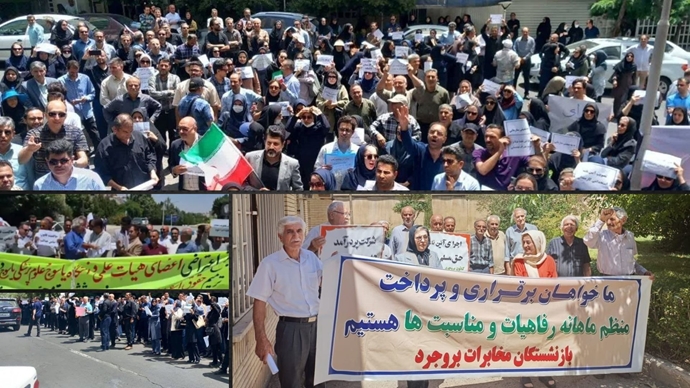

On June 29, 2026, protests erupted across various cities in Iran as retirees, healthcare staff, workers, drivers, and importers took to the streets. Videos and images published from these gatherings showcase the continuation of protests and expanding dissatisfaction among different strata of society against the regime’s policies.
In a striking display of national discontent, telecommunication retirees held simultaneous rallies in Kermanshah, Sanandaj, Isfahan, and Borujerd. Chanting slogans such as, “We don’t want an incompetent government,” and “Executing bylaws is our absolute right,” the pensioners rallied around livelihood and legal demands. They demanded the full and flawless implementation of the 2010 personnel and welfare bylaws. Furthermore, they called for the immediate and complete execution of rulings issued by the Court of Administrative Justice, payment of delayed arrears, welfare expenses, and a reduction in their supplementary insurance premiums to previous rates, as their payment share had been previously doubled.
Workers face exploitation and denial of basic benefits
The plight of the Iranian working class was starkly visible at the “Iran Barak” factory, where workers gathered in the factory courtyard to protest against unpaid wages, ambiguous employment statuses, and severe insurance irregularities. Despite years of labor in this production unit, workers are now facing severe livelihood challenges. Over the past year, their salaries were withheld for several months, and the employer paid only one month of insurance premiums to Social Security.
Management has spent the last 16 months pushing out experienced workers and forcing them to stay home, replacing them with retirees who demand lower wages and do not require insurance payments. Due to the employer’s failure to pay past premiums regularly and fully, the laid-off workers are now entirely deprived of unemployment benefits, stuck in limbo despite management’s unfulfilled promises of returning them to work.
Healthcare and transportation sectors join the strikes
Unrest also spread to the healthcare and commercial sectors. Employees of the Tabriz Health Center and other healthcare staff held a protest rally in front of the Administrative and Recruitment Organization, protesting wage discrimination. Holding placards, the demonstrators demanded that officials address their living conditions and reform the payment processes. Simultaneously, importers in the Mazandaran Free Zone protested the halt of vehicle clearances, while leased drivers continued their strike for a third consecutive day.
Environmental disaster sparks mass protests in Garmsar
Beyond industrial and labor disputes, the severe environmental crisis has sparked outrage among local populations. In Garmsar, a diverse crowd comprising farmers, bazaar merchants, workers, employees, women, youth, and the elderly rallied on June 29 to protest a severe water shortage.
Emphasizing the people’s right to access water, families gathered in large numbers to warn about the drying up of local farms and orchards, which has sharply intensified livelihood challenges. Their primary demand is the immediate restoration of their legal water rights from the Hableh Rud river, urging authorities to urgently address the critical water crisis threatening their region.