

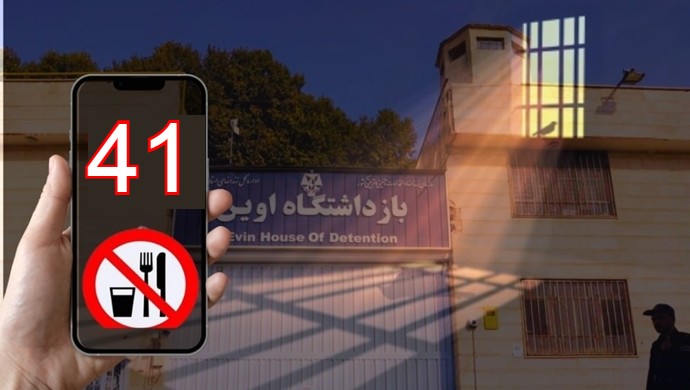

The 41st week of the “No to Executions Tuesdays” campaign took place on November 5, across 24 prisons throughout Iran. The “No to Executions Tuesdays” campaign is a coordinated protest movement initiated by political prisoners across Iran to oppose the regime’s extensive use of the death penalty. Since its inception in early 2024, the campaign has involved weekly hunger strikes and statements condemning executions, aiming to raise awareness and mobilize both national and international support against capital punishment in Iran.
The prisons participating in the 41st week of the campaign included Evin (women’s ward, wards 4 and 8), Ghezel Hesar (units 3 and 4), Karaj Central Prison, Greater Tehran Prison, Arak Prison, Khorramabad Prison, Asadabad Prison in Isfahan, Sheiban Prison in Ahvaz, Nezam Prison in Shiraz, Bam Prison, Kahnuj Prison, Mashhad Prison, Qaemshahr Prison, Rasht Prison(men’s and women’s wards), Ardabil Prison, Tabriz Prison, Urmia Prison, Salmas Prison, Khoy Prison, Naqadeh Prison, Saqqez Prison, Baneh Prison, Marivan Prison, and Kamyaran Prison.
In their statement for the 41st week of the campaign, striking prisoners declared: “Under the execution-driven regime, repression and executions continue to escalate. Since October 23, nearly 56 prisoners have been executed; in the past week alone, at least 23 individuals have been hanged.”
The statement further noted: “Yesterday, we observed the trial of eight young individuals arrested during the 2022 protests, known as the Ekbatan case, conducted behind closed doors. Given the severity of the charges against them, there is a serious concern they may face death sentences.”
The declaration for the 41st week of the “No to Executions Tuesdays” campaign highlighted: “As reported last week, four Baluch compatriots—Eid Shahbakhsh, Abdolghani Shahbakhsh, Abdolrahim Ghanbarzehi, and Soleiman Shahbakhsh—members of the campaign, have had their death sentences upheld by the regime’s Supreme Court and referred to the First Branch of the Sentence Enforcement Office at District 33’s Prosecutor’s Office. Their execution could be carried out at any moment.”
In their statement, the participating prisoners called on political activists, human rights defenders, and all conscientious individuals to be the voice for these anonymous prisoners and those sentenced to death. They urged them to protest louder than ever and to reveal the perpetrators and enablers of the execution and killing machinery to the conscience of the world.
The human rights situation in Iran has deteriorated alarmingly in recent years, with a sharp increase in state-sanctioned executions and repressive measures. The month of October 2024 alone witnessed 170 recorded executions, a dramatic 85 percent surge compared to the same month in 2023, when 92 executions were documented. The intensified use of the death penalty is a tool for suppressing dissent and maintaining control amid growing unrest. High-profile cases, such as those of individuals arrested during the 2022 protests and charged with severe crimes, have heightened fears of politically motivated executions.
In addition to executions, the Iranian regime has escalated the arrests of dissidents, including supporters of opposition groups like the People’s Mojahedin Organization of Iran (PMOI/MEK). Reports indicate that several individuals have been detained and subjected to harsh interrogations, including torture, under the pretext of charges like “waging war against God.” Trials are often conducted behind closed doors, lacking transparency and due process. For example, since mid-September 2024, multiple PMOI supporters have faced death sentences, underscoring the regime’s attempts to stifle any form of political resistance.
Beyond the use of capital punishment, the regime has engaged in other severe punitive actions, such as amputating the fingers of prisoners accused of theft, as seen in the recent case of two brothers in Urmia Prison. These brutal practices highlight the pervasive culture of fear and punishment used by the Iranian authorities to quash dissent and maintain an iron grip on society.
The escalating rates of executions and violent crackdowns against political prisoners and protestors reflect the Iranian regime’s determination to silence opposition at any cost. Despite these dire circumstances, voices of resistance persist both within Iran and internationally. Movements like the “No to Executions Tuesdays” campaign shine a spotlight on the resilience of those opposing the death penalty and advocating for basic human rights.