

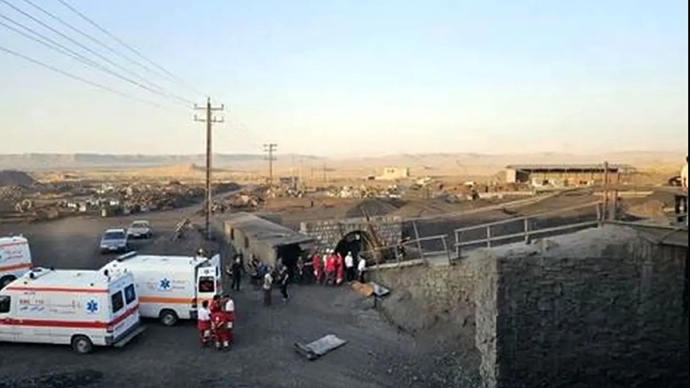

Once again, in a bitter tragedy, a number of impoverished workers of Iran lost their lives. This time, the disaster occurred in the Tabas coal mine, where more than 50 workers were killed in an underground explosion. At the time of the explosion, 70 workers were working deep underground, so it is expected that the death toll will rise as more bodies are retrieved.
The main culprit behind this tragedy and the daily deaths of many workers in our country is the Iranian regime, which pays no attention to the lives of workers, viewing them merely as tools for exploitation. As a result, work-related fatalities continue to rise. According to the regime’s Forensic Organization, 2,115 people lost their lives in work-related accidents last year.
Meanwhile, miners face even more dangerous conditions. “Since 1993, an average of 105 coal miners have lost their lives each year in accidents” (Source: Ruydad 24, September 4, 2023).
The poor safety conditions in these mines are far below international standards. According to the miners, they sometimes work deep underground with broken safety helmets and non-functional ventilation systems, which are turned off to reduce electricity costs. Given the methane gas produced in coal mines, they are like powder kegs that can explode with the slightest spark. This situation repeats itself several times each year.
The Tabas mine incident is strikingly similar to the 2017 “Zemestan Yurt” coal mine disaster in Golestan Province. In that tragedy, 43 miners died and 70 were injured. Despite clear and obvious violations of safety standards, no officials or those responsible were ever held accountable. Even the unpaid wages owed to the victims, who hadn’t received their salaries for months, were buried along with their crushed bodies, and their surviving family members were left to fend for themselves.
The management and control of most mines in the country, either directly or indirectly, lie in the hands of the Revolutionary Guards and the regime’s military forces. The Khatam al-Anbia construction conglomerate, owned by the Revolutionary Guards, is the largest contractor for mining operations throughout the country.
On November 14, 2023, the Iranian parliament approved a plan obligating the Ministry of Industry, Mining, and Trade to issue permits for the military to exploit mines located within military bases (Madan News, November 14, 2023).
The concept of “mines located in military bases” is a ridiculous charade meant only for appearances. For years, the Revolutionary Guards have been investing heavily in the industrial and mining sectors. For instance, on November 7, 2023, IRNA news agency reported that the Director-General of Industry, Mining, and Trade in Razavi Khorasan Province stated that a mining exploration project covering 3,000 square kilometers in a border area near Afghanistan has been handed over to the military.
In recent years, as safety measures in mines managed by the Revolutionary Guards and semi-private sectors have deteriorated, the job security of miners has also reached its most precarious state. Each year, the number of miners working under one-month, three-month, and blank-signature contracts, with promissory notes and gag orders, continues to grow. When the Zemestan Yurt mine exploded, none of the miners had insurance coverage for hazardous jobs, and they hadn’t been paid for months. According to a June 20, 2024, report by Etemad newspaper, from early 2022 until June 2024, thousands of miners working in coal, copper, iron ore, and chrome mines in Kerman, Mazandaran, Yazd, Razavi Khorasan, South Khorasan, and Semnan provinces held protests, ranging from a few hours to several weeks, demanding their legal rights. Of the 12 miners’ protests in these 27 months, the common issue in 10 was delayed wage payments and demands for higher wages.
Thus, despite working in extremely harsh conditions, sometimes as deep as 1,000 meters underground and in conditions worse than those faced by slaves in ancient times, miners are deprived of all their rights. In addition to being denied the safety equipment and facilities standard in mines around the world, they also face the looting of their meager wages, and their protests go unheard, as the constant threat of being fired without receiving back pay looms over them.
The suffering and hardship of the hardworking people of Iran will only end with the overthrow of the Iranian regime and the establishment of a free Iran, liberated from the tyranny of both the monarchy and the mullahs.