

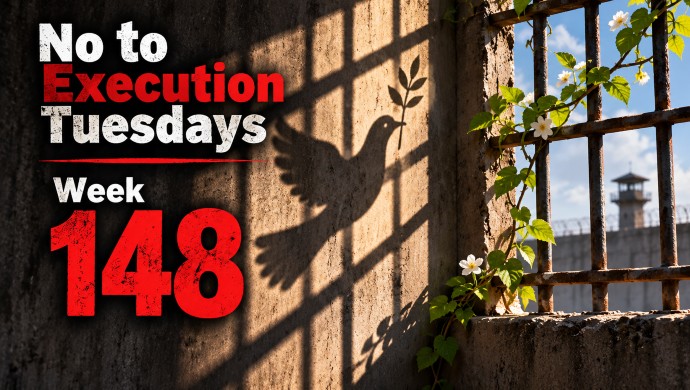

Prisoners in 67 prisons across Iran staged a coordinated hunger strike on Tuesday, November 24, 2026, marking the 148th consecutive week of the “No to Executions Tuesdays” campaign against capital punishment. In a statement issued for the 148th week, participating inmates declared their opposition to the issuance and implementation of death sentences and the deprivation of the fundamental right to life.
The statement notes that the hunger strikes have continued for nearly three years despite escalating security pressures, threats, restrictions on contact and communication with the outside world, and punitive measures aimed at wearing down prisoners’ resolve and silencing their protest. With the campaign expanding to 67 facilities, the prisoners stated that opposition to the death penalty is not confined to a single prison or group of inmates, but represents a sustained protest across wards nationwide.
In their statement, the prisoners pointed to the adoption of the 73rd resolution condemning human rights violations in Iran by the Third Committee of the United Nations General Assembly alongside a continuing wave of hangings inside the country.
“Once again, the world heard the voice of the Iranian people, the prisoners, and the bereaved families of the executed,” the statement read. “The adoption of the 73rd resolution condemning human rights violations in Iran in the Third Committee of the United Nations General Assembly demonstrated once again that the cry for justice of the victims of executions and repression is heard and echoed at the global level.”
The prisoners contrasted that international censure with the pace of executions carried out by the Iranian regime over the past month. “However, the machine of execution and repression continues to claim victims. Between October 23 and November 21, 2026 alone, more than 81 people were executed, and in the past week, at least 29 prisoners were hanged,” they wrote. “Under such circumstances, the issuance and upholding of death sentences and threatening the lives of prisoners remain among the regime’s primary tools to suppress protests and instill fear and terror in society.”
The UN committee vote follows growing international backing for the “No to Executions Tuesdays” campaign itself from UN human rights experts and legal figures—including UN Special Rapporteurs Gina Romero, Leopoldo Maldonado Gutiérrez, and Andrea Bolaños Vargas; Ana Lorena Delgadillo Pérez, Vice-Chair of the UN Working Group on Enforced or Involuntary Disappearances; former UN Special Rapporteur David R. Boyd; Alexis Anagnostakis, Chair of the Human Rights Committee of the European Criminal Bar Association (ECBA); and 2022 Nobel Peace Prize laureate Oleksandra Matviichuk.
The 148th-week statement issued an urgent warning regarding two political prisoners, Milad Armoun and Navid Najaran, whose death sentences were upheld in recent days. According to the prisoners, both men are currently held in solitary confinement at Ghezel Hesar Prison and face the imminent risk of execution at any moment. The campaign called on the public and “awakened consciences” to take action to save their lives and halt the implementation of their sentences.
The prisoners also reported that death sentences were handed down in the past week against five additional individuals: Hossein Parvin, Amirhossein Gholamshahi, Hossein Jafari, Pouya Fakhrabadi, and Mohammad Sharghi. The statement warned that thousands of prisoners facing general and political charges remain at risk of receiving or facing the execution of death sentences—a threat it noted particularly endangers protest detainees, months after the regime relied on mass killings to suppress the nationwide uprisings of December 2025–January 2026.
Beyond prison walls, the statement detailed recent demonstrations and arrests in Abdanan alongside public solidarity actions in Rasht. Residents of Abdanan took to the streets last week to protest the deaths of fellow citizens in road incidents, quickly turning the demonstrations into chants of “Death to the dictator.” Security forces arrested at least 15 young protesters and transferred them to an undisclosed location.
“Given the regime’s record of dealing with similar protests and turning them into a pretext for issuing heavy sentences and even executions, the ‘No to Executions Tuesdays’ campaign demands the unconditional release of these protesters,” the statement said. “The regime seeks to silence the people’s voice of protest with the noose; however, the outcome of this policy is nothing other than the spread of anger, solidarity, and the people’s determination to end repression.”
The statement also reported that on Tuesday, November 17, 2026, coinciding with the prisoners’ weekly hunger strike, a group of retirees in Rasht chanted “No to executions” in solidarity with the campaign. Describing the rally as a display of practical resistance against repression and capital punishment, the prisoners stressed the importance of turning “No to executions” into a broad societal demand.
At the conclusion of their 148th-week statement, the prisoners invited trade associations, workers, retirees, and political and civil activists to join the “No to Executions Tuesdays” campaign and stand against the death penalty and state repression. Together, the expansion of the strike to 67 prisons, the solidarity of retirees on the streets, and mounting international scrutiny illustrate that the Iranian regime’s escalating reliance on executions has failed to extinguish organized resistance either inside its prisons or in society at large.