

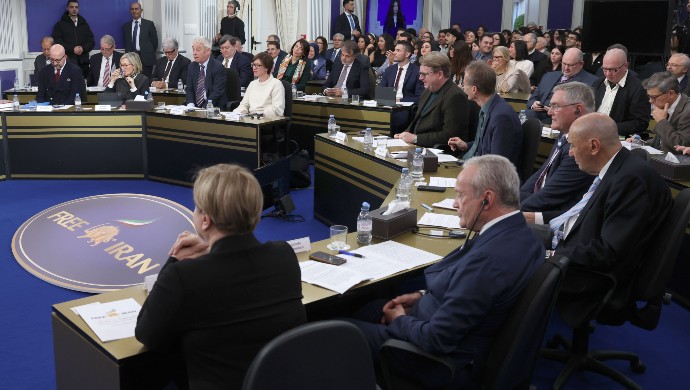

On November 21, 2026, current and former European and Latin American lawmakers, former heads of government, diplomats, and human rights advocates convened in France alongside the National Council of Resistance of Iran (NCRI) to commemorate the seventh anniversary of Iran’s November 2019 nationwide protests. The conference, entitled “No War, No Appeasement: An Iranian Solution for Regime Change,” focused on Iran’s domestic human rights crisis, Western foreign policy toward Tehran, and competing visions for Iran’s political future.
Conference on the anniversary of the November 2019 uprising:
No war, no appeasement, an Iranian solution for regime changehttps://t.co/xPb5RQNe9s— People's Mojahedin Organization of Iran (PMOI/MEK) (@Mojahedineng) November 21, 2026
Throughout the conference, speakers attributed Iran’s ongoing instability primarily to domestic opposition and outlined their perspectives on European responsibility, human rights accountability, and political alternatives to the Islamic Republic.
Maryam Rajavi’s Keynote Address: Structural Deadlock and the “Third Option”
In her keynote speech, Maryam Rajavi, president-elect of the NCRI, argued that despite regional hostilities and a “state of neither war nor peace,” the central existential crisis confronting Tehran stems from domestic society’s readiness for an uprising rather than international conflict. Commemorating the November 2019 protests across 144 Iranian cities, Mrs. Rajavi stated that the unrest “demonstrated that the regime’s overthrow is possible, inevitable, and certain.”
The Third Option Conference
My sincere appreciation to all those who have stood with the people of Iran.
Our message, and the message of our people, is clear:
No to the shah, no to the mullahs. We seek a democratic republic based on people's sovereignty pic.twitter.com/SFJGkI1DZx— Maryam Rajavi (@Maryam_Rajavi) November 22, 2026
Mrs. Rajavi contended that the government faces a deepening structural deadlock following the January 2026 crackdown—in which thousands of protesters were killed—and the leadership vacuum left by Ali Khamenei’s death. Describing Mojtaba Khamenei’s position as precarious, she argued he lacks the authority to contain accumulated internal contradictions amid 77 percent inflation, negative 10 percent economic growth, the loss of former Syrian ally Bashar al-Assad, and weakened regional proxies.
Rejecting both diplomatic appeasement and foreign war, Mrs. Rajavi advocated the “Third Option: overthrow by the Iranian people and their organized Resistance, spearheaded by the Resistance Units and the Liberation Army.” Guided by the slogan “Neither Shah nor Mullahs,” she dismissed efforts to promote remnants of the former monarchy as a “mirage” that aids the ruling establishment. Highlighting the Magnitsky Human Rights Award granted to death-row prisoner Mohammad Javad Vafaei Sani, Mrs. Rajavi reiterated the NCRI’s platform for a secular, non-nuclear democratic republic and urged European Union governments to condition ties on ending executions and killings, close Iranian embassies, and recognize the Iranian people’s struggle against the Islamic Revolutionary Guard Corps (IRGC).
“We call on Europe to adopt a firm policy toward this regime,” Mrs. Rajavi stated. “And the clearest expression of such resolve is to stand with the Iranian people and their Resistance in their struggle to overthrow the regime.”
Condemnation of Executions, Political Prisoners, and Domestic Repression
A central theme across the conference was the scale of executions, arbitrary arrests, and broader human rights abuses in Iran, with multiple speakers citing figures from human rights monitors and recent protest crackdowns. Lord Steve McCabe, a member of the United Kingdom’s House of Lords, noted that he and parliamentary colleagues had recently raised the issue in Westminster. Citing Amnesty International figures, he stated that Iran accounted for 2,159 of the 2,706 executions reported globally in 2025—nearly 80 percent of the world’s total. Warning that “without decisive measures, we risk another tragedy reminiscent of the 1988 massacres,” Lord McCabe called for an international accountability mechanism to investigate crimes against humanity linked to both the November 2019 protests and ongoing repression.
Other delegates pointed to continuing executions throughout 2026. Alejo Vidal-Quadras, former Vice President of the European Parliament and President of the International Committee in Search of Justice, reported that more than 1,200 people had been executed since the start of 2026, including at least 28 women and 50 protesters, nine of whom were members of the People’s Mojahedin Organization of Iran (PMOI/MEK). He added that over 100 additional protesters—including 14 affiliated with the PMOI—faced the immediate threat of execution, while annual inflation exceeded 70 percent.
.@CharlesMichel: The regime's greatest propaganda weapon is the message that change is impossible, that there is no alternative, that the Iranian people cannot organize themselves, that if the Mullahs disappear, chaos will inevitably follow. That's a lie. That's fake news. That's…
— NCRI-FAC (@iran_policy) November 21, 2026
Former Norwegian Member of Parliament Lars Rise similarly referenced an exhibition at the conference documenting 1,250 executions in 2026, noting that political prisoners face torture and lack legal counsel.
Several speakers highlighted individual cases of political prisoners to illustrate the human toll. Emanuelis Zingeris, a member of the Lithuanian Parliament and Head of the Seimas Delegation to the Parliamentary Assembly of the Council of Europe, recounted attending the Global Magnitsky Award ceremony in London honoring Mohammad Javad Vafaei Sani, a boxer arrested during the 2019 uprising who has been placed on death row three times. Zingeris read an excerpt from Vafaei Sani’s recent letter from prison: “I remain steadfast in my pledge, and I will not bow before oppression until the people of Iran will be free.”
Dorien Rookmaker, a former Member of the European Parliament from the Netherlands, named female political prisoners Zahra Tabari, 67, and Arghavan Fallahi, 25, who has been sentenced to death for supporting the PMOI. Rookmaker quoted Fallahi’s message from Evin Prison: “We are Generation Z. We oppose dictatorship and dependency. We stand against both the Shah and the mullahs. The day is not far when the unstable regime of executions will be crushed.”
Addressing the December 2025–January 2026 protests, Detlef Seif, a member of the German Bundestag, observed that demonstrations beginning in the bazaars had swept the country before meeting lethal force. “Hospitals, actually places where one gets help, became places of fear. Militias fired live ammunition at demonstrators, indiscriminately,” Seif said, adding that tens of thousands had been abducted and declaring that “a government that wages such a war against its own population has forfeited every right to exist.”
Baroness Verma of the UK House of Lords recalled that over 1,500 protesters were killed during the November 2019 uprising and noted that protests had continued through September 2022, January 2023, and as recently as the previous week in the city of Abdanan. “We must press our governments to ratify and implement the universal jurisdiction to have officials of this regime accountable and to face justice for their crimes,” she stated.
.@CharlesMichel: Iran's future belongs neither to the Shah nor the Mullahs—it belongs to the Iranian people. That is why the 10-point plan matters: a concrete roadmap for a democratic, non-nuclear republic based on free elections, gender equality, separation of religion and…
— NCRI-FAC (@iran_policy) November 21, 2026
Mairead McGuinness, the European Union Special Envoy for the Promotion of Freedom of Religion or Belief and a former EU Commissioner, contextualized Iran’s domestic record within global democratic trends, noting that Freedom House assigns Iran a score of 10 out of 100 for political rights and civil liberties. Quoting the latest report of the UN Special Rapporteur on human rights in Iran, McGuinness highlighted the finding that “the people of the Islamic Republic of Iran have been caught between external aggression and internal repression. Neither has displaced the other; each has compounded the harms of the other.”
Speakers also pointed to the treatment of Iranian women and environmental degradation as core dimensions of the crisis. Italian Member of Parliament Naike Gruppioni addressed Iranian women directly, stating, “You are not victims to be pitied; you are protagonists in a battle for freedom… women’s freedom is not a concession, and dignity is not negotiable.”
Meanwhile, Ola Elvestuen, Norway’s former Minister of Climate and the Environment, reported raising Iran’s ecological crisis before the Human Rights Council in Geneva. Citing depleting groundwater, land subsidence, drying wetlands, dust storms, severe urban air pollution, deforestation, and Iran’s failure to ratify the Paris Agreement, Elvestuen argued that “to have the right to a healthy environment is also a human rights issue. You should have the right to have clean water.”
Beyond Appeasement and Foreign Intervention: Calls for an “Iranian Solution”
A recurring argument throughout the conference was that neither decades of Western diplomatic engagement nor external military strikes can produce democratic governance in Iran. Charles Michel, President of the European Council from 2019 to 2024 and former Prime Minister of Belgium, noted that he and 24 other prominent European figures had issued a declaration the previous month calling for a fundamentally new Iran strategy. Summarizing what he described as three lessons from recent decades, Michel told attendees: “We tried appeasement, we got more oppression. We tried concessions and negotiations, we got blackmail and hostage-taking. We witnessed military confrontation, and we got more destruction and suffering, and the regime is still there.”
.@CharlesMichel: For more than four decades, Iranian men and women have risked everything to keep the flame of freedom alive. The @Mojahedineng and its #MEKResistanceUnits underground are at the forefront of this struggle—facing surveillance, imprisonment, torture, and execution.…
— NCRI-FAC (@iran_policy) November 21, 2026
Drawing a parallel to Europe’s own history, Michel argued that the fall of the Berlin Wall in 1989 resulted neither from appeasement nor from foreign military intervention, but from citizens mobilizing while knowing they had international solidarity. “We don’t have to choose between appeasement and foreign military intervention. We don’t need to choose between dictatorship and chaos,” he said, urging that “democratic change led by the Iranian people themselves” become the cornerstone of European policy.
Former German diplomat Hans-Ulrich Seidt, who served as Germany’s ambassador to Afghanistan and South Korea and co-authored the study “Iran – the Internal Opposition as a Strategic Factor” with German MP Carsten Müller, echoed this assessment from a strategic standpoint. Seidt argued that 30 years of European diplomacy—beginning with the Critical Dialogue in 1992—had aimed to steer Tehran in a constructive direction but made no progress.
Turning to the military strikes of 2025 and 2026, Seidt observed that while senior regime figures were eliminated, “the regime’s response was harsh: a shift of power even further into the security apparatuses, which maintain their rule in the country with brutal force.” Referring to regional precedents, he added, “Neither in Iraq nor in Afghanistan could democracy be achieved from outside through the use of military force.”
Concurring with his co-author, Carsten Müller, Chair of the German Bundestag’s Judiciary Committee, stated that “we cannot rely on help coming from the outside, or on a military intervention bringing freedom to the Iranian people; rather, the Iranian people want to win freedom themselves, they can win it themselves.”
Former German Minister @jungfj: The EU must actively back the Iranian people's push for freedom. Through its nuclear program, proxy terror groups, and threats to maritime shipping, Tehran endangers Europe—proving lasting security depends on democracy in a future Iran.…
— NCRI-FAC (@iran_policy) November 21, 2026
Other speakers reinforced the view that external bombardment does not resolve internal political oppression. McGuinness cited the UN Special Rapporteur’s observation that “war has not loosened the Iranian authorities’ repression of its own people; it has tightened it,” emphasizing that “peace is a prerequisite to meaningful democratic change.”
Italian parliamentarian Alfredo Antoniozzi similarly stated, “I do not believe that this issue will be resolved with bombs, nor merely through negotiations between governments, which remain on the surface.”
While emphasizing adherence to international law and opposing external military intervention, Detlef Seif argued that European governments should go beyond traditional diplomacy and sanctions by politically supporting Iran’s democratic opposition.
Drawing on her background in Poland’s Solidarność movement, former Polish Foreign Minister Anna Fotyga remarked that “every drop of Iranian blood counts,” arguing that lasting freedom requires determined domestic organization backed by international unity.
In outlining what makes domestic opposition viable, Seidt contended that spontaneous street protests alone cannot unseat an entrenched authoritarian state; instead, an opposition requires organized structures operating inside the country, multi-generational experience, and a clear political platform. Summarizing his policy conclusion, Seidt stated, “Iranians alone decide the future of Iran. Neither the Europeans decide, nor do the Americans decide.”
Rejection of Both Monarchy and Religious Tyranny
Alongside condemning the Islamic Republic, numerous speakers addressed debates over post-regime leadership, explicitly endorsing the slogan “Neither Shah nor Mullahs” and criticizing efforts in certain Western circles to promote Reza Pahlavi, son of Iran’s former monarch, as a political alternative.
Former @EU_Commission Pres @CharlesMichel: The regime is weaker than it once led us to believe. Its political foundations are becoming more fragile every day. Its economy is exhausted, its legitimacy is shattered—with the so-called supreme leader forced into hiding in secret…
— NCRI-FAC (@iran_policy) November 21, 2026
Charles Michel argued that democratic legitimacy must stem from free and fair elections rather than hereditary claims or “digital manipulation,” remarking that “you cannot manufacture popular support with bots, no matter how many you deploy.” Criticizing Reza Pahlavi for publicly calling for foreign military intervention and praising his father’s legacy—including the former secret police, SAVAK—Michel noted that Pahlavi had not been permitted to address the Belgian Parliament.
“Let’s be clear: the people of Iran do not need a would-be king; they need democracy,” Michel said. “We cannot oppose one dictatorship while opening the door to another one.”
John Bercow, Speaker of the UK House of Commons from 2009 to 2019, devoted a substantial portion of his remarks to scrutinizing Reza Pahlavi’s public record. Bercow cited Pahlavi’s past statement that he was proud of his family’s heritage and “everything they did,” arguing that while private familial loyalty is understandable, “disavowal, rejection, and condemnation of an egregious human-rights-abusing past is a matter of public responsibility.”
Bercow also pointed to Pahlavi’s October 1980 oath as king and criticized his political blueprint for placing an unelected figure in a central role over executive, legislative, and judicial appointments. Concluding his argument, Bercow stated, “The future of Iran does not belong to a prince because of his birth. It does not belong to a cleric because of his title. And it does not belong to a politician because of his ambition. It belongs to the people of Iran themselves.”
Former UK House of Commons Speaker John Bercow: Reza Pahlavi claims to be "proud of the heritage of my family and everything they did." Personal loyalty to a father is private, but aspiring to lead Iran carries a public duty to disavow and condemn the Shah's human rights-abusing…
— NCRI-FAC (@iran_policy) November 21, 2026
Former German Defense Minister Franz Josef Jung likewise argued that nationwide protests had shown Iranians reject both clerical rule and a return to monarchy. Describing Reza Pahlavi as lacking credibility, Jung stated, “He neither distances himself from the crimes of his father nor clearly from the Revolutionary Guards. He is not an alternative for a free Iran.”
Lord McCabe questioned Pahlavi’s assertions that millions chanted his name during the 2022 protests and noted Pahlavi’s claim of support from over 100,000 IRGC and Basij personnel. While stating he did not object to Pahlavi making his case to Iranians, Lord McCabe urged Western governments not to grant him preferential treatment, recalling the 1979 uprising against the Shah and contemporary chants of “Down with the dictator, be it the Shah or the mullahs!”
Lars Rise argued that Pahlavi’s remarks opposing the dismantling of state security structures suggested a willingness to preserve repressive elements of the mullahs’ regime, while Hans-Ulrich Seidt observed that Pahlavi and his supporters lack operational networks inside Iran, operating primarily from diaspora communities in the United States. A
dditional speakers—including Alejo Vidal-Quadras, Argentine Congressman Damián Arabia, Estonian MP Juku-Kalle Raid, Norwegian former minister Ola Elvestuen, and Dorien Rookmaker—voiced similar opposition to restoring a monarchy, with Rookmaker arguing that Pahlavi’s campaigning “divides rather than unites” and “relies on foreign powers rather than the Iranian people.”
Support for the NCRI, Resistance Units, and the Ten-Point Plan
In contrast to hereditary or externally imposed models, speakers at the conference expressed support for the NCRI, its internal network of PMOI Resistance Units, members residing in Ashraf 3, and Maryam Rajavi’s Ten-Point Plan for a future democratic republic.
Speakers repeatedly highlighted the core principles of the Ten-Point Plan: universal suffrage and free, fair elections; separation of religion and state; gender equality; freedom of speech, press, and assembly; an independent judiciary; autonomy for ethnic minorities; the abolition of the death penalty and torture; dissolution of the IRGC; and a non-nuclear Iran living in peace with its neighbors.
.@jungfj: @Maryam_Rajavi's Ten-Point Plan clearly outlines a future built on free and secret elections, freedom of speech, press, assembly, and political parties, dissolution of the IRGC, abolition of torture and the death penalty, separation of religion and state, gender…
— NCRI-FAC (@iran_policy) November 21, 2026
Lars Rise noted that these principles mirror the foundational standards of the Council of Europe and the European Convention on Human Rights since 1948, stating that the central question for Iran’s transition is “not who opposes the regime, but who has the principles, the organization, and the capacity to replace it.”
Charles Michel pushed back against narratives asserting that the collapse of the clerical system would inevitably lead to chaos, calling such claims “the regime’s greatest propaganda weapon.” Addressing Resistance Units inside Iran and residents of Ashraf 3 directly, Michel declared, “You are not spectators of history; you are making history!”
John Bercow praised the NCRI’s decades-long organizational continuity and collective ethos, arguing that its personnel prioritize their cause over personal office. Anna Fotyga similarly commended the movement’s organizational prudence, describing it as “well organized, very prudent, caring for people, their security in particular, and their well-being.”
Several delegates emphasized the role of women within the NCRI and the broader protest movement. Baroness Verma, who noted having worked with the PMOI and NCRI for over 20 years, stated that by championing women’s leadership as “democratic Muslims, they have emerged as the antithesis of Islamic fundamentalism.”
Naike Gruppioni recalled hosting Mrs. Rajavi in the Italian Chamber of Deputies on May 21 to endorse the Ten-Point Plan, asserting that “there will be no genuine democratic transformation if women are not free and present in the places where decisions are made.” Dorien Rookmaker highlighted both the Ten-Point Plan and a seven-point plan aimed at ending executions through international accountability.
Speakers also cited growing parliamentary backing across multiple continents. Damián Arabia reported that lawmakers across party lines in the Argentine Congress had built a parliamentary majority supporting the Free Iran statement and the Ten-Point Plan, alongside resolutions condemning the executions of Iranian activists Behrouz Ehsani and Mehdi Hassani.
Juku-Kalle Raid noted that one in ten members of the Estonian Parliament belong to a Support Free Iran group and that 80 percent of Estonian MPs had signed a declaration opposing the clerical regime and backing democratic freedoms—so that “every Iranian citizen should have an opportunity to their free speech, free media, free elections.”
Lord McCabe urged the British government and European partners to engage directly with the NCRI, noting that “the Resistance isn’t asking Western governments to fight its battle. It’s seeking political support for the Iranian people’s legitimate struggle for freedom, justice, and democracy.”
Regional Security, Transnational Repression, and Calls for European Action
Beyond Iran’s domestic human rights crisis, participants linked the Iranian government’s policies to international security threats and transnational repression, urging European and other democratic governments to adopt concrete enforcement measures.
The Third Option Conference: Overthrow by the Iranian people and Resistance
We call on Europe to adopt a firm policy toward this regime.
And the clearest expression of such resolve is to stand with the Iranian people and their Resistance in their struggle to overthrow the… pic.twitter.com/ntf65KrMX7— Maryam Rajavi (@Maryam_Rajavi) November 21, 2026
Franz Josef Jung argued that Tehran’s nuclear program, support for proxy terrorist groups, and threats to maritime shipping directly endanger European security, contending that “lasting security is not achieved solely by limiting military capabilities; rather, it depends on democracy in a future Iran.”
Emanuelis Zingeris likewise pointed to maritime pressures in the Strait of Hormuz and intelligence coordination between Iran and Russia. Noting that Lithuania would assume the rotating presidency of the Council of the European Union on January 1, Zingeris pledged to prioritize human rights and the enforcement of measures against the IRGC during Lithuania’s chairmanship.
Multiple speakers underscored the threat of Iranian transnational repression and terrorism beyond the Middle East. Alejo Vidal-Quadras recounted surviving an assassination attempt in Madrid on November 9, 2023, which the regime attempted due to his support for the PMOI, the NCRI, and Mrs. Rajavi. Noting that the criminal trial was expected to begin in Madrid within a month and that prosecutors had implicated the Iranian regime in the plot, Vidal-Quadras argued that “decades of engagement, concessions, and accommodation have been interpreted by the regime as weakness rather than goodwill, and only yielded to warmongering, hostage-taking, and terrorism.”
He outlined five steps for Europe: abandoning concessions, conditioning relations on ending executions and freeing political prisoners, acting decisively against IRGC transnational repression networks, recognizing the Iranian people’s right to resist tyranny, and ending what he called the mistake of “confusing stability with the survival of a cruel and criminal dictatorship.”
From Latin America, Damián Arabia connected Iran’s regional activities to the 1992 bombing of the Israeli embassy in Buenos Aires (which killed 29 people), the 1994 attack on the AMIA Jewish Community Center (which killed 85), and the January 2015 murder of prosecutor Alberto Nisman shortly before he was scheduled to testify before Argentina’s Congress.
Arabia noted that Argentina had designated the IRGC as a terrorist organization and recently enacted legislation enabling trials in absentia to advance the AMIA investigation. Responding to Tehran’s subsequent designation of Argentina’s Navy and Air Force as terrorist groups, Arabia declared, “We will not be intimidated by a regime responsible for terrorism.”
Delegates from Germany, the United Kingdom, Switzerland, and Estonia pressed for stricter implementation of existing sanctions and terrorist designations. Detlef Seif welcomed both the EU’s terrorist listing of the IRGC and a February amendment to Germany’s Criminal Code stiffening penalties for foreign espionage and intimidation, but emphasized enforcement: “We must sustainably combat this terrorist organization, investigate financial flows, eliminate all structures on the ground, and not simply say, now they are listed and that’s enough.”
Baroness Verma similarly called on the UK to crack down on the foreign assets and properties held by families of proscribed IRGC officials. Patrick Lussi, a member of the Geneva Grand Council, urged Switzerland to abandon unconditional dialogue—stating that “neutrality does not apply to a treacherous and murderous regime”—and called on Bern to designate the IRGC as a terrorist organization, condemn executions via parliamentary resolution, and ban senior Iranian officials involved in abuses.
Meanwhile, Ando Kiviberg, Chair of the Estonian Parliament’s Constitutional Committee, emphasized individual accountability, stating, “Behind every execution, behind every crime committed in the name of the regime are individuals. We know who they are,” and urging sustained international pressure to shake the confidence of perpetrators.
Held seven years after the November 2019 uprising and amid the fallout of the 2025–2026 protests and regional hostilities, the November 21, 2026 conference in France underscored a shared policy argument among the NCRI and its international guests: that neither diplomatic accommodation nor external military intervention offers a viable resolution to Iran’s political and human rights crisis. Any lasting political transformation in Iran must ultimately be determined by the Iranian people themselves.